
9 días de curso de formación de profesores de yoga yin-yang de 85 horas en Rishikesh, India
Yin Yang Yoga Teacher Training in India
This 85-hour Yin-Yang Yoga and Meridian Yoga Teacher Training course offers vital knowledge of yoga and its essential components. This is a short-term and affordable course and is most suitable for intermediate to advanced levels. Hare Rama Institute always advocates small batches to promote student-teacher interactions and enhance the learning experience.
Conoce a los instructores
Destacado
- Yin and Yang yoga asana practice
- Guided meditation and yoga Nidra session
- Pranayama and Shatkarma, mudra, and mantra chanting
- 1 sound healing session
- Certificate of completion
- 8 nights accommodation
- 3 meals per day
- Pick-up from Dehradun airport
Nivel de experiencia
- Principiante
- Intermedio
- Avanzado
Estilos
7 días con instrucción en Inglés
Alojamiento
Instalaciones
- Comedor
- Wi-Fi gratis
Hare Rama Institute surroundings and accommodations are some of the best and cleanest spaces in the whole of Rishikesh. Whether you are on a vacation or on a yoga course, amenities make life a little easier when you're away from home. For different types of travel, there are amenities that are more important than others.
They provide two types of accommodations, private and twin shared rooms, and students can choose according to their preferences. In the room, clean bed sheets, blankets, and pillows will be provided. Every room has an air conditioner and an attached bathroom with cold and hot water for 24 hours.
The complete school campus has unlimited high-bandwidth Wi-Fi service. The school is surrounded by serene green mountains which heal the inner soul and the river Ganga flows within walking distance.
Programa
Certifications
The course/hours count as Continuing Education hours for Registered Yoga Teachers (RYT®) only.
Preconditions and eligibility
There are no preconditions nor do you have to be a yoga teacher, however, some form of yoga experience will be an advantage for most of the courses.
Overview
This course covers an elementary knowledge of Yin yoga asana, Yin yoga sequencing, Yang yoga asana, pranayama, Shatkarma, mudra, meditation, yoga Nidra, teaching methodology, Yin yoga philosophy with the body meridian system, and the amalgamation of Indian Ayurveda-Marma which is neuromuscular and orthopedic science.
You will discover that what you practice is significant yet the way in which you practice it is much more significant. In Yin yoga, you position your body in a specific posture and afterward, let go of every solid exertion and give up to the floor for gravity to accomplish the work.
Thus, you loosen up your muscles and apply moderate pressure to the most profound layers of connective tissues of the body - ligaments, belt, and tendons working on the wellbeing and versatility of joints.
Their 85-hour Yin YTT gives every one of the apparatuses, assets, and information you really want to develop your training and to begin showing Yin yoga to other people. The practical methodology of the course - in light of skeletal varieties and uniqueness of each and every specialist, gives a recharged point of view of the yoga asanas.
This 85-hour program is developed as per the standard of Adi Yoga Ashram. Their Yin yoga course would offer you vital knowledge of yoga and its essential components.
What is Yin yoga?
Yin yoga blends two ancient principles - traditional Chinese medicine and yogic philosophy. Both these ancient principles focus on balancing the universal life force energy. The yogis call this 'prana' and the Chinese call it 'qi'.
Yin yoga has its roots in Taoist traditions, which see that there are two opposing yet complementary energies at work within the universe, Yin (passive), and Yang (active). In Yin yoga, certain passive yoga poses are held for a longer duration of time. The poses can be held for 3-10 minutes.
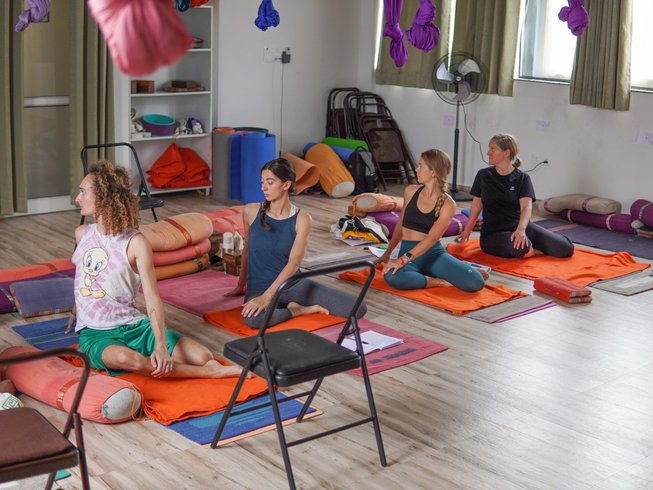
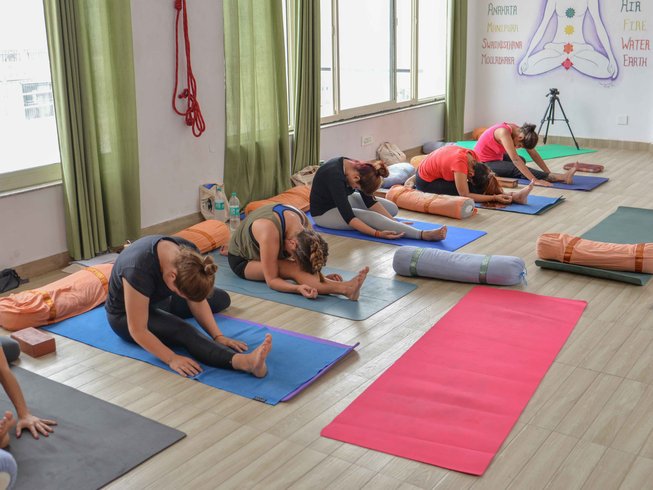
In Yin yoga, only the passive (Yin) poses are used. The use of muscles is kept to a minimum, so the muscles are gently engaged to hold the posture without any extra effort. As the poses are to be held for a longer duration, the use of props like cushions, bolsters, etc., is encouraged.
When you hold a pose for a longer period, you bring the stretch to the Yin tissues, which are the deeper tissues such as the tendons, fascia, ligaments, and other connective body tissues. Your Yin tissues are less vascular (supplied with blood) and less elastic, and therefore, need more time to stretch. When stretched regularly, it increases the overall flexibility, circulation, and range of motion in the joints and ligaments.
What is Yang yoga?
Yang yoga, such as Ashtanga-Vinyasa yoga and modern Hatha yoga, the movement makes the muscles take the main load and stretch. Muscles are Yang tissues, they are quick to warm up and stretch but also quick to cool down and rebound. That is why, if you do not practice for a few days, you see a big decline in flexibility and strength.
So, if you practice only dynamic forms of yoga, you will gain muscle strength, but not necessarily a wider range of motion. To have a healthy range of motion around your joints, many of you need to also stretch the deep connective tissue and the joints.
What is Ayurveda-Marma?
Marma (pressure points) are the vital energy points located throughout the body. They are often located at junction points where two or more types of tissue meet such as muscles, nerves, tendons, joints, ligaments, or bones. Any obstruction to these points creates an imbalance that results in disease, pain, and discomfort.
The aim is to identify and address blockages in the marma system to restore the flow of energy in the body. This has the effect of boosting the body’s healing capacity.
What are the benefits of Yin yoga
Physical benefits
- Fascia: With the long holds, you stretch and stimulate the layers of fascia in your body. With regular stress, your fascia becomes subtle and the flow of nutrients increases. This results in the improved overall functioning of the body
- Ligaments: Your ligaments connect bones to bones. Ligaments are stiff and strong fascial bands that protect your joints from going out of place, and therefore, limit your range of motion. But ligaments are always contracting with age. With Yin yoga, you gently stretch your ligaments and maintain the range of motion of your joints
- Tendons: Your tendons are the connective tissue that connects muscle to the bone. With yang exercises, the tendons become strong and short. This results in a decreased range of motion of the tendons. This is the top reason for injury in athletes. With Yin poses, you pressure and lengthen the tendons gently and retain their range of motion
- Joints: All physical movement happens at your joints. But due to the modern lifestyle which promotes a lack of movement and short-range movements, the fluids in the joint capsules decrease. This decreases the lifespan of the joint. With Yin yoga, you put gentle pressure on the joints, which revitalizes the joints and renews the fluids
- Viscera: With gentle and long pressure on your internal organs, you stimulate them and improve their functioning
- Myofascial: As the quality of the connective tissue is improved, the range of flexibility in your muscles (myofascial) is also positively affected
Physiological benefits
- Studies based on five-week Yin yoga-based interventions have found that Yin yoga works as a preventive tool in lowering plasma adrenomedullin. High ADM is one of the main causes of stress, anxiety, and depression. These are added risk factors for many non-communicable diseases
Mental benefits
- Stress release: It helps to release stress which is stored in your deeper tissues
- Emotional balance: It stimulates your endocrine glands by pressuring them during long-held poses. The effect is an improved hormonal balance which results in more balanced emotions
- Clarity: There is power in stillness. The regular practice of sitting still and focusing brings mental clarity
Complete course syllabus
Yin philosophy
- Meaning and importance of Yin yoga
- History and origin of Yin yoga
- Understanding the concept of yin and yang
- Yin and Yang organ
- Yin yoga in daily life
- What is Yang yoga
- Yin tattva
- Tao and yin
- Chakra
- Nadis
- Understanding yoga and Yin
Body meridians
Meridians are energy channels that transport energy and life through your body. They affect how you think, feel, and your overall health. When the meridian pathways are open and clear, pranas freely flow through your body to maintain harmony and balance. Practitioners are taught asanas that target these body meridians.
Ayurveda-Marma
- Introduction of Ayurveda and its principles
- Introduction to Tridosha and Prakriti (know your body type)
- Introduction to seven tissues (Dhatus) of the body
- Introduction to Marmas: Energy points of yoga and Ayurveda
- Marmas on the arms and hands
- Marmas on the legs and feet
- Marmas on the abdomen and chest
- Marmas on the back and hips
- Marmas on the head and neck
Mudras
Practitioners learn the technique of using seals or gestures to facilitate the flow of energy in the body.
- Jnana mudra
- Chin mudra
- Yoni mudra
- Bhairava mudra
- Hridaya mudra
- Shambhavi mudra
- Nasikagra mudra
Bandhas
Practitioners learn the technique of consciously blocking and unblocking energy flow to different parts of their body.
- Mulabandha
- Uddiyana
- Jalandhar
- Maha Bandha
Yin pranayama
- What is prana and pranayama
- How to take Yin breath
- Types of breathing
- Healing pranayama
- Yang breath
- Cooling breath
- Breathing and Yin movements
- Different from normal pranayama
Yin yoga asana
- Camel pose
- Cat pulling its tail pose
- Caterpillar pose
- Child’s pose
- Dangling pose
- Deer pose
- Dragon pose
- Melting heart pose
- Ankle stretch pose
- Banana pose
- Half butterfly pose
- Butterfly pose
- Frog pose
- Happy baby pose
- Reclining spinal twist pose
- Saddle pose
- Shoelace pose
- Snail pose
- Sphinx pose
- Seal pose
- Square pose
- Squat pose
- Straddle pose
Yang practice
In contrast to Yin, Yang is a more active practice that works on the muscles, blood flow, building strength, stamina, and flexibility. Practitioners learn Yang styles of yoga, which involve rhythm and repetition quite like the Ashtanga-Vinyasa flow.
Anatomy
Learn more about the anatomy of the body to better understand safe and stable physical alignment in yoga poses. Pick up in-depth knowledge to take to the mat to fine-tune and deepen your practice.
- Tissues
- Joints and movement
- Systems
- Compression and tension in the body according to Yin postures
Alignment and adjustment
- Purpose of props and support material
- Right placement of the props
- Contraindications and challenges
- Overcoming teaching challenges
Meditation and yoga Nidra
- Meaning and purpose of meditation
- Meditation and yoga Nidra
- Practices
- Technique 1: Basic relaxation practices
- Technique 2: Visualization yoga Nidra
- Technique 3: Chakra awareness yoga Nidra
- Technique 4: Inner flame yoga Nidra
Teaching methodology
The assistants will help students with modifications, props, alignment, and physical assistance. This is a great way to gain experience. Once this has been mastered, teaching friends in small groups, semi-private, or private sessions are a good way to develop inner confidence.
- Explaining the art of teaching Yin postures
- Building teaching skills
- Building communication skills
- Preparing for a class
- Managing a class
- Overcoming teaching challenges
Students will take turns practicing their teaching skills by performing in front of their peers and teachers. Assessments are based on
- Attendance
- Performance
- Behavior
Daily schedule
- 06:00 Wake up
- 06:00-07:30 Yin yoga asana and teaching practice
- 08:00-09:00 Pranayama / Mudra and Shatkarma
- 09:00 Breakfast
- 11:00-12:00 Noon Yin philosophy
- 12:00-13:00 Body Meridian
- 13:00 Lunch
- 15:00-16:00 Yang Yoga (Hatha, Ashtanga and Aerial yoga)
- 16:00-17:30 Yin Yoga Sequence and Teaching Methodology
- 17:45-18:45 Meditation, yoga Nidra and sound healing
All classes are mandatory. Only in the case of an emergency or illness, you can take leave with the permission of the respective teachers. Uninformed leaves will not be accepted and this will affect students' monthly performance.
Instructores
Monika Pundir Ji
Monika Ji began practicing yoga in 2015. Discovering her natural aptitude, she quickly progressed to becoming a yoga pranayama and meditation teacher. She has training in traditional Hatha yoga and pranayama. She has M.A. in yogic science from Uttarakhand Sanskrit University in Haridwar. She also holds an E-RYT 500-hour and YACEP registered yoga teacher certificate from Yoga Alliance USA. Although her pranayama skills have earned her recognition, Monika's teaching includes mindfulness and the intention to form a complete practice.

Shubham Negi
Shubham began practising yoga in 2019. Discovering his natural aptitude, he quickly progressed to become a yoga asana teacher. He has training in traditional Hatha yog. He has completed B.A. in yogic science from Uttarakhand University in Haridwar. He also has learned and practiced under the guidance of many renowned yoga gurus in Rishikesh. Although his asana skills have earned him recognition, Shubham's teaching includes mindfulness and the intention to form a complete practice. He incorporates mantras, meditation, and relaxation into his classes.
Pradeep Singh
Experienced and passionate 500-hour certified yoga instructor with over six years of teaching beginner, experienced, and advanced training in Ashtanga, Hatha, Yin, and Vinyasa approaches. Sincere and positive, with an innate ability to connect with others, he is committed to providing extensive instruction and counseling to his students, while motivating them to find true inner peace and mental well-being. Adept at creating powerful teaching plans that aim to support and benefit each and every student.
soma ji
From a young age, Soma was drawn towards a spiritual way of living and mind-body connection. She loved yoga right from the start, exploring many different styles. It wasn’t until a couple of years later that Soma started practicing Asana Pranayam & Meditation yoga and meditative qualities captured her heart. Soma had no intentions of teaching yoga. She wanted to immerse herself in a training to deepen her practice. Little did she know the universe had other plans. Soma has practiced with many renowned teachers and is always learning and expanding her experience and knowledge of this lifelong.
Ajay ji
Ajay Pandey, hailing from Rishikesh, is a highly experienced yoga teacher who has dedicated himself to sharing the transformative benefits of yoga with others. With a solid background in yoga training and education, Ajay has been practicing and teaching yoga for the past five years. In June 2018, Ajay completed a yoga teacher training program, earning a certification for 200 hours of comprehensive training. This foundational training provided him with a deep understanding of yoga principles, asanas, pranayama, meditation techniques, and the underlying philosophy of yoga.
Ubicación
Learn yoga in the world’s yoga capital, Rishikesh, from traditional Himalayan yoga teachers, from the basics to advanced, in a traditional way, at Hare Rama Institute.
The school is situated in Tapovan, Laxman Jhula, in Rishikesh, which is in India's northern state of Uttarakhand, in the Himalayan foothills, beside the Ganges River. The river is considered holy, and the city is renowned as the world’s yoga capital.
The surroundings of Hare Rama Institute are very serene and peaceful, and at the same time very energetic by the flowing energy of the river Ganga. Also, Rishikesh is a magical and holy place that has been somehow attracting people from all over the world for many years already.
The school is within walking distance from the river Ganga. It is surrounded by serene green mountains which heal the inner soul and the Ganga River flows within walking distance. The school is far from the craziness but near enough to reach everything you need. All over Rishikesh, you can find local markets, unique shops, and breathtaking views of the holy river and nature.

Alimentos
Hare Rama Institute regards food as medicine. Using only fresh seasonal herbs and vegetables from local markets, they provide a daily menu of wonderfully nourishing vegetarian food. Food that not only supports the healing of the body but also enhances the purification process during your stay.
In addition to serving healthy, soulful, delicious vegetarian meals, they also provide unlimited filtered mineral water from their private well, naturally chilled and served from traditional earthen water basins.
Hare Rama Institute also provides an unlimited supply of detoxifying herbal tea made from homegrown herbs like tulsi basil, lemongrass, and ginger. This wonderfully refreshing tea, available throughout the day, is a great detox drink for the body, keeps one well hydrated, and is designed to support the digestive process.
Food provided at their center is 100% vegetarian, not vegan. You will need to inform them in advance so their chef can prepare food for you especially.
Los siguientes alimentos están incluidos:
- Breakfast
- Lunch
- Dinner
- Drinks
Las siguientes bebidas están incluidas:
- Agua
- Té
Tipos de alimentación disponibles:
- Vegetariana
- Libre de gluten
- Frugívoros
- Yóguicos
- Ayurvédicos
Actividades opcionales
There are some amazing things to do in Rishikesh. These activities are not included in the package, but they can be arranged upon request:
- Cliff jumping
- Bungee jumping
- Attend Ganga Arti
- Rappelling and rock climbing
- Ayurvedic massage and therapies
- River rafting - the most popular thing to do in Rishikesh
- Experience the traditional Indian culture
- Parasailing and paragliding
- Camping and bonfire
- Mountain biking
- Flying fox
- Kayaking
- Trekking
El paquete incluye
- Daily Yin-Yang yoga classes
- Daily pranayama and Shatkarma
- Daily meditation and mantra chanting
- One sound healing session
- Certificate of completion
- 3 times daily nutritious vegetarian meals, juice, and tea
- 8 nights of comfortable accommodation
- Taxi-pickup from Jolly Grant Airport (DED)
- Complete study kit (manual, notebook, pen, yoga bag, neti pot, mala, school t-shirt)
- GST
No incluye
- Airfare
- Air-conditioner or room heater (25 USD extra charge)
- Transportation from Indira Gandhi International Airport (DEL) (75 USD extra charge)
- Extra night stay in the school (15 USD extra charge per night)
- Drop off
¿Cómo llegar?
Aeropuertos recomendados
Traslado incluido
Jolly Grant Airport
A 15 km de tu destino
Traslado disponible por un costo adicional US$ 75 por persona
Indira Gandhi International Airport
A 209 km de tu destino
Arrival by airplane
Please book your flight to arrive at Dehradun Jolly Grant Airport (DED) in India. Traveling by plane from Delhi airport to Dehradun airport is the safest and most convenient way of transportation and it is a one-hour journey. Most of the students choose this option. At Dehradun airport, the school driver will be waiting with a name board to pick you up and transfer you to the school. Drop off to the airport is not included in the price.
Arrival by train
Traveling by train (from Delhi train station to Haridwar Station) is also suitable and the fare is between 20-25 USD, and it is a 4-5 hour journey. At Haridwar railway station, the school driver will be waiting with your name board to receive you.
Arrival by taxi
Delhi airport to Rishikesh by car is a 6-7 hour journey. Delhi airport to Rishikesh taxi can also be arranged for 75 USD by the school. At Delhi airport, the school driver will be waiting with your name board and transfer you to the school.
Política de cancelación
- Una reserva requiere de un depósito del 24% del precio total.
- El depósito no será reembolsado si la reserva es cancelada.
- El resto del pago deberá ser completado a tu llegada.

Comentarios
Con este organizador puedes asegurar tu reserva a través de BookYogaTeacherTraining.com. Todas las tarjetas de crédito principales son aceptadas.