
28 jours-200h en formation de professeur de yoga multi-style à Rishikesh, Inde
Multi-style Yoga Teacher Training in India
This course is designed to provide students with a comprehensive understanding of the fundamentals of Hatha yoga and its many practices. The course includes an in-depth study of Hatha yoga, including asanas (yoga postures), pranayama (breathing techniques), meditation, mantra chanting, and yoga philosophy. The course also provides training in teaching techniques, which will enable the student to become a certified Hatha yoga teacher.
Rencontrez les professeurs
Particularités
- Éligible à l’inscription auprès de Yoga Alliance à l’issue de la formation
- Cours de yoga quotidiens
- Programme de formation de professeur de yoga de 200h
- Excursions le week-end
- Prise en charge depuis l’aéroport Jolly Grant (DED)
- 27 nuits d’hébergement
- Repas végétariens quotidiens
Niveau de pratique
- Débutant
- Intermédiaire
Styles
28 jours de cours en Anglais
Hébergement
Installations
- Coin repas
- Jardin
- Studio de yoga
Rishikesh Nath Yogshala provides comfortable accommodation for its students in a peaceful and serene environment. The ashram has a total of eight rooms, each equipped with all the necessary amenities such as private bathrooms, attached balconies, air conditioners, and other basic amenities.
It provides learners and practitioners with state-of-the-art well-equipped rooms and accommodations with pure sattvic, vegetarian food. The institute is located in the yoga capital of India, Rishikesh.
Nutrition, exercise, and sleep are all equally important aspects of good health, and health is obviously one's most coveted asset. Rishikesh Nath Yogshala will take care of all of those while you learn yoga. Accommodation provided to you will have all necessary amenities. The options range from single rooms to double shared rooms, with all having attached bathrooms.
The bathrooms are equipped with Western toilet seats and showers. Hot water is also made available during winters. Your comfort is not compromised and the most conducive-to-learn environment in is provided to you.
Programme
Certification
Students who complete the training are eligible to register with Yoga Alliance as Registered Yoga Teachers (RYT®).
How the training works
The aim of this teacher training course is to create a solid basis for you in order to help you pursue a career as a certified yoga teacher. The training focuses on quality in all aspects, ranging from accommodation, a healthy diet, and a team of experienced teachers.
Through the first two steps, mental strength is enhanced by interpreting the qualities of one’s own mind and its limitations. Restlessness ceases to exist at this stage and all the limitations and imperfections of the mind are left behind. Analytical observation and intellectual energy tend to grow, and you will start to enjoy internal bliss.
About the training
This course is designed to provide students with a comprehensive understanding of the fundamentals of Hatha yoga and its many practices. The course includes an in-depth study of Hatha yoga, including asanas (yoga postures), pranayama (breathing techniques), meditation, mantra chanting, and yoga philosophy. The course also provides training in teaching techniques, which will enable the student to become a certified Hatha yoga teacher.
Rishikesh Nath Yogshala offers this 200-hour yoga teacher training, a Yoga Alliance affiliated, beginner to intermediate level, yoga teaching course that will run for 28 days. This program will help people in finding the path of actual yoga learning. The course will also aid in understanding and learning the basics of yogic science.
During this, you will come to know about beginner-level yoga asana. This will help in transforming you from a normal individual to a yogic aspirant. It will also develop your love for yoga by making you understand the factual meaning of yoga. Moreover, the various beginner-level yoga asanas will be part of the yoga teaching curriculum. Overall, this is a 28-day yoga course that helps in starting your career in yoga teaching.
The 200-hour yoga teacher training in Rishikesh is a comprehensive yoga program designed to train a student to become a certified yoga instructor who can teach yoga in any environment. Yoga Alliance USA certifies this program. It is a holistic approach towards understanding the ancient science of Yoga. It is a combination of theoretical and practical training which covers all aspects of yoga including asana (postures), pranayama (breathing techniques), meditation, philosophy, anatomy, and physiology.
It also covers important topics like yoga for healing, yoga for stress relief, and yoga for fitness. The program also offers in-depth guidance on how to teach a yoga class. Upon successful completion of the program, the student will be certified as a yoga teacher. Rishikesh Nath Yogshala provides the best 200-hour yoga teacher training in Rishikesh as well as in all of India.
Aims and objectives
- Strengthen the roots of yoga in yoga aspirants
- Connect the students with spirituality
- Practicing yoga postures, pranayama, mudras, dhyana, and kriyas
- Building class-conducting skills
- Knowledge of the advantages of yoga on health and wellness
Benefits of yoga teacher training
- Turns you into a qualified yoga teacher
- Improves flexibility, endurance, blood circulation, memory, and concentration
- Keeps you updated on online courses and workshops on the latest practices in the field of yoga that you can attend from home whenever you have the time
- Speak with experts and come up with new innovative poses and modifications to the old ones, or even suggest a new style similar to Hot yoga or whatever
- Access to endless information, including research documents, and even do your own yoga research
What does your training cover?
Rishikesh Nath Yogshala follows a curriculum that is in compliance with the international standards of Yoga Alliance from the USA, coupled with the expertise of renowned yoga gurus. The prime aim of this course is to teach physical and spiritual practices that lay down the foundation to become a well-rounded and successful yoga teacher.
The five main modules of the course include yoga teaching techniques, teaching methodology, yogic lifestyle and philosophy, anatomy and physiology, as well as practice.
Yoga pranayama
Pranayama is a set of yogic techniques and practices generally defined as breath control and is on its own considered a science. Here is what you’ll learn on the subject:
- Introduction of pranayama
- Benefits of pranayama
- The pranic body
- Prana and lifestyle
- Breath, health, and pranayama
- Pranayama and the spiritual
Bandhas (energy locks)
Bandhas are energy locks provided by the contraction of certain groups of muscles and are widely used in yoga practice. Here's a glimpse of what you’ll learn on the subject:
- Preparation for bandha
- Benefits of bandha
- Mula bandha
- Jalandhara bandha
- Uddiyana bandha
Mantra chanting
Mantras play a big role in daily yogic life. Mantras are sounds and prayers that carry huge energy and vibration. Rishikesh Nath Yogshala will teach you to sing:
- Opening mantra
- Om chanting
- Gayatri mantra
- Guru vandana (prayer to guru)
- Student and master mantra
- Patanjali mantra (Ashtanga mantra)
- Completeness mantra
Kriya and shatkarma (The six purification methods of Hatha yoga)
Shatkarma is the Sanskrit term for one of the six yogic purification techniques (kriyas) as outlined in the "Hatha Yoga Pradipika." The purpose of these cleansing techniques is to keep the body strong, clean, and healthy. They remove toxins and anything blocking the flow of prana in the body.
Practicing shatkarma internally purifies the body, and makes pranayama and meditation practice easier by preparing the body to perform these practices without distraction, discomfort, or fatigue. This is a traditional yogic cleansing technique that is very effective and good to remove many illnesses and open body blockages.
You will learn:
- Jal neti
- Ruber neti
- Sutra neti
- Kunjal neti
Hatha yoga
Traditional Indian yoga style is called "Hatha" (“ha” means sun; “tha” means moon), unifying the sun and the moon within (Yin and Yang). It's a physical method for preparing and maintaining the body, providing stamina flexibility, balance, and strength. This is the most traditionally popular and beneficial yoga style.
What you will practice:
1st week:
Joints warm-ups (pawanmuktasana series A, B, and C)
- Surya namaskara (sun salutation) and chandra namaskara (moon salutation)
- Yoga mudrasana
- Matsyasana
- Gupta padmasana
- Baddha padmasana
- Kukkutasana
- Garbhasana
2nd week:
Backward bending asanas
- Saral bhujangasana (easy cobra pose)
- Bhujangasana (cobra pose)
- Tiryaka bhujangasana (twisting cobra pose)
- Sarpasana (snake pose)
- Ardha shalabhasana (half locust pose)
- Shalabhasana (locust pose)
- Saral dhanurasana (easy bow pose)
- Kandharasana (shoulder pose)
- Ardha chandrasana (half-moon pose)
- Setu asana (bridge pose)
- Gomukhasana (cow’s face pose)
3rd week:
Forward bending asanas
- Paschimottanasana (back stretching pose)
- Gatyatmak paschimottanasasna (dynamic back stretch pose)
- Pada prasar paschimottanasana (legs spread back stretch pose)
- Janu sirshasana (head to knee pose)
- Ardha padma paschimottanasana (half lotus back stretching pose)
- Hasta pada angushthasana (finger-to-toe stretch)
- Padahastasana (hand to foot pose)
- Sirsha angustha yogasana (head-to-toe pose)
- Utthitajanusirshasana (standing head between knees pose)
4th week:
Spinal twisting and advanced asanas
- Ardha matsyendrasana (half spinal twist)
- Parivritti janu sirsasana (spiraled head to knee pose)
- Poornabhujangasana (full cobra pose)
- Kurmasana (tortoise pose)
- Poornashalabhasana (full locust pose)
- Poornadhanurasana (full bow pose)
- Dhanu-rakarshan-asana (archer’s pose)
- Chakrasana (wheel pose)
- Hanumanasana (leg-splitting pose)
- Poornamatsyendrasana (full spinal twist pose)
- Mayurasana (peacock pose)
- Padma mayurasana (lotus or bound peacock pose)
- Gorakshasana (yogi gorakhnath’s pose)
- Astavakrasana (eight-twist pose)
- Vrischikasana (scorpion pose)
- Inverted pose, balancing pose, and core pose
Teaching methodology and adjustment
During these classes, you will learn how a perfect posture should be. You will also learn how to connect with your future students through correct class verbal guidance and touch adjustment, and all about recurrent yoga injuries and how to prevent them.
Teaching methodology is one the most important parts of the course as the students will learn the following:
- How to conduct a class
- Classroom management
- How to get in and come out from the posture
- How to assist and help while teaching the class
- Which kind of words you should be using as a yoga teacher
- What makes you different from other teachers in terms of teaching?
- Which kind of asanas you should recommend for different health issues
- How to use belts, bolster, bricks, and chair during the class adjustment
Yoga philosophy
The history of yoga, the sutras of Patanjali, and the importance of yoga and its origins in India are the subjects of these classes and lectures. Questions will be addressed, and you will deepen your knowledge about yoga.
Yoga anatomy
Anatomy classes expose how the body, bones, inner systems, and respiration are affected by asanas and the flow of breath. Knowing the basic structure and function of the organs and systems is very important to practitioners so that their work as yoga teachers can be safe and beneficial to future students.
These are what you’ll learn:
- Complete body anatomy
- Skeleton system
- Muscular system
- Circulatory system
- Nervous system
- Respiratory system
Ashtanga Vinyasa
An intensive and integral part of yoga, the Ashtanga yoga style requires deep commitment and self-practice to achieve the goal. The pyramid’s yoga instructors have experienced teachers and advanced practitioners of the Ashtanga style and will guide you safely through the hardest postures. you’ll learn the complete Led primary series:
Standing poses
- Hasta padangusthasana and pada hastasana
- Utthita tri konasana
- Parivrtta tri konasana
- Utthitan parsva konasana
- Parivrtta parsva konasana
- Prasarita padottanasana A, B, C, and D
- Utthita parsvottanasana
- Utthita hasta padangusthasana
- Utthita parsvasahita
- Utthita eka padasana
- Ardhabaddha padmottanasana
- Utkastasana
- Virabhadrasana A, B, and C
Primary asanas
- Paschimottanasana A, B, and C
- Purvottanasana
- Ardha baddha padma paschimottanasana
- Tirieng mukha eka pada paschimottanasana
- Janu sirsasana A, B, and C
- Marichyasana A, B, and D
- Navasana
- Lolasana
- Bhuja pidasana
- Kurmasana
- Garbha pindasana
- Kukkutasana
- Baddha konasana A and B
- Konasana A and B
Intermediate asanas
- Salabhasana A and B
- Dhanurasana
- Ustrasana
- Kapotasana A and B
- Supta vajrasana
- Bakasana A
- Bakasana B jump
- Ardha matsyendrasana
- Yoga nidrasana
- Tittibhasana
- Picha mayurasana
- Vatayanasana
- Gomukhasana A and B
- Hasta sirsasana (headstand)
Advanced A (optional)
- Kasyapasana
- Bhairavasana
- Urdhva kukkatasana A
- Galavasana
- Eka pada viparita dandasna
- Viprita salabhasana
- Gandha bherundasana
- Hanumanasana
- Natrajasana
- Raja kapotasana
Course prerequisites
Students must overcome the theoretical and practical tests that will be proposed and perform the formative assessment tests, which will be indicated throughout the course, in order to obtain the corresponding accreditation.
- Daily study - for good use of the course, the student will commit to dedicating at least two hours to daily study.
- Teaching materials - the students must know that for this course, they will be given didactic material protected by copyright.
- Punctuality - classes have their established start time that must be respected at all times.
- Optional reinforcement - the students may request these optional reinforcement classes.
What are expected from you?
- Normal physical and psychological resilience
- Harmonious and balanced cooperation in the training group
- Relaxed after the training weekend
- Election of a further participant as a training and training partner for deepening the content of the training
- Take-over of small activities for the common good of the group in the course of the training (Karma yoga): (e.g., preparation of tea and meals, assistance in the yoga room)
- Openness and commitment: the training is aimed at everyone who wants to deepen their practice and share with others. A certain Vinyasa yoga experience is desirable, but passion, dedication, and openness with which you want to devote yourself to education are far more important. You will be expected to integrate yoga into your everyday life during your training.
- Discipline: A pre-requisite for obtaining the certificate is 100% presence during the entire training and the internship, the submission of all homework and book reports, as well as compliance with the theoretical and practical examinations.
Why choose Rishikesh Nath Yogshala for yoga learning?
The role of a good yoga teacher or guru is the prime factor that affects yoga learning. Moreover, a naturalistic and calm environment also supports the authentic learning of yoga. Since the ancient era, rishi Munis have been highlighting the importance of a serene and inartificial atmosphere for yoga learning from the core of the heart. They often look for such places for their yogic practices and Rishikesh was one of those.
Rishikesh Nath Yogshala is the combination of the prime location and brilliance of yoga teachers. It is one of the best yoga schools in the Rishikesh, and it is situated in the vicinity of nature. The calm and natural environment of this Yoga Alliance-affiliated yoga school is the perfect choice for your yoga learning.
Moreover, the skill and knowledge of the yoga teachers help in the overall modification of a person. They not only believe in yoga learning, but in their school, they fabricate the personality of a person into a yoga teacher. Also, they emphasize the overall development of the body from mind to soul. Thus, this top-class yoga school will help you in bringing perfection to yoga learning.
Daily schedule:
- 05:30 Wake up
- 06:00 to 06:30 Morning tea
- 06:30 to 08:00 Hatha yoga class
- 08:00 to 09:00 Pranayama
- 09:00 to 10:30 Breakfast / tea
- 10:30 to 11:30 Mantra / anatomy / adjustment / teaching methodology
- 11:30 to 11:45 Tea break
- 11:45 to 12:45 Teaching methodology / anatomy
- 13:00 to 15:00 Lunch
- 15:30 to 16:00 Philosophy
- 16:00 to 17:00 Anatomy
- 17:00 to 17:30 Tea break
- 17:30 to 18:00 Ashtanga Vinyasa
- 18:00 to 19:00 Meditation / yoga Nidra
- 19:30 to 21:00 Dinner
Excursions
Rishikesh Nath Yogshala believes in the overall development of a person during their 200-hour yoga teacher training course. Thus, the weekly excursion is an important part of their course curriculum. Every weekend, Rishikesh Nath Yogshala will take their students to nearby spiritual and natural places to help in awakening the true senses of a person.
- Ganga River
- Forest
- Cave
- Kunjapuri Temple
Professeurs
Ajay Uniyal
Ajay Uniyal s’est plongé dans la vie spirituelle dès son plus jeune âge, et il y est resté fidèle depuis. Sous la guidance de son grand-père, il a commencé à étudier la philosophie du yoga et le vedanta à l’âge de 11 ans. Ensuite, Ajay a rejoint le Gurukula et a अभ्यासé le yoga pendant quatre ans. Depuis cette époque, il poursuit sans cesse des formations plus avancées et a également obtenu de nombreuses distinctions, ainsi qu’une solide expérience de plusieurs années dans l’enseignement du yoga.

Harmindra Singh
Harmindra's specialty is anatomy and physiology. Harmindra Singh is one of the most sincere and natural teachers of Ashtanga and Vinyasa Flow in Vinyasa yoga ashram, He has been practicing Ashtanga and Vinyasa Flow for more than 4 years and teaching around the world. He has completed his Master's degree in yoga sciences. He is also a certified teacher. His teaching method is very simple and traditional. His classes are also very informative while at the same time light-hearted and lively.

Rupam Pundir Ji
Rupam Pundir est un jeune professeur de yoga dynamique, spécialisé en pranayama. Sa passion pour le yoga a commencé dès son plus jeune âge, et elle a passé de nombreuses années à étudier auprès de grands maîtres, apprenant tous les aspects du yoga, avec un intérêt particulier pour les bienfaits du pranayama et de la méditation sur la santé et le bien-être. Elle poursuit actuellement ses études en préparant un master en sciences du yoga à l’université sanskrite d’Uttarakhand, à Haridwar, en Inde. Rupam est une enseignante dévouée, dotée d’une solide expérience, et appréciée de tous ses élèves.
Lieu
Tapovan, Rishikesh
This program will take place in Tapovan in Rishikesh, India..
About the venue
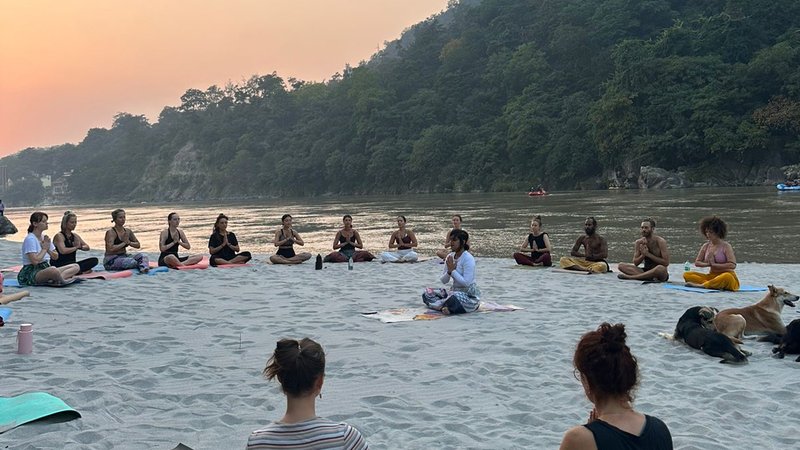
Rishikesh Nath Yogshala is located in the yoga capital of the world and stands close to the banks of River Ganga. Rishikesh is located in the North Indian state of Uttarakhand and is surrounded by Himalayan Hills. The place is intersected by the holy River Ganges, and thus, it is also known as the land of yoga and spirituality.
Rishikesh is claimed to be the "yoga capital of the world," and people from different countries all around the world visit this divine city to enjoy nature, learn yoga, and other forms of spirituality. The place is full of spiritual ashrams and yoga shalas.
If you seek a mix of everything - pleasure and peace of inner self, then Rishikesh Nath Yogshala can help you.
Distances
- Dehradun, 35 kilometers
- Delhi, 250 kilometers
- Haridwar, 30 kilometers

Repas
Sattvic meals
Get yourself energized with healthy and sattvic diet. Your food will be Rishikesh Nath Yogshala's responsibility. They will ensure to fulfill your nutritive requirements and also educate you about food’s link with energy and emotions during your course.
Meals will be provided to you. Three traditional vegetarian meals in a day - breakfast, lunch, and dinner - will be served there. Herbal tea will also be served during the day. Reverse Osmosis (RO) filtered safe drinking water is also available at the facility.
The food provided by the institute is very nice. You will be provided with a delicious sattvic meals three times a day.
The menu will change on a weekly basis, focusing mainly to introduce healthy and nutritious elements in the meal.
If you wish to try something else, several restaurants and local hotels are located nearby. However, it is suggested that the students only consume natural and pure meals.
Les repas suivants sont inclus:
- Breakfast
- Lunch
- Dinner
- Drinks
Les boissons suivantes sont comprises:
- Eau
- Thé
Les régimes alimentaires suivants servis et/ou pris en charge :
- Végétarien
Ce qui est inclus
- Certificat de fin de formation
- Matériel d’étude
- Tapis de yoga
- Kits de purification
- Excursions le week-end
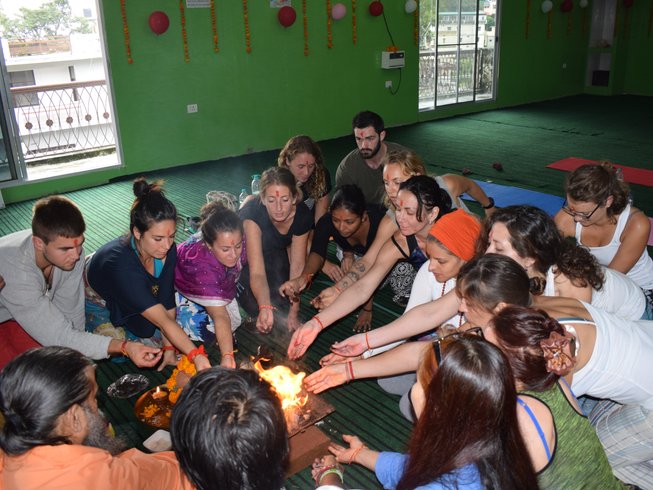
- Cérémonie du feu
- Accès au Wi-Fi
- Transfert gratuit depuis l’aéroport de Jolly Grant (DED)
- 27 nuits d’hébergement
- Repas entièrement végétariens
Ce qui n'est pas inclus
- Billet d’avion
- Repas supplémentaires
- Séjour supplémentaire
- Repas en extérieur
- Assurance voyage
- Transfert de l’école à l’aéroport Jolly Grant (DED), à la gare routière, et plus encore
Comment se rendre sur place ?
Aéroport recommandé
Transferts inclus
Jolly Grant Airport
À 16 km de votre destination
Transferts non disponibles
Indira Gandhi International Airport
À 209 km de votre destination
Arrival by airplane
Please book your flight to arrive at Indira Gandhi International Airport (DEL). You may rent a car or catch a taxi from the airport.
You may book another flight to the nearest domestic airport near Rishikesh, which is Dehradun’s Jolly Grant Airport (DED). Transfer from this airport is included. Rishikesh Nath Yogshala will pick you up from the airport.
Arrival by bus
From Delhi, the city of Rishikesh is about 230 kilometers away and is well connected by buses. A bus journey may take about five to seven hours depending on the traffic and it costs you about 130 to 350 INR.
A bus with air conditioning will cost about 250 700 INR. In Rishikesh, there are several travel agencies scattered around Swarg Ashram and Lakshman Jhula that can book luxury buses to common destinations like Delhi, Jaipur, Pushkar, and Varanasi.
Arrival by train
A quiet branch line connects Rishikesh to Haridwar, but there are only about three slow trains daily. It is better to take the train to Haridwar and continue by bus from there which will take 45 minutes and costs 30 INR, by taxi it will take 30 minutes and costs 800 INR or by auto-rickshaw taking 40 minutes and 500 INR. However, traveling by train is recommended in peak seasons or during a ‘mela’ (fair) when bus routes are diverted in Haridwar whereas trains often run empty and the fares are low at just 4 INR for a passenger train service.
You can take share rickshaws (vehicle brand name Vikram) towards Lakshman Jhula for 15 INR from Rishikesh station. You will have to cross Ram Jhula to reach Swarg Ashram on the other side of the River Ganga. There are many trains from Delhi to Haridwar. Some of the better options are Shatabadi Express, Jan Shatabdi, AC Special Express, and Mussoorie Express.
Conditions d'annulation
- Pour réserver, un dépôt de garantie correspondant à 30% du prix total est requis.
- Le dépôt de garantie est non-remboursable si vous annulez votre réservation.
- Le reste du paiement est dû à votre arrivée.

Avis
Pour cette offre, vous pouvez effectuez votre réservation sur BookYogaTeacherTraining.com. La plupart des cartes de crédits sont acceptées.