
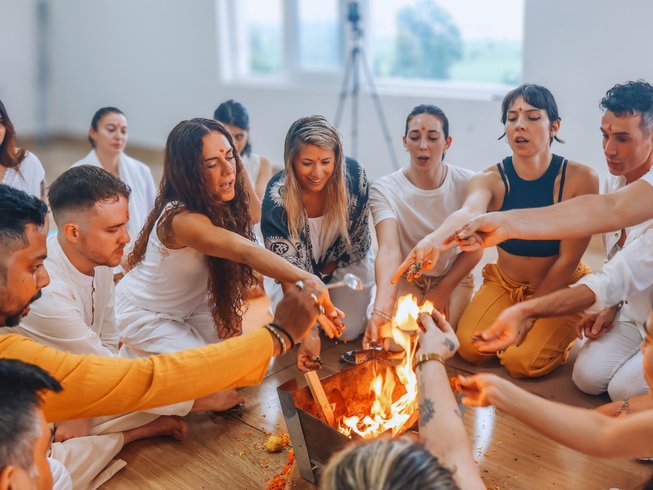
24 jours-200h en formation de professeur de yoga hatha et vinyasa traditionnel à Rishikesh, Inde
Yoga Teacher Training in India
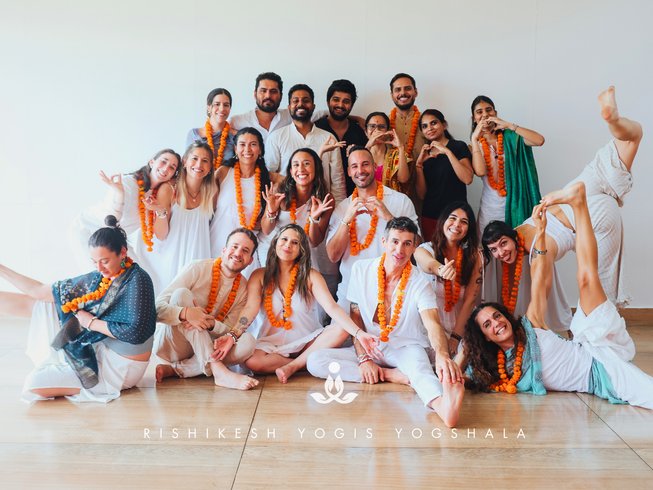
Why join a yoga course with Rishikesh Yogis Yogshala? The teams of teachers are dedicated practitioners and teachers who have led various yoga camps successfully. Their main focus is to cultivate traditional teaching and values of yoga with updated information on body-mind science.
Rencontrez les professeurs

En savoir plus
Particularités
- Admissible à l’inscription auprès de Yoga Alliance à l’issue de la formation
- Excursions guidées captivantes vers des lieux d’importance spirituelle et yogique
- Formation dirigée par une équipe de professeurs de yoga hautement qualifiés et authentiques
- Exposition équilibrée au Hatha yoga, aux méditations, au pranayama, aux mudras et aux bandhas
- Kit essentiel de yoga fourni à chaque participant à l’arrivée
- Pour ceux qui ont toujours rêvé d’apprendre les racines du yoga
- 3 repas végétariens nutritifs et équilibrés par jour avec tisane
- 23 nuits d’hébergement
Niveau de pratique
- Débutant
- Intermédiaire
Styles
23 jours de cours en Anglais
Hébergement
Installations
- Coin repas
- Cuisine
- Terrasse
- Studio de yoga
- WI-FI gratuit
You will be staying at a clean and hygienic accommodation with attached hot showers, 24/7 power backup, and a 24/7 Wi-Fi facility available.
- Yoga hall
- Shared room
- Dining room
- Lawn area
- Private rooms available too
Nurturing your body and soul
Experience an alternative sanctuary for your heart and soul with the lodging during your yoga course. Involve yourself in comfy and serene accommodations, offering you an excellent sanctuary for relaxation and reflection. Rishikesh Yogis Yogshala's attentively curated culinary offerings, personalized to support both body and spirit, will boost your wellness.
Programme
Certification
Students who complete the training are eligible to register with Yoga Alliance as Registered Yoga Teachers (RYT®).
A training open to all who wish to connect with the essence of yoga
If you've always dreamed of traveling to India and learning the roots of yoga, then this course is for you. The 200-hour training sessions will be suitable for everyone, whether you're a beginner looking to begin this path or a practicing yoga practitioner who wants to go deeper and teach and share yoga with others. It is a training open to all who wish to connect with the essence of yoga.
200-hour yoga teacher training in Rishikesh: Discover yoga foundations
Rishikesh Yogis Yogshala offers the best 200-hour yoga teacher training (YTT) in Rishikesh, a transformative immersion right into the ancient art and science of yoga. Residing in the spiritual heart of India, Rishikesh has a peaceful background for this thorough program.
The program covers asanas, meditation, philosophy, and teaching techniques, ensuring a well-rounded understanding of yoga. Rishikesh Yogis Yogshala's 200-hour YTT programs are led by knowledgeable trainers. All the participants dig deep into their method, cultivating personal growth and the abilities needed to lead others on their yoga journey.
Rishikesh, known as the “yoga capital of the world,” improves the overall experience. It gives an authentic and inspiring environment for aspiring yoga teachers.
An overview of the course: An introduction to the program
This 200-hour YTT in Rishikesh envelops a holistic exploration of yoga’s core aspects. This thorough program is set in the backdrop of Rishikesh’s spiritual atmosphere. It provides a transformative journey for striving yoga teachers. The curriculum extends to asanas, meditation, ideology, and effective mentor methods.
Rishikesh, snuggled in the Himalayan foothills, provides an excellent setting for self-discovery. This makes this 200-hour training course an extensive and enriching experience for those seeking to strengthen their yoga practice and mentor abilities.
Illuminating your yoga journey - Key features of the 200-hour YTT
Distinctive features of Rishikesh Yogis Yogshala's training ensure an enlightening expedition into the significance of yoga. Customized to brighten every element of your training, the program incorporates asanas, meditation, viewpoint, composition, and ingenious teaching techniques.
The experienced teachers blend ancient knowledge with contemporary understandings. It delivers a detailed and unique education. Rishikesh’s sacred mood conveys a distinct spiritual measurement to the training, raising the overall discovering experience.
Focusing on individual development and the proficiency of effective methods, this training will not only boost your practice, but will also encourage you to masterfully direct others on their private yoga trips.
Why is Rishikesh Yogis Yogshala considered the top choice for the 200-hour YTT in Rishikesh?
Unveil the essence and navigate the core elements of Rishikesh Yogis Yogshala's training for an immersive exploration into the intricacies of yoga. Embark on a journey through a thoughtfully curated curriculum dissecting asanas, meditation, philosophy, anatomy, and innovative teaching methodologies.
Facilitated by seasoned guides, this distinctive program deconstructs each element, providing a nuanced understanding and fostering a profound connection with the practice. The sacred ambiance of Rishikesh serves as a unique canvas, enriching the exploration of the 200-hour yoga training's fundamental components.
Join them to unravel and redefine your 200-hour yoga training experience, gaining expertise and transformative insight for both mastery and impactful teaching.
Nurturing mind, body, and spirit - Dive into the YTT course curriculum
Allow yourself to experience the detailed educational program of Rishikesh Yogis Yogshala's 200-hour course curriculum. Their program transcends standard borders, cultivating holistic development. Explore mind-enhancing meditation, body-strengthening asanas, and spirit-enriching approaches.
All their courses are led by knowledgeable trainers. This transformative journey integrates composition, mentor methodologies, and personalized advice. Explore the extensive harmony of these aspects, advertising not just the proficiency of yoga, but also the nurturing of your overall well-being.
With a concentration on mind, body, and spirit, the educational program functions as a roadmap to self-discovery and encourages you to direct others by yourself through transformative courses.
Components of 200-hour YTT course in Rishikesh
Practical Hatha yoga
Thorough interactive discussions and practical sessions in group concept of incorporating personal sadhana in Hatha yoga classes will be shared.
- Understanding and discovering the center of the movement in the human body that connects the lower body to the upper and the left to the right
- Discovering the essential movement that is embodied in your human anatomy
- Pelvic movements, lower body joint movements, spinal movements, shoulder joints movements, arm movements, and neck movements
Students will learn to explore the natural range of the human body in relation to daily life movements. They will also cover 50 asanas, along with integrated movements.
- How to perform the asanas
- How to teach the asanas - the three stages of teaching pedagogy
- Counter indications
- How to use props in the asanas
Groups of asanas
- Standing balancing
- Standing twist
- Standing forward
- Standing lateral
- Seated
- Inversion
- Spinal extensions
- Retorative
Vinyasa yoga and meditation
Yoga practices like embodied meditative Vinyasa integrate breathing exercises, movement, and meditation to foster awareness, presence, and mindfulness. A few of the main components of personified contemplative Vinyasa are listed here:
- Breathwork: Embodied meditative Vinyasa places strong importance on cautious breathing techniques to unwind the mind, bring equilibrium to the nervous system, and enhance the bond between the breath and action.
- Movement: The exercises involve a variety of quick, fluid motions that are timed to the breath. Depending on the practitioner’s experience level and the class’ objectives, the motions may change.
- Mindfulness: The technique fosters awareness and presence, urging practitioners to stay in the present and give their complete attention to each movement and breath.
- Embodiment: The emphasis of the practice is on the connection of the body system, dash, and thoughts; it invites specialists to inhabit their physical bodies fully as well as to be in touch with their physical experiences as well as emotional states.
- Meditation: This form of exercise comprises times of sitting or lying down in a relaxed position to help practitioners develop their awareness, presence, and calm.
- Self-inquiry: The exercise may include times for the practitioner to reflect on themselves, encouraging them to connect with their feelings, thoughts, and beliefs.
- Intention-setting: Setting an aim or goal for the practice may be the first step in the process. Examples of such intentions or focuses include developing compassion, gratitude, or self-awareness.
Embodied meditative Vinyasa is actually an all-inclusive strategy that integrates motion, breathwork, and mindfulness, as well as reflection to nurture a feeling of awareness, presence, and affinity along with the body, mind, and character.
Pranayama
Prana means ‘vital energy’ or ‘life force.’ It is the force that exists in all things, whether consciously or unconsciously. Breath control could be generally referred to as pranayama. Indeed, it is more subtle than air or oxygen, yet it is closely related to the air you breathe.
Pranayama must not be mistaken for simple breathing exercises targeted at increasing oxygen levels in the lungs as it is much more than that; it is getting your conscious and subconscious minds together while you breathe.
Breathing is used in pranayama to control the inflow of prana through the nadis, or energy channels, of the pranamaya kosha, or energy body. Despite the fact that this interpretation appears to be correct in light of the practices involved, it doesn’t convey the entire meaning of the term.
The word pranayama is based on two roots of yoga: prana and ayama. The words “ayama” and “yama” often get mixed. To clarify further, the word yama refers to ‘control’ and is used to indicate various rules or codes of conduct, whereas ayama is defined as ‘expansion.’
While understanding the concept of pranayama, people often mix the words ‘yama’ and ‘ayama’ with the word ‘prana.’ However, the precise word is ‘ayama,’ which has far more association than the word ‘yama.’ The combination of prana and ayama makes pranayama, which means ‘expansion of the aspects of prana.’
The techniques of pranayama focus on providing a method for activating and regulating the life force in order to go beyond one’s normal boundaries or limitations and achieve a higher state of vibratory energy.
- Introduction of pranayama
- Preparations for pranayama
- Basic pranayama
- Observing the yogic breathing - prana vikshana
- Abdominal diaphragmatic breathing
- Kapalbhati
- Bhastrika pranayama
- Agnisara kriya
- Ujjayi pranayama 1, 2, and 3
- Nadi shodhana pranayama 1 and 2
- Brahmari pranayama
- Sheetali
- Shetkari
- Bandhas
- Mula bandha
- Uddiyana bandha
- Jalandhara bandha
- Maha bandha
- Mudras
- Gyana mudra
- Chinmaya mudra
- Prana mudra
- Shambhavi mudra
- Shanmukhi mudra
- Hridaya mudra
- Nasikagra drishti
- Ashvini mudra
How to teach a pranayama class
The shat kriyas, referred to as the six cleansing procedures of the body, is a science that is exceedingly explicit and systematic.
The aim of Hatha yoga, and by extension of the shatkarmas, is to achieve physical and mental purification and balance by achieving harmony between the two major pranic flows, ida and pingala.
The shatkarmas are also used to balance the three doshas or humours in the body: kapha - mucus; pitta - bile; and vata - wind. An imbalance of the doshas, according to both Ayurveda and Hatha yoga, causes sickness. These practices are also utilized prior to pranayama and other higher yoga practices to cleanse the body and promote safe and successful spiritual evolution.
This powerful balancing technique must not be followed or practiced from an undefined source, like books, random videos, or even tutors. If you must follow the tradition, only those instructed by a guru may teach others. While practicing, it is essential to be personally instructed as to how and when to perform them according to individual needs.
Practices:
- Jal neti
- Sutra neti
- Kunjal
- Laghoo sankhaprakshalana
Yoga philosophy - yoga darshana
The Yoga School of Hindu Philosophy was systematized in the Yoga-sūtras written by the Sage Maharshi Patanjali. Yoga means ‘union.’ Patanjali is the compiler of the Yoga-sūtras and certainly one of the most important Vedic teachers in history.
However, many people mistakenly attribute Patanjali as the founder of yoga philosophy. The teachings of Yoga Darshana have existed since the time of the ancient Vedas in various forms.
In fact, the Mahabharata declares that Hiraṇyagarbha is the original teacher of yoga; Hiraṇyagarbha (The Golden Source) there is a reference to Lord Brahma, the creator in the Hindu Trinity and the first guru, who also represents the Vedas and the cosmic mind.
In the Vedas, Hiranyagarbha is identified as the universal being, the creative source of the universe and the Vedic sun god whose chief disciple is Rishi Vasishta. Yoga Darshana of Patanjali is closely related to the Sankhya Darshana of Kapila. Its philosophy is developed directly as an extension of the existing Sankhya Darshana.
However, Yoga Darshana does differ from Sankhya Darshana on a few important concepts. The most distinct feature is the introduction of the Isvara principle or the god principle, making Yoga Darshana a theistic school while Sankhya Darshana is a non-theistic school.
Isvara is a special self (vishesha purusha) who is not smeared by afflictions, actions, their fruitions, and the domains of their accumulated propensities; who is omniscient; who is the guru even of the very first teachers; and who is signified by the mantra OM (AUM) - this is the god of Yoga Darshana.
Isvara is the guide and support of the yogis on the spiritual path. It is for this reason that the Yoga Darshana is also called Sa-Isvara Sankhya (Sankhya with Isvara), while the older Sankhya Darshana is called Nir-Isvara Sankhya (Sankhya without Isvara).
Yoga Darshana says that human suffering and transmigration are caused by ignorance (avidya), and as in Sankhya Darshana, this ignorance is removed through discriminative wisdom and self-awareness that leads to spiritual liberation called kaivalya.
This wisdom constitutes the realization of consciousness or self (purusha) as separate from the body-mind matter (prakriti) and thus abiding in one’s true nature. Therefore, Raja Martanda, also called Bhoja Vrtti, with a gloss on the Yoga Sūtras, explains yoga as the process of separation (viyoga) of the self (purusha) from the material nature (prakriti).
The Sankhyan emphasis on knowledge for the attainment of liberation is combined in Yoga Darshana with techniques that can be practiced to harness the mind towards an inward personal exploration and experience. This distinguishes Yoga Darshana’s emphasis from that of Sankhya Darshana.
Patanjali says that through systematic practice of certain techniques, one can restrain the mental waves and reach a state of absorption in one’s own true self called samadhi. Remaining in one’s true pure awareness, steady wisdom dawns that removes all attachment with mental modifications - the false identities of the ego and intellect.
Patanjali outlines the spiritual practices in a systematic methodology called Ashtanga yoga (the eightfold yoga path). Ashtanga yoga is the primary spiritual practice of Yoga Darshana. Although principles of practices related to Karma yoga, Bhakti yoga, and Japa yoga are mentioned in the Yoga-sūtras, they are incorporated as part of the Ashtanga yoga system.
Ashtanga yoga is a spiritual discipline that focuses on mental training in the sublimation of thought fluctuations, developing concentration, and meditation.
Ashtanga yoga - The eightfold steps of Ashtanga yoga
- Yama - Practice of cultivating the five values: Ahiṃsā: Non-violence, non-hurtfulness, non-harming other living beings; Satya: Truthfulness, integrity, sincerity; Brahmacārya: Walking in awareness of the highest reality, chastity, and sexual moderation; Asteya: Non-stealing; Aparigraha: Non-avarice, non-possessiveness
- Niyama - Practice of the five observances: Śauca: Purity, cleanliness of mind, speech, and body; Santoṣa: Contentment, acceptance of others and one’s circumstances; Tapas: Perseverance, austerity; Svādhyāya: Study of Vedas and Vedic scriptures; Īśvarapraṇidhāna: Contemplation of the Isvara (god), presence of thought on Isvara
- Asana - Practice of sitting in a meditative posture with firmness and ease
- Pranayama - Practices of the regulation of breath
- Pratyahara - Practices of withdrawal of the sense organs
- Dharana - Practices of concentration of the mind
- Dhyana - Practices of meditation of the mind
- Samadhi - Practices of absorption of the mind
Advaita vedanta - Body - mind - self-anatomy of Vedanta
Millennia ago, the Hindu sages (rishis) of the Vedas declared that one's true being, their true self (atman), is different from their body and mind. The self is a distinct witness-consciousness. In search of the true self, the Vedic sages recorded profound observations of the different constitutions of the human body and mind in structured models.
Yoga practices were developed to support and cultivate each aspect of the human constitution so that they become efficient instruments to help one discover their true self. The Vedic sages imparted spiritual wisdom to their students using human constitutional models as a methodology to guide them through a process of self-inquiry and meditation.
There are two important ways to organize the components of the body and mind: one is the model of ‘the triple bodies’ (sharira trayam) and the model of ‘the five sheaths’ (panchakosha).
Both of these models are related. What is strikingly evident is the completeness of these models in representing all functional aspects of the human constitution. It is holistic and more comprehensive than the simplistic body-mind-spirit concept.
Sharira trayam - The triple bodies
The individual person is evidently a combination of the physical and psychological components. The physical is the body and the psychological is the mind. Vedanta teaches people to also look at their mind as another body.
The mind is also a structure, just like the physical body. Although it is made of thought-waves, the functioning of a certain type of thought-waves makes up different mental organs. In this way, one can study them part by part. Vedanta says that there are three bodies in total, which are called sharira trayam in Sanskrit (sharira - bodies, trayam - triple).
These three bodies are the ‘machines’ through which one experiences life - also in three states - waking state, dreaming state, and deep sleeping state.
Sthula sharira - The gross body
The first body is the gross body (sthula sharira). This is the physical body that one can perceive through their senses. It is the part of you that you can see, touch, smell, hear, and taste, just like any other gross object that you experience externally.
The gross body undergoes six modifications, and this process is known as shad-bhava-vikaras. The changes that affect the body do not affect the atman - the true self, the knower of all changes. The atman is therefore different from the gross body as it has to be constant and changeless to be able to observe the changing phenomenon of the body.
Sukshma sharira - The subtle body
The second body is the subtle body (sukshma sharira). This is the vital psychological body that one cannot perceive through their senses, but they can experience it as sensations, feelings, and thoughts of energy, emotions, memories, ideas, and identities. It is vital and mental. Since it is not perceptible to the senses like objects are, it is more subtle than sthula sharira.
The subtle body is in constant fluctuation, appearing and disappearing moment to moment. It is a body of energy and thought vibrations. It is subject to constant change. Therefore, it is not the changeless atman or self. The self is the knower of all modifications of thoughts.
Karana sharira - The causal body
The third body is the causal body (karana sharira). This is the blueprint body, which one cannot perceive as a physical object nor know as a thought or feeling. It is totally not perceivable. However, it is the cause of both the subtle and gross bodies. It is recognized only when it manifests in its mental and physical forms.
This body is made of mental impressions called samskaras. It is also the seat of one's karma and ignorance (avidya). The causal body is not constant, as one can see in its effects (manifestations). New mental impressions can be gathered. Old impressions can be exhausted. It is the object of your awareness in your deep sleep; therefore, the atman is not the causal body.
Beyond the three bodies is the atman or self. You are this self that is pure consciousness and that witnesses everything. You are the witness of the gross, subtle, and causal bodies. In a deep sleep state, you witness the causal body. There, you appear as the deep sleeper. The self-identified with the causal body is called the prajna (self plus causal body).
In the dream state, you witness the causal body and subtle body. There, you appear as the dreamer. The self identified with the causal body and subtle body is called taijasa (self plus causal body plus subtle body). In the waking state, you witness the causal body, subtle body, and gross body. There, you appear as the waking person.
The self identified with the causal body, subtle body, and gross body is called visva (self plus all three bodies). The pure self or atman, being the witnessing awareness of the three bodies and the three respective states, is called sakshi (silent witness).
All three bodies undergo change. Self is changeless. This self is expressed as ‘I’ (aham), and people normally refer to the body as ‘this’ (idam).
Panchakosha - The five sheaths
The Sanskrit word panchakosha literally means five sheaths (pancha - five, kosha - sheath), because this model constitutes five composite layers. The five layers are:
- Anna-maya-kosha - The food sheath
- Prana-maya-kosha - The prana sheath
- Mano-maya-kosha - The mental sheath
- Vijnana-maya-kosha - The intellectual sheath
- Ananda-maya-kosha - The bliss sheath
The word maya appended to each term here means ‘saturated’ and implies the preponderance of ‘anna,’ ‘prana,’ etc., in that layer. The five sheaths are a further division of the three bodies that you have seen earlier.
This allows the study of the components of the three bodies with further depth and the understanding of the relationship between each layer of the total constitution.
The first sheath corresponds to the gross body. The second, third, and fourth sheaths are part of the subtle body, and the fifth sheath is the causal body.
Annamayakosha - The food sheath
Annamayakosha (anna-maya-kosha) is the biological layer or sheath.
The first layer refers to the physical body or gross body. However, the Sanskrit designation annamayakosha actually means the ‘food sheath’ (anna - food) simply because the physical body is made of nutrients such as protein, fat, minerals, and other substances primarily derived from the food that people consume.
The science of Ayurveda describes this layer as having seven tissues, namely plasma (rasa), blood (rakta), muscle (mamsa), fat (meda), bone (asthi), bone marrow and nerve (majja), and reproductive fluid (shukra). Think about what yoga practices work with the annamayakosha directly.
Pranamayakosha - The prana sheath
Pranamayakosha (prana-maya-kosha) is the vital layer or sheath. The second layer is the energy field that permeates the body and mind. The pranamayakosha contains prana or vital forces and karma indriyas or motor senses. The prana or vital force fuels all of one's physiological and psychological processes.
The prana runs in channels called nadis. There are 72,000 nadis running throughout the pranamayakosha. The most important nadis are the ida, pingala, and sushumna nadis. Prana facilitates the exchange of information between the body and mind. Prana is classified into vayus (pranic air) based on its functions and movements.
There are many prana vayus, but the major are five kinds:
Panchaprana - The five major pranas
- Prana - relates to the respiratory and circulatory systems; it is the basic prana from which other pranas arise and thus gives its name to the group as a whole; it has a forward movement
- Apana - relates to the elimination of waste through excretory systems and also to the reproductive functions; it has a downward and outward movement
- Udana - relates to the vocal apparatus and facial expressions (speaking, singing, laughing, and crying); it has an upward movement; it also plays a role in thought activity and in the shifting of the mind between the states of wake, dream, and deep sleep
- Samana - relates to the digestive and metabolic system; it is characterized by inward movement
- Vyana - relates to muscular movement and the coordination and circulation of blood and energy to the entire body (blood stream)
Pancha karma indriyas - The five organs of actions
The karma indriyas or motor senses control the movement of the body. They are also called organs of action or motion. There are five karma indriyas:
- Speech (mouth)
- Grasping (hand)
- Locomotion (feet)
- Procreation (genital)
- Excretion (anus)
Think about what yoga practices work with the pranamayakosha directly.
Manomayakosha - The mental sheath
Manomayakosha (mano-maya-kosha) is the mental sheath. The third layer is the psychological and emotional. This is the seat of thoughts and feelings. Perceiving and feeling are the key functional aspects. The faculties involved are jnana indriyas, manas, and citta.
The perceptive aspect of the mental body constitutes jnana indriyas or cognitive senses that receive and process external stimuli. They are also called ‘sense organs of knowledge.’ There are five jnana indriyas:
- Hearing - sound
- Feeling - touch
- Seeing - form
- Tasting - taste
- Smelling - smell
Manas is the surface mind, which is involved in the feeling and thinking aspects. This is characterized mainly by thoughts and feelings related to the objects of perception. Thoughts include desires, imaginations, notions, sentiments, and expectations, as well as their contrary thoughts, which tend to create a state of doubt and indecision.
Citta is the faculty of retention and retrieval of thoughts. Citta is also known as memory. The mental body is metaphorically likened to a relentless flowing river of thoughts and emotions. Think about what yoga practices work with the Manomayakosha directly.
Vijnanamayakosha - The intellectual sheath
Vijnanamayakosha (vijnana-maya-kosha) is the intellectual layer. The fourth layer is the seat of reasoning and identity. There are two main faculties: buddhi and ahamkara.
Buddhi is the intellect that performs the functions of reasoning, judging, analyzing, and discerning in the mind with decision and direction. It can be cultivated and enhanced by logical thinking and proper knowledge.
Ahamkara is the ego or the sense of individuality that is represented by the ‘I’ notion associated with the body and mind. It is a bundle of identities. This is your lower self or false self. The ego gives rise to the idea of ownership and doership in relation to the thoughts and feelings that you have. The ego is really a composite of self-images.
Anandamayakosha - The bliss sheath
Anandamayakosha (ananda-maya-kosha) is the causative layer. The fifth layer is the causal body. This is the most subtle of all five layers of the human complex. It is primarily made of mental impressions or samskaras of all thoughts and feelings.
These samskaras are not visible to the conscious mind. However, in deep sleep, one is aware of the fifth layer as a state of peace and devoid of thought experience. There, the mind (thoughts) is withdrawn into the causal body and remains dormant in its unmanifested state, and so, one does not have awareness of the remaining four layers.
Since you experience a blissful rest in deep sleep, it is called ananda-maya-kosha, wherein the Sanskrit term ananda means ‘bliss.’ Samskaras are the blueprint for the rising of future thoughts and emotions.
The most influential of all impressions is called vasanas. Vasanas are the deep, driving desires that shape one's personality, especially their inclinations, ambitions, attractions, and interests. It molds the way that people view life and influences, particularly their likes and dislikes, among other behaviors.
Anatomy and physiology
Respiratory system:
- Introduction to the respiratory system
- Muscles of the respiratory system
- Breathing patterns and how to improve them
- Asanas and flow of breath
- Pranayama and its impact on the respiratory system
- Channels of energy (ida, pingala, and sushumna)
Skeletal and muscular system:
- Introduction to the skeletal system
- Body wireframe
- Types of the skeletal system
- Asanas - align your body’s incorrect posture
- Anatomical movements
- Anatomical planes of the body
- Physiology of stretching and flexibility
- Connective tissues
- Understanding your muscle tissue during yoga practice
Meditation from dharana
When you are able to hold the mind in one place, it is called concentration. The word dharana is a Sanskrit word derived from the root dhri, which represents ‘foundation’ or ‘base.’ In the yogic tradition, dharana belongs to the internal stages of Raja yoga, which is the path of mental and psychological discipline.
Dharana follows the stage of pratyahara, where the mind withdraws from the external objects and is embodied internally. The mind has the power to separate from the senses and go deeper to create its own world, while the senses remain outside.
Differentiation between sensory awareness and mental awareness needs time with practice. Once you are able to understand this distinction, then the mind will be able to dwell in other deeper states wherein the dharna becomes intense. The practice of deepening mental awareness can also be referred to as dharana.
The concept of dharana is not just merely holding the thoughts running in your mind, but also bringing one’s awareness and consciousness to a state where the body’s and mind’s propensity are functioning together. The state of dharana provides supreme relaxation, mental power, and a greater ability to concentrate.
With regular practice and dedication, you will become aware of your thoughts. With dharana, you train your mind in understanding and dealing with your surroundings. The greater your awareness, the better will be your control of the distressing nature of your personality, like anxiety, negative thoughts, fear, depression, emotions, and so forth.
Practices taught in Rishikesh Yogis Yogshala 200-hour YTT
- Yoga Nidra (deep relaxation technique)
- Kaya sthairyam (body stillness)
- Ajapa japa (meditation on spontaneous sound)
- Chakra shuddhi (meditation on energy centers)
- Antar mouna (inner silence)
- Chidakash dharana (conscious head space)
Level: Intermediate - Meditation techniques, training, and practice
- Understanding of Antaranga yoga (internal practice of yoga)
- Yoga Nidra (art of relaxation)
- Meditation on concentration and withdrawal of senses
- Kaya sthairyam
- Ajapa japa
- Antar mouna
- Chidakasha dharna
- Chakra shuddhi
Level: Advanced - The art of sequencing
- How to sequence a progressive Dynamic and Restorative class
- Teaching methodology - beginning a class
- Classroom management
- Demonstration of asanas in class
- Teaching principles
Structure for mindfulness - A glimpse into your daily schedule in the yoga course
A framework for mindfulness provides a glimpse into your daily timetable in this course. Rishikesh Yogis Yogshala's carefully crafted itinerary is a roadmap for mindfulness. Each day unravels with purpose, integrating vibrant asanas, reflection, and enhancing viewpoint sessions.
The routine is designed to nurture a balanced strategy, emphasizing not just physical toughness but also psychological quality. Guided by seasoned 200-hour yoga training course in Rishikesh trainers, this daily framework promotes a unified blend of discipline and self-reflection.
Immerse yourself in this 200-hour yoga course in India with a thoughtful regimen, as it becomes the scaffolding for your transformative journey - all this while promoting mindfulness and growing a much deeper link to the art and science of yoga.
Your investment in wellness - Fee structure of the 200-hour YTT
Look into the fee structure of Rishikesh Yogis Yogshala's YTT, your financial investment in health. Their team relies on making your journey to health and wellness readily available and transparent. Their diligently created cost framework covers tuition, course materials, and lodging. They will ensure a comfortable and immersive atmosphere of discovery.
Rishikesh Yogis Yogshala's team prioritizes the 200-hour YTT in Rishikesh's cost without jeopardizing the premium quality of instructions. Furthermore, the financial investment includes access to distinctive workshops, explorations, and assistance throughout your training.
This holistic strategy mirrors their commitment to your complete health. This ensures economic investment not merely in a course, but also in a transformative experience that will resound long after the training concludes.
Top reasons to enroll - Benefits of joining a 200-hour yoga school in Rishikesh
The benefits of signing up with Rishikesh Yogis Yogshala are manifold.
To start with, Rishikesh’s spiritual setting improves the transformative experience. Their experienced educators bring treasures of knowledge, leading people using a comprehensive curriculum covering asanas, reflection, ideological background, make-up, and training approaches.
The immersive nature of the program advertises private development, building a solid structure for intending yoga teachers. Furthermore, the peaceful Himalayan setup supplies a kicked-back background for concentrated exploration. Joining this training ensures not only an expanded understanding of yoga, but also a life-altering trip of self-discovery and ability growth.
Education with purpose and impact:
Beyond the asanas: Explore additional activities and excursions included in the YTT
Explore additional activities and excursions included in the 200-hour YTT for a versatile experience. Elevate your journey past physical postures as you engage in workshops, social tours, and immersive activities.
Look into meditation hideaways and philosophical discussions, and get in touch with the vivid local area. These auxiliary experiences will improve your understanding of yoga, fostering personal growth.
Embrace the picturesque environments of Rishikesh with outdoor sessions and excursions. With this, develop a harmonious mix of knowledge and expedition. Beyond the mat, this training offers an all-natural method. Ensure with Rishikesh Yogis Yogshala a transformative and culturally enriched yoga immersion in the heart of India.
Anticipating transformation: What to expect from the YTT
A 200-hour yoga training in Rishikesh is an insightful preview right into a life-altering trip. Brace yourself for an all-natural change as experienced trainers direct you via an immersive curriculum covering asanas, meditation, viewpoint, composition, and effective training methodologies.
Anticipate a genuine experience in Rishikesh, along with yoga resources, improving your spiritual link.
Study self-discovery, see individual development, and the purchase of teaching abilities. This 200-hour YTT is not just a training course; it’s an expectancy of profound change. This is laying the foundation for a union journey right into the world of yoga, both directly and expertly.
Begin your yoga journey
Your 200-hour YTT in Rishikesh is a personalized journey into the very essence of yoga - an immersion that transcends convention, weaving together ancient wisdom and contemporary techniques for practice and teaching.
Guided by experienced teachers, the program will unfold an integrated mosaic of āsana, meditation, philosophy, functional anatomy, and mentoring methodologies that cultivate clarity, confidence, and presence - both in your personal practice and your future role as a teacher.
Rishikesh, at the foothills of the Himalayas, will deepen this journey by offering a unique setting for self-discovery. There, you will deepen your practice, expand your understanding, and strengthen your teaching skills in an authentic spiritual environment.
This course is more than a refinement of skills. It marks a defining chapter in your personal and spiritual evolution, a turning point that resonates far beyond the 200 hours.
Frequently asked questions (FAQs)
How do I prepare for 200-hour YTT in Rishikesh?
You can prepare yourself by starting to read the books recommended by Rishikesh Yogis Yogshala's teachers. Here is the list of books:
- Asana Pranayama Mudra Banda by Bihar School of Yoga
- Light on Yoga by BKS Iyengar
- Dharna Darshan by Bihar Yoga
- School Anatomy of Hatha Yoga by David Coulter
This will give you a solid understanding of the fundamentals of yoga and enable you to lay the proper groundwork for your practice. Additionally, you may also start with some self-practice by joining Rishikesh Yogis Yogshala's online drop-in classes. This will allow you to get a feel for the practice and build your skills before you begin your 200-hour YTT in Rishikesh.
Is a 200-hour YTT certification enough to teach yoga?
This 200-hour YTT in Rishikesh is the basic to intermediate level. The course will be done wisely. It will help you to build a strong foundation for the future and step forward into your journey.
Yes, you may start teaching. However, the exceptional feature comes with dedicated practice and years of experience.
Rishikesh Yogis Yogashala's team of teachers has intricately designed the curriculum of this 200-hour YTT, which covers yoga philosophy, meditation, yogic anatomy, pranayama, yoga adjustments and alignment, and teaching methodology. The students will be offered to take a class to explore and experience the concepts of teaching yoga and transform into a classic yoga teacher.
Sessions will be conducted on different themes and on different variations: for different age groups and for people who have physical limitations. Rishikesh Yogis Yogashala also stays connected with their students even after the completion of the course, in case of any guidance needed.
How long should I have been practicing yoga before teaching?
This 200-hour YTT will give you a direction on how to conduct a class. The level of teaching will depend on your dedication to teaching. As an institution, Rishikesh Yogis Yogshala suggests to all of their students to start sharing their knowledge as soon they have absorbed all the learnings of the YTT.
The yoga course will definitely bring out the best version of you, and you may start teaching the next yoga aspirants around the world. Afterall, yoga is a never-ending journey that makes one reach the different aspects of wisdom and knowledge through dedication and practice.
Daily schedule for the 200-hour YTT (Monday to Saturday)
A typical day in Rishikesh Yogis Yogshala's 200-hour YTT comprises various elements - practical sessions and theory workshops every day. You will also get the opportunity to immerse yourself in three practice sessions and three theory workshops in a day. Each of these sessions will equip you with the knowledge and understanding of various facets of yogic wisdom.
06:30 - 08:00 - Asana practice
- Start your day by activating your mind and body, and follow the most important and primary techniques of traditional Hatha yoga.
08:00 - 09:00 - Breakfast
- Rishikesh Yogis Yogshala provides nourishing and balanced meals throughout the day. Breakfast prepared in their kitchen is nutritious, tasty, balanced, and prepared from fresh nuts, vegetables, fruits, and grains. During your stay with them, you will have an opportunity to taste traditional Indian delicacies.
09:00 - 10:00 - Yoga philosophy talks
- In this theory cum discussion session, you will get in to the roots of yogic traditions and how you can maintain its authenticity by inculcating those principles in your teaching and life.
10:15 - 11:15 - Alignment and teaching methodology
- This session will help you understand the correct way of doing the poses, enhancing your awareness of each posture with insights to prevent accidents during a class.
11:30 - 12:30 - Anatomy and physiology and teaching methodology
- This will be a dedicated session on anatomy and physiology and teaching methodology. It will focus on the application of yogic practices in light of in-depth knowledge of human anatomy and physiology.
13:00 - 14:00 - Lunch
- Rishikesh Yogis Yogshala serves pure vegetarian, ‘sattvik,’ wholesome, and nutritious meals. The food prepared in their kitchen includes freshies, ghee (clarified butter), fruits, legumes, and whole grains. The meals will help you maintain the lightness of your body and keep your mind calm.
15:30 - 17:00
- Hatha yoga
17:15 - 18:30
- Pranayama / yoga Nidra / mantra / meditation
19:00 - 20:00 - Dinner
- Rishikesh Yogis Yogshala serves pure vegetarian, ‘sattvik,’ wholesome, and nutritious meals. The food prepared in their kitchen includes freshies, ghee (clarified butter), fruits, legumes, and whole grains. The meals will help you maintain the lightness of your body and keep your mind calm.
20:30 - 22:00 - Self-reflection
- While you stay with Rishikesh Yogis Yogshala, they will encourage you to maintain a journal of your day-to-day experiences. They believe that maintaining a record will definitely make your journey more mindful and insightful.
22:00
- Lights out
Sunday
- A day to relax / excursions / local sightseeing / etc.
Excursions
Additional activities or excursions included in the 200-hour YTT:
- The fun fact: get ready for a refreshing holy dip in the Ganges; Rishikesh Yogis Yogshala will take you down to the beaches of the Holy River Ganga for outdoor meditation and a holy dip
- Walk to the Holy Ganges for outdoor meditation and much more to experience
- Engage yourself with guided excursions to sites of historical and yogic significance in the town (Rishikesh walks!)
- Caves! Visiting an ancient meditation cave to experience its uplifting vibes!
Professeurs
Uttam Ghosh
Uttam Ghosh was born in Rishikesh, India. His fascination with yoga developed during childhood when he experienced the ‘Bhakti’ form of yoga with his grandfather. His curiosity for yoga led him to explore and study the mystic invisible life force energy. It was because of this hunger to search the depth of mystic life forces that Uttam started his spiritual journey which led him to learn and practice Kundalini, Yantra, Mantra, and Tantra yoga. Uttam teaches a wide range of transformational Kundalini, Hatha, and Ashtanga yoga in Rishikesh.
Lieu
Rishikesh Yogis Yogshala is close to the Ganga River and the greens of Rishikesh, India. It is away from crowded places, making it the perfect location for peaceful and calm surroundings ideal for yoga and sadhana practices.
Rishikesh is a beautiful place and holds immense power to heal. It's the ideal place to study yoga because of its spiritual atmosphere, its connection to the Ganges and the Himalayas, and its large number of experienced practitioners and teachers, making it the "yoga capital of the world."
Is it safe to travel alone to Rishikesh and stay at Rishikesh Yogis Yogshala's ashram?
Rishikesh is a spiritual city considered as one of India's safest cities. It attracts people from all over the world; most of the locals welcome their guests wholeheartedly and will make you feel at home. As it is a spiritual place, Rishikesh Yogis Yogshala recommends that their students maintain modesty in all aspects, such as clothing, behavior, etc.
The ashram is a safe place to stay at. Of course, one should always be careful and alert about their belongings and surroundings. The ashram lifestyle will encourage you to understand the bare minimum required in life while also gaining great knowledge among like-minded people.

Repas
The school provides nourishing and balanced meals throughout the day. Breakfast prepared in the kitchen is nutritious, tasty, balanced, and prepared from fresh nuts, vegetables, fruits, and grains. During your stay, you will have an opportunity to taste traditional Indian delicacies.
Rishikesh Yogis Yogshala serves pure vegetarian, "sattvik," wholesome, and nutritious meals. They do have vegan options for all our participants and also gluten-free options on request. The food prepared in the kitchen includes freshies, ghee (clarified butter), fruits, legumes, and whole grains. The meals will help you maintain the lightness of your body and will help to keep your mind calm.
Culinary delights during your yoga course
Take pleasure in wholesome, authentic meals that will match your 200-hour yoga teacher training in Rishikesh journey. Rishikesh Yogis Yogshala will provide food that aligns with the concepts of natural living.
This nurturing atmosphere ensures that in every element of your stay, from vacation lodging to food, the aura will contribute to a detailed and enhancing experience in your transformative yoga training course.
Les repas suivants sont inclus:
- Breakfast
- Lunch
- Dinner
- Drinks
Les boissons suivantes sont comprises:
- Eau
- Thé
Les régimes alimentaires suivants servis et/ou pris en charge :
- Végétarien
- Vegan
- Sans gluten
- Yogique
Cadeaux exclusifs
Rishikesh Yogis Yogshala a préparé quelques surprises spéciales pour vous, y compris des expériences uniques et des attentions particulières pour rendre votre voyage encore plus mémorable.

Ganga Aarti à Rishikesh

Excursion exclusive au temple d'Itharna

Encens exclusif en résine indienne pour la méditation
Cadeau : t-shirt souvenir de l’école
Sac d’école pour transporter vos livres
Neti Pot pour le nettoyage nasal
Ce qui est inclus
- Éligibilité à l’inscription auprès de Yoga Alliance à l’issue de la formation
- Frais de scolarité complets du programme de formation de professeur de yoga de 200h
- Excursions guidées captivantes
- Un kit essentiel de yoga
- 23 nuits d’hébergement
- 3 repas végétariens nutritifs et équilibrés chaque jour avec tisane
- 18% de GST
Cadeaux exclusifs inclus
Ganga Aarti à Rishikesh
An exclusive experience to witness the Ganga Aarti in Rishikesh, a beautiful spiritual ceremony held on the banks of the sacred Ganges River. This experience offers the chance to immerse yourself in local traditions, enjoy the peaceful atmosphere, and watch the mesmerizing rituals of lights, chants, and prayers at sunset.
Excursion exclusive au temple d'Itharna
Un voyage exclusif vers le temple d’Itharna, un temple sacré dédié à Shiva, niché dans les montagnes. Cette expérience comprend une route panoramique à travers de magnifiques paysages, une visite paisible du temple, ainsi que l’occasion de découvrir la culture locale, la spiritualité et des vues panoramiques à couper le souffle.
Encens exclusif en résine indienne pour la méditation
Un coffret exclusif de bâtonnets d’encens fabriqués à partir de résines indiennes traditionnelles, spécialement conçus pour favoriser la méditation et la relaxation. Leur arôme riche et naturel aide à créer une atmosphère calme et spirituelle, idéale pour les moments de pleine conscience et d’équilibre intérieur.
Cadeau : t-shirt souvenir de l’école
Un t-shirt d’école offert en cadeau, que vous conserverez comme un souvenir impérissable pour toujours. Ce souvenir plein de sens représente votre expérience, les amitiés nouées et les moments inoubliables partagés tout au long de votre parcours.
Sac d’école pour transporter vos livres
Un sac d’école pratique et résistant, conçu pour transporter confortablement vos livres et vos effets essentiels. Il est idéal pour un usage quotidien, offrant praticité, organisation et un souvenir marquant de votre expérience d’apprentissage.
Neti Pot pour le nettoyage nasal
Un pot traditionnel de Jala Neti utilisé pour le nettoyage nasal à l’eau saline. Cette pratique ayurvédique simple aide à dégager les voies nasales, à améliorer la respiration et à favoriser la santé respiratoire ainsi que le bien-être général.
Ce qui n'est pas inclus
- Billet d’avion
- Transferts depuis et vers l’aéroport
- Dépenses personnelles
- Activités supplémentaires
Comment se rendre sur place ?
Aéroport recommandé
Transferts disponibles moyennant un coût supplémentaire US$ 20 par personne
Jolly Grant Airport
À 16 km de votre destination
Transferts non disponibles
Indira Gandhi International Airport
À 198 km de votre destination
Arrival by plane
Take a flight to Dehradun. This can be done with Indigo, Air India, Vistara, or Jetstar airlines. The flight takes approximately one hour and costs between 40 and 70 USD.
Once you arrive in Dehradun, Rishikesh Yogis Yogshala can help you arrange a taxi to take you to the school in Rishikesh (approximately one hour) - 20 USD.
Indira Gandhi International Airport (DEL) is the nearest international airport. Upon landing, you can avail a direct cab to the school. Alternatively, you can also ask the school to arrange a pick-up. For more information, please send an inquiry.
Arrival by train
The nearest railway station is in Haridwar (Uttrakhand). You can book a direct train to this town. Upon reaching the station, you can either avail a cab for the ashram or ask the ashram to arrange a pick-up.
Arrival by bus
There are ample numbers of direct bus routes from various cities in the northern part of India to Rishikesh. Upon reaching the bus stand in Rishikesh, you can take a rickshaw to the school. Alternatively, you can ask the school to arrange a pick-up. For more information, please send an inquiry.
Arrival by taxi
Rishikesh Yogis Yogshala can also help you arrange a taxi from Delhi to Rishikesh for 100 USD. The taxi ride takes approximately six hours, depending on traffic.
Conditions d'annulation
- Pour réserver, un dépôt de garantie correspondant à 30% du prix total est requis.
- Le dépôt de garantie est non-remboursable si vous annulez votre réservation.
- Le reste du paiement est dû à votre arrivée.

Avis
Pour cette offre, vous pouvez effectuez votre réservation sur BookYogaTeacherTraining.com. La plupart des cartes de crédits sont acceptées.
Des Formations de professeur de yoga similaires que vous pourriez aimer
Vous avez récemment consulté