26 Jour 200-heure Formation Résidentielle pour Devenir Professeur de Yoga Ashtanga à Mysore, en Inde
Ashtanga Yoga Teacher Training in India
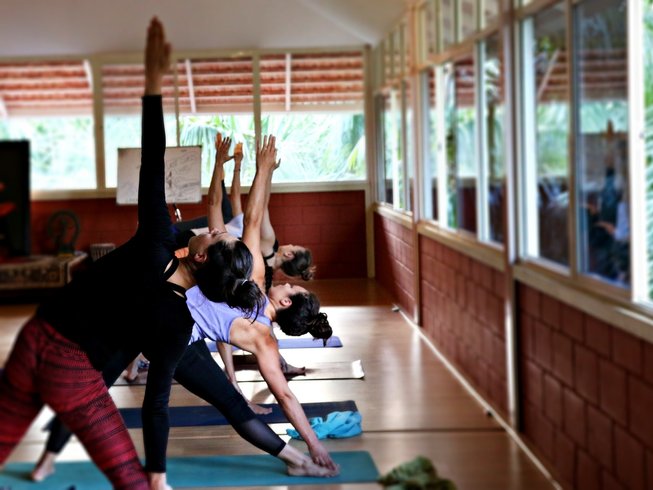
This is a residential intensive yoga teacher training in the Ashtanga Yoga Primary Series at Samyak Yoga Ashram, one of the best-rated yoga teacher training destinations near Mysore, India. With serene nature around, private and twin-sharing accommodations, and Ayurveda-based delicious food, Samyak Yoga Ashram can assist you in refining your skills of practicing and teaching Ashtanga yoga.
Rencontrez les professeurs
En savoir plus
Particularités
- Éligible à l’inscription auprès de Yoga Alliance à l’issue de la formation
- Cours quotidiens de la série primaire d’Ashtanga
- Pratiques traditionnelles de méditation et de pranayama
- Apprendre à enseigner le yoga Ashtanga de manière systématique
- Apprendre auprès de l’institut de yoga primé et le mieux noté
- Accompagnement après la formation de professeur de yoga
- Transfert depuis l’aéroport international de Bengaluru (BLR) inclus
- 25 nuits d’hébergement avec repas ayurvédiques quotidiens et pauses thé
Niveau de pratique
- Intermédiaire
- Avancé
Styles
25 jours de cours en Anglais
 Nombre moyen d’heures d’activité par jour : 9.25
Hébergement
Installations
- Coin repas
- Jardin
- Cuisine
- Yoga shala
- Superette/épicerie
- WI-FI gratuit
- Planche à repasser
- Service de blanchisserie
Accommodations at Samyak Yoga Ashram are built with the requirements of yoga teacher training students' needs in mind. There are 20 well-equipped rooms. All of them are supported with attached washrooms and Western closets. The accommodations also have a 24/7 hot water facility and are Wi-Fi-enabled.
All rooms have attached balconies with a serene view of the sugarcane fields and palm trees with parrots, peacocks, and monkeys around.
Private accommodation
There are 12 private (single) accommodations available for yoga teacher training students. These are situated on the first floor of Yoga Dhama, the main building of Samyak Yoga Ashram.
Twin-sharing accommodation
There are six twin-sharing accommodations available, accommodating 12 students in the yoga teacher training program. These are situated on the ground floor of Yoga Dhama, the main building of Samyak Yoga Ashram.
All rooms include...
- Wi-Fi - Wi-Fi is available in all rooms with a 200 Mbps speed
- Laundry services - The in-house laundry services are available at an extra cost
- Hot water - All rooms have a 24/7 hot water shower facility
- Table and chair - All rooms have tables and chairs for the study, with adequate space for yoga practice
- Attached washrooms - All accommodations have attached washrooms with Western closets
- Cupboards - There is a minimalist cupboard to organize your clothes with a locking facility
Facilities
- Private accommodations / twin-sharing accommodations
- Attached washrooms with Western closet
- 24-hour hot water
- Wi-Fi
- Study area
- Laundry facility
Be advised
There are no mosquito nets in the accommodations. You can use mosquito repellents such as Odomos if necessary. However, you don’t need to expect a lot of mosquitoes as the place is highly hygienic. The accommodations are spacious enough to practice and prepare for your classes in.
Laundry service
- 2,000 INR / 30 EUR / 30 USD
You will make a refundable deposit at the beginning of the training, and a nominal fee will be deducted, and the remaining will be refunded at the end of the training.
Programme
Certification
Students who complete the training are eligible to register with Yoga Alliance as Registered Yoga Teachers (RYT®).
Yoga teacher training course (YTTC) certification process
This Ashtanga Vinyasa YTTC is a Yoga Alliance-certified 200-hour program. The course structure follows standards set by the Yoga Alliance. To complete the course, you will have to pass the examination. After successfully completing the training, you will be a 'Registered Yoga Teacher (RYT).'
If your knowledge is inadequate to become a yoga teacher, you might not receive the certification. You also might not receive the certification if you miss more than three sessions (not three days) during the training. In this case, you will get the participation certificate, not the teacher training certificate. You will have time to rework and complete the assignments to receive the 'Yoga Teacher Certification.'
- Traditional Ashtanga Vinyasa primary series practice
- Asana clinic, which includes a detailed understanding of every asana with alignment cues, variations, usage of props, Vinyasa Krama, and the art of hands-on adjustments
- Traditional pranayama and meditation practices
- Yoga philosophy (definitely life-changing perspectives)
- Theme-based asana practices
- Intuitive understanding of the sequencing of Ashtanga yoga
Eligibility for this training
The Ashtanga yoga teacher training is not suitable for complete beginners. If you have limited experience with asanas and are looking for a program that provides a comprehensive immersion, then this training may not be the right fit for you.
If you've dedicated yourself to consistent practice on the mat for an extended period, ideally a year or more, and you're now eager to take your yoga practice to the next level, then this course is tailor-made for you.
Who can apply?
If you are interested in deepening the practice and possibly planning to take this passion for teaching Ashtanga Vinyasa yoga as your profession, then this course is for you. This residential intensive training expects you to be completely dedicated to the practice and philosophy. If you are just interested in some practice and are not serious about learning, then this training is not for you.
Course syllabus
This course focuses on the practice and teaching methodology of the primary series of Ashtanga Vinyasa yoga. The primary series includes over 70 asanas (postures), linked sequentially by Vinyasa (breath-initiated movements between the asanas).
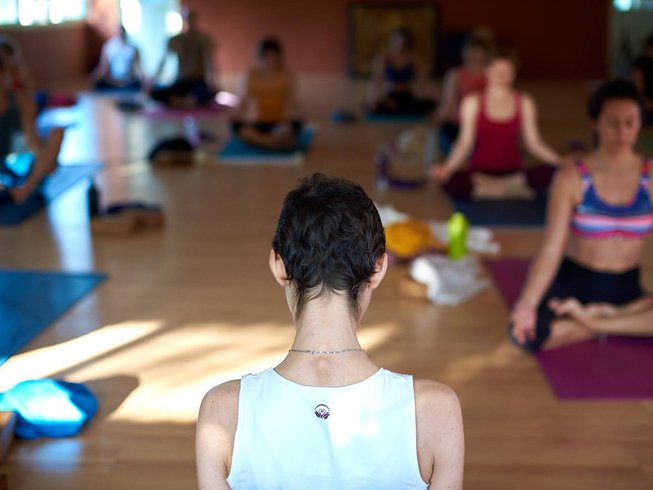
The course begins with detailed instruction of the primary series practice in the first two weeks and then continues with a morning Mysore style in the third week of the yoga training.
The fourth week gives an opportunity for the trainees to teach the Ashtanga primary series to the entire group of trainees, through which the trainees get ready to teach Ashtanga yoga and spread the wisdom of yoga, light, and love around the world.
Traditional practice
To practice a particular pose in-depth, one needs to know the intelligent way of using the muscles, the appropriate way of breathing, the meditative state of the mind, and the spiritually rooted soul. The practice of postures is a moving meditation.
In the session “asana clinic,” you will try to explore the concepts on which a particular posture is developed, how it can be practiced on a deeper level, as well as the benefits and contraindications. Samyak Yoga will also discuss the usage of props, the balance between strength and flexibility, and so on.
Sanskrit names and Tristhana practice
The Sanskrit names of the postures will be explained elaborately, and how to teach an Ashtanga Led yoga class effectively will be evaluated in detail.
The benefits of the specific sequencing and the principles of Vinyasa (the movements between postures), ujjayi pranayama (the sound-induced breath), drishti (the gaze), and bandhas (the three locks or seals), are included as essential elements of the practice and teaching of Ashtanga yoga during the course.
Traditional Ashtanga Vinyasa
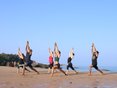
Practice and explore the traditional Ashtanga primary series during the 200-hour Ashtanga YTTC. With its Vinyasa Krama, tristhana, the traditional Ashtanga practice becomes a transformational process within.
Vinyasa Krama
The most significant and hardest aspect of the Ashtanga Vinyasa tradition is its Vinyasa Krama. There is a specific count for every asana. During the training, you will work on exploring the Vinyasa counts of every asana of the primary series.
Asana clinic
The practice of asanas makes proper progress when practiced safely and with an understanding of its subtle aspects. During the asana clinic, you will explore these subtle techniques, how to practice Ashtanga without any injuries at different levels, and how to deepen the practice.
Yoga anatomy
You will have an introduction to yoga anatomy, in which you will discuss the anatomical aspects of yoga practice. It is important to know how to engage / relax the muscles, deepening the stretches yet not injuring yourself physically, and so on. It is also important to understand the structure of your respiration to improve the quality of breathing by pranayama techniques.
Ayurveda for yoga teachers
Why study Ayurveda for yoga teachers? Whether you like it or not, as you become a yoga teacher and take this journey forward, you will always be asked what to eat, when to drink water, and what food can go with the other type of food. The Internet is flooded with so many different concepts that people get more confused instead of getting clarity. While in the training, you will look into food and daily life from an Ayurvedic perspective.
It is also important to understand the body types, such as 'vata, pitta, and kapha types,' so that you can understand yourself well, which is deeply connected to the way you practice asanas.
Yoga philosophy
Philosophical sessions cover a variety of fundamentals such as Yoga Sutras, nadis, chakras, origin and evolution of yoga philosophy, etc.
Pranayama and meditation
You will not only practice pranayama, but teach, too. As an Ashtanga teacher, you should be able to teach pranayama too.
Kriya practices
During this Ashtanga YTTC, you will practice jala neti, kapala bhati, and trataka. Kriyas will help you in cleansing the system.
Theme-based practices
Some theme-based practices, such as Yin yoga, backbends, etc., will help you in preparing for your Ashtanga practice.
What is Ashtanga Vinyasa yoga?
Ashtanga Vinyasa yoga is a method of yoga developed by Sri T Krishnamacharya and Sri Pattabhi Jois, wherein the asanas are practiced in a specific order. It is not just the sequence of asanas put together. Rather, every single asana has its own specific sequence to follow. This method of practice is called "Ashtanga Vinyasa Krama."
What is the thristhana practice?
Thristhana is a three-fold practice element in Ashtanga Vinyasa yoga, wherein the specific asana, breath, and drishti lead the practice. This three-fold practice is a traditional way of practice, leading to the practice of bandha to dhyana at later stages.
Teacher training approach
The entire course is designed to follow the Ashtanga Vinyasa yoga primary series. If you are looking for fitness-based flow or some dance form-based modern flow practices in the name of Ashtanga Vinyasa yoga teacher training, then this course is not for you.
Graduates
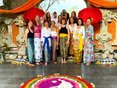
You can meet the recent graduates of Samyak Yoga's teacher training courses, from India, and also outside the country. This institute is established not only for Europeans. You will be treated as a student, not a customer / traveler, but only a seeker. This ashram is a place for seekers of yoga who are looking for genuine, authentic yoga practice and philosophy.
Awarded yoga institute
Samyak Yoga has been recognized with honors, such as Best Yoga Teacher Training Institute and Best Eco-Friendly Yoga Center. They are also proud to be consistently awarded TripAdvisor’s Travellers’ Choice - 2025, reflecting the trust and love of the global yoga community.
What you should know before you get registered:
- All classes are mandatory.
- This course is intensive. You need to have a regular practice three to four times per week for up to three to six months prior to the course start.
- Yoga is not a competition; respect your body.
- The course covers a 200-hour Yoga Alliance certification. Therefore, except in the case of severe illness, students cannot skip any class.
- Obtaining yoga certification will depend upon ethical yoga behavior and successful completion of the theoretical exam and the written exam. However, if a student was not able to participate in all classes, only a participation certificate will be provided.
- During the group practice, students can lead their class in their own language, such as Spanish, French, Italian, Japanese, etc.
- The ashram is eco-friendly. Do not bring any plastic bottles or plastic bags. Bring your own eco-bottle. Filtered RO water will be provided at the ashram. Please respect the collection of waste; do separate paper and tea bags from organic waste.
- Bring your own yoga mat and belt.
- Bring your own towel for the shower.
During this training, you will be working on the traditional practice of the Ashtanga yoga primary series.
This includes understanding the intuitive sequencing of the Ashtanga primary series, the Sanskrit names of asanas, tristhana practice, Vinyasa Krama, modifying the primary series for different levels without losing the tradition, the art of hands-on adjustments, etc. You will also build your self-practice of Ashtanga yoga, popularly known as “Mysore style.“
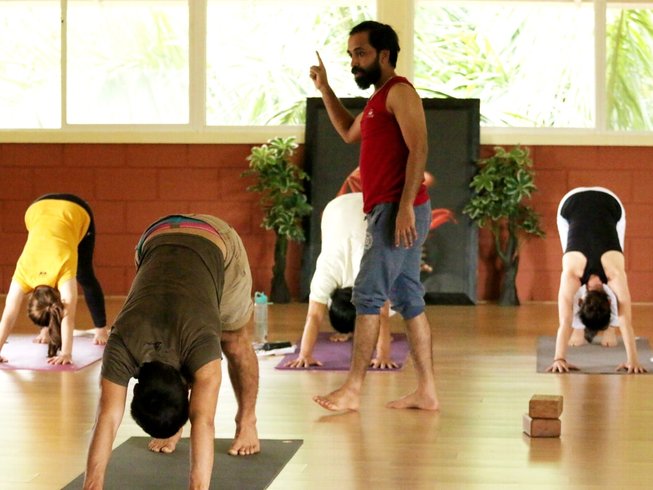
Besides, you will be teaching from Day 2. As you teach every day under the guidance of the lead teachers, along with the feedback, it will refine your knowledge and skills, as well as steadily build the Ashtanga yoga teacher within.
The training focuses on tristhana practice and Vinyasa Krama of the Ashtanga yoga tradition. Therefore, you are advised to keep a regular practice before you arrive at the training at Samyak Yoga.
Tradition
You will be practicing Ashtanga, with its Vinyasa Krama and tristhana practice. You will also be working on the Mysore method of Ashtanga traditional practice. These methods of practice will assist you in building your practice of Ashtanga comprehensively.
Traditional teachers
Samyak yoga teachers have learned the practice and philosophy of yoga from the Gurukula system of education, wherein the study of yogic wisdom is in Sanskrit, from the roots, not the translations under Acharya Ramachandra Bhatt.
Teaching every day
During this training, you will be teaching every day under the guidance of the teachers. This practice will get intense every following week and will bring out the teacher within you.
Meditation
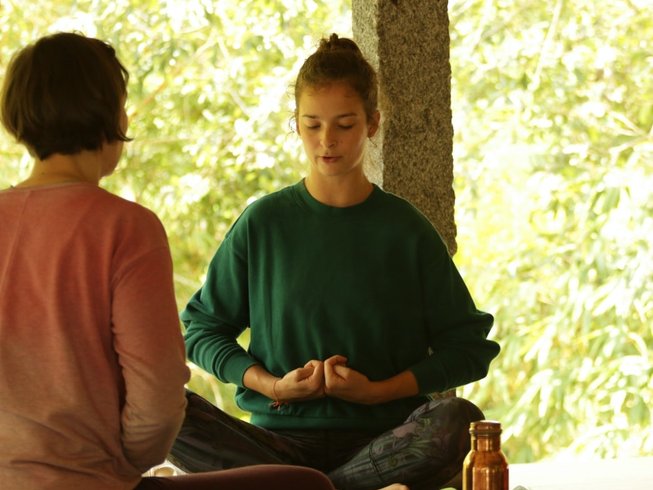
You will also be required to build your meditation practices. During the training, you will be practicing and learning how to teach meditation to become a better yoga teacher.
Pranayama and kriya
During the training, you will be exploring the techniques of practicing pranayama. You will also be teaching them so that you will be able to refine the skills of a better Ashtanga yoga teacher.
Yoga ashram
Samyak Yoga Ashram is situated on the outskirts of Mysore, on the banks of the Cauvery River. You will be entirely focused on practicing and teaching Ashtanga yoga, without distractions.
When to register for the training?
It is always better to register at least five to six months before the training begins. The 200-Hour Ashtanga YTTC at Samyak is not something you book and simply show up for. It is an intensive, residential immersion that requires physical stamina, mental steadiness, and readiness to study and reflect.
Early registration is not just about reserving a seat. It is about preparing properly. Once you register, you will receive access to Samyak Kulam and can begin preparatory practice and study. Samyak Yoga strongly recommends at least one hour of practice, five to six days a week, for a few months before arrival.
This preparation builds consistency and inner discipline. Students who register early arrive more grounded and absorb the training more deeply. Early registration is the first step of your journey.
Purvabhyasa on Samyak Kulam: Pre and post-YTTC support
A YTTC is not a retreat, but an intense, professional training that needs preparation beforehand. But then, how can you prepare before the training begins?
Once the preparation fee is paid, you will get access to Samyak Kulam. This will allow you access to 'Purvabhyasa - Preparation for Yoga Teacher Training.' This includes videos, audio files, PDF charts, tips for packing for the training, etc. This 'Purvabhyasa' is accessible once the registration fee (preparation fee) is paid.
Even after the training, you will have access to frequent online practice classes and weekly philosophy classes. Ask and get motivated with the Samyak community of over 3,000 yoga practitioners across the world.
Your teachers in training
At Samyak Yoga, their teaching team is a blend of tradition and modern clarity. Each teacher has lived the yogic path through years of study in gurukulas and daily practice, bringing depth, precision, and heart into every class. Together, they offer not just techniques, but also the spirit of yoga - rooted in wisdom, refined by experience, and shared with joy.
Recommended reading
- Yoga Mala: The Original Teachings of Ashtanga Yoga Master Sri K. Pattabhi Jois by Sri K. Pattabhi Jois
- Autobiography of a Yogi (Self-Realization Fellowship) by Paramahansa Yogananda
- Light on Pranayama by B.K.S. Iyengar
- Light on Life: The Yoga Journey to Wholeness, Inner Peace, and Ultimate Freedom by B.K.S. Iyengar
- Health, Healing, and Beyond Yoga and the Living Tradition of T. Krishnamacharya by T. K. V. Desikachar
Days off
The 7th, 14th, and 21st of the month are days off for the classes. You can go shopping / booking massages, as well as visiting in and around Mysore.
Dinacaryā: Tentative timetable
- 06:00 - 07:30 Traditional Ashtanga yoga practice
- 07:30 - 08:30 Pranayama and meditation practices
- 08:30 - 09:30 Breakfast break
- 09:30 - 10:45 Yoga philosophy sessions
- 10:45 - 11:00 Herbal drink break
- 11:00 - 12:00 Asana clinic
- 12:00 - 13:00 Teaching methodology
- 13:00 - 16:00 Lunch break
- 16:00 - 17:30 Asana clinic and theme-based practices
- 17:30 - 18:00 Break
- 18:00 - 19:00 Yoga anatomy, Ayurveda, and kirtans
- 19:00 - 20:00 Dinner
- 20:00 - 21:30 Svadhyaya time
- 21:30 Lights off
Professeurs
Yogacharya Rakesh
Yogacharya Rakesh was first introduced to the practice and philosophy of the yoga in Veda Vijnana Gurukulam by Guruji Dr. Ramachandra Bhatt. He obtained a bachelor and masters in Sanskrit along with the study in Veda Vijnana Gurukulam and completed Masters in Yogic Sciences, Bangalore. He was awarded for the best presentation in the Master's study in Yoga and trained the students of Ayurvedic Medicine in Sanskrit. Yogacharya Rakesh is a teacher and student of Yoga School of philosophy along with Advaita Vedanta Philosophy of Acharya Shankara.
Lieu
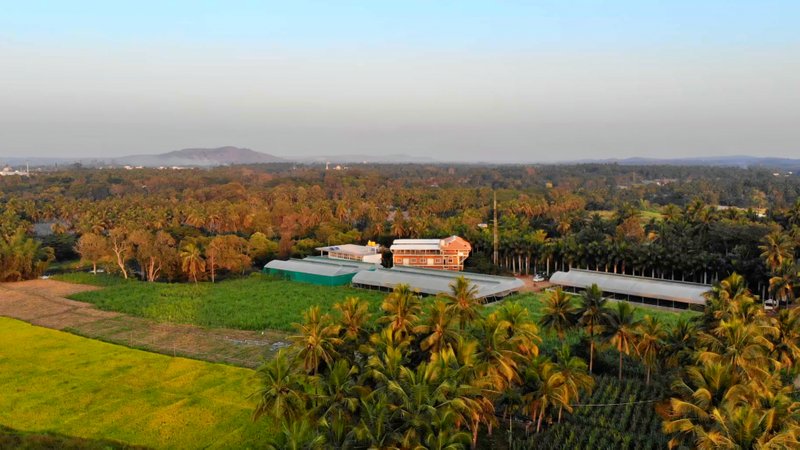
Situated on the banks of the Cauvery River, Samyak Yoga Ashram offers a structured, rooted in Ashtanga tradition, four-week-long training in Ashtanga yoga. This entire ashram is situated on the banks of the Cauvery River. It has palm trees, paddy fields, sugarcane gardens, mango, and jackfruit trees.
There is a small island where you can sit and deepen your meditation in front of the divine River Cauvery. You can relax and introspect during your leisure time. The river and this tiny island have given a completely transforming and soul-awakening perspective to the ashram and its activities.
Samyak Institute of Yoga & Ayurveda is located on the bank of the Cauvery River, engulfed by paddy fields, sugarcane fields, organic farming, etc. They are 20 kilometers away from Mysore City, in a calm, serene atmosphere that is completely focused on the practice and philosophy of yoga.
Nearby places
- Kempegowda International Airport (BLR), 170 kilometers
- Cauvery River - 6 minutes

Caractéristiques
Équipements
- Coin repas
- Jardin
- Cuisine
- Yoga shala
Services
- Superette/épicerie
- WI-FI gratuit
- Planche à repasser
- Service de blanchisserie
Repas
Know more about food
Yogic Indian food served during the yoga teacher training is suitable for students' yoga practice and helps detoxify the body for yogic practices. Besides nutritional value, Samyak Yoga loves to give a glimpse of the local food taste of Mysore.
They don’t offer meat, fish, and eggs, which are considered stimulating / lethargic for yogic practices. The yogic food is seasoned with mild spices, which are part of the Ayurvedic diet. All food is prepared with filtered water at Samyak Yoga's clean and spacious kitchen, where they give utmost importance to the hygiene of all the food items and cooks.
Students with a preference for vegan and gluten-free diets can comfortably manage there. You will have brown bread, muesli, and cornflakes with fruits for breakfast, while lunch and dinner include salads, vegetables, lentils, beans, rice, and wheat items, soups and desserts on occasion.
They designed the menu to calm the body down while you are undergoing detoxification during the intensive practice / course, which generates a lot more heat in the body and mind, and is beneficial to the intense yoga practice. All foods will be served buffet-style, and you can take as much as you want to.
Be advised
Food will be prepared based on Ayurvedic concepts such as vata, pitta, and kapha doshas. The food will be strictly vegetarian. However, the students can opt for vegan food or gluten-free food. The chef there can also make some changes to the food in case of any specific allergies.
Food served during the training
- Brown rice, green salad, and kheer
- Masala dosa
- Green salad with rice
- Roti and nuts curry
- Idly with salad
- Rice and veggies
The factors involved in the making of the food
The ingredients
The quality of the fruits, nuts, and vegetables is used to have an impact. Everyone should be well aware of the source of the food. Hence, at Samyak Yoga Ashram, they directly bring the ingredients from the local farmers.
The preparation
The process of making the food is a significant part, too. The chef, while preparing, should be happy. The mind involved in the preparation of the food influences the outcome.
The concept behind
The food will be prepared based on the type of yoga practice involved. You should have all three qualities of Ayurveda, i.e., vata, pitta, and kapha, in the food proportion. The food menu will be created in such a way that is delicious and nourishes all system dimensions.
The consumption
The way of eating the food is also significant. At Samyak Yoga Ashram, participants all sit together like a family and enjoy the food. When shared with others, the heart opens and helps in bringing energy and light within. Eating together is one of the best ways to connect with others. During your mealtime, you will connect, laugh, share stories, and often practice silent meals too.
Tentative food schedule
- 08:30 Breakfast includes fruits, muesli, cornflakes, brown bread, etc.
- 11:15 Tea break for Indian masala chai, black coffee, black tea, or herbal tea
- 13:15 Lunch includes salads, dosa, upma, idly, or vegetable dishes, along with a rice variety, fruit juice, and dessert
- 18:00 Tea break for Indian masala chai, black coffee, black tea, or herbal tea
- 19:30 North Indian dishes such as roti or kathi roll; Chinese popular dishes such as gobi Manchurian, noodles, etc., with a variety of soups offered every day
Students with low blood pressure are advised to bring extra iron or mineral supplements. Samyak Yoga Ashram provides drinking water purified with RO filters, the best possible filtration in India. Please bring a water bottle to fill up anytime at the dining or the yoga shala.
Les repas suivants sont inclus:
- Breakfast
- Lunch
- Dinner
- Drinks
Les boissons suivantes sont comprises:
- Eau
- Café
- Thé
Les régimes alimentaires suivants servis et/ou pris en charge :
- Végétarien
- Vegan
- Sans gluten
- Yogique
- Ayurvédique
Activités et lieux à visiter
There is a small island wherein you can sit and deepen your meditation in front of the divine river, Cauvery. You can relax and introspect during your leisure time. The river and this tiny island have given a completely transforming, soul-awakening perspective to the ashram and its activities.
Ce qui est inclus
- Éligibilité à l’inscription auprès de Yoga Alliance à l’issue de la formation
- Pratique quotidienne traditionnelle de la série primaire d’Ashtanga yoga
- Pratique de l’enseignement à partir du Jour 2
- Pratique quotidienne traditionnelle de la méditation et du pranayama
- Apprenez à pratiquer la série primaire complète d’Ashtanga yoga
- Étude des Yoga Sutras, des chakras - nadis, etc., avec Yogacharya Rakesh
- Accès à 'Samyak Kulam' pour vous préparer à la formation
- Accompagnement après la formation - sur Samyak Kulam
- Manuel de formation de professeur d’Ashtanga yoga
- Vêtements yogiques Samyak Yoga
- Kit de kriya yoga
- Journal de formation en yoga et un stylo
- Accès Wi-Fi
- Transfert depuis l’aéroport international de Bengaluru (BLR)
- 25 nuits d’hébergement
- 3 repas ayurvédiques quotidiens
- 2 pauses thé quotidiennes
- Toutes les taxes comprises
Ce qui n'est pas inclus
- Billet d’avion
- Transport à la fin de la formation
- Frais de blanchisserie
Comment se rendre sur place ?
Aéroport recommandé
Transferts inclus
Kempegowda International Airport
À 142 km de votre destination
Arrival by plane
Please book your flight to arrive at Bangalore International Airport, or Kempegowda International Airport (BLR). The transfer from this airport is included in the price.
The distance between the airport and the institute is 170 kilometers. Share your flight details, such as flight name and number, as well as the date and time of your arrival. The taxi will be arranged by the institute, and the journey is about two to three hours.
Arrival by train
Samyak Yoga can arrange the transfer from the Mysore train station as well.
Arrival by car
You can also arrive anywhere in Mysore, and Samyak Yoga can arrange the transfer from Mysore.
Conditions d'annulation
- Pour réserver, un dépôt de garantie correspondant à 20% du prix total est requis.
- Le dépôt de garantie est non-remboursable si vous annulez votre réservation.
- Le reste du paiement est dû à votre arrivée.

Avis
Pas encore d'avis disponible
Pour cette offre, vous pouvez effectuez votre réservation sur BookYogaTeacherTraining.com. La plupart des cartes de crédits sont acceptées.
Des Formations de professeur de yoga similaires que vous pourriez aimer
Vous avez récemment consulté