
24 Day 300-Hour Yoga Teacher Training in Vinyasa and Yin Yoga in Evia Island, Greece
Intensive Yoga Teacher Training in Greece
This 300-hour Vinyasa Flow Yoga Advanced Teacher Training in Greece course is an intensive program designed to deepen your already existing knowledge and foundations of yoga. You must have already completed a 200-hour yoga teacher training course in any style to be eligible for this course. Teaching experience is not mandatory, but it will enhance your overall experience and absorption of techniques into practice. Classes are in session from Monday to Saturday, with Sundays off for rest.
Meet the instructors
Highlights
- Eligible to register with Yoga Alliance upon completion
- Applied philosophy
- Workshops on advanced asanas
- Sequencing for different levels of students, adjustments, alignment, and applied anatomy
- Dynamic Vinyasa yoga classes in the morning,
- Yin, Restorative, yoga Nidra in the afternoons, so you can relax and wind down
- Delicious breakfasts, afternoon snacks, and dinners for all days
- 23 nights accommodation in clean rooms
Skill level
- Intermediate
- Advanced
Types
23 days with instruction in English
 Average daily hours of activity: 9
Accommodation
Facilities
- Swimming pool (outdoor)
- Air-conditioned rooms
- Terrace
- Free Wi-Fi
This yoga training in Greece will take place at a serene retreat center on Evia island. Eco Filion Suites and Hotel is a retreat center amphitheatrically built near a waterfront village on Evia Island. Constructed and designed with bioclimatic principles and an ultra-low carbon footprint, the hotel prioritizes the correct temperature, humidity, and ventilation. It provides clients with tranquility and privacy.
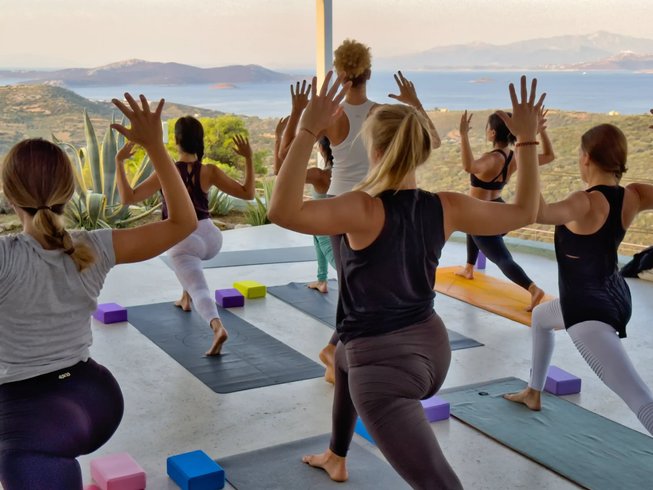
The yoga studio offers an undisturbed, stunning view of the Gulf of Evia, allowing you to practice and study yoga while gazing at the sea. Waking up to this view every day is truly a dream come true. And why not finish your yoga classes by jumping from Shavasana straight into the spacious swimming pool? Perfect for taking long laps or just a refreshing dip.
The retreat center offers single, twin, triple, and quadruple rooms. All rooms include a thermostatic air conditioning unit and Wi-Fi. Your en-suite bathroom has a rain shower and a powerful hairdryer. Spacious balconies offer either sea or garden views. Roommates will be assigned to all shared rooms unless otherwise requested. Shared rooms can be mixed genders.
Program
Certification
Students who complete the training are eligible to register with Yoga Alliance as Registered Yoga Teachers (RYT®).
This 300-hour yoga teacher training is registered with Yoga Alliance U.S.A. and Yoga Professionals U.K. It focuses on 4 educational categories:
- Asana practice: You will practice Dynamic Vinyasa Yoga in the mornings.
- Teaching skills and adjustments: You will start teaching from day one and practice hands-on adjustments with your fellow students. The teachers will give you constant feedback so that you can improve every time.
- Yoga philosophy: While the asana is all about how to do yoga, in philosophy, you will finally go deep into the why behind it.
- Functional yoga anatomy: This module will help you understand sequencing, how your body moves, and how your students' bodies move in the postures. It will also help you create safe and sustainable yoga classes for your students.
300-hour YTTC in Vinyasa and Yin Yoga: prerequisites
This 300-hour yoga teacher training in Vinyasa and Yin Yoga, located in Europe, Greece, is a 23-day in-person, all-inclusive intensive course designed to deepen your existing knowledge and practice of yoga. It includes supplementary video content for pre-course preparation and subsequent independent study.
To join this course, you must have completed a 200-hour yoga teacher training in any yoga style (Alpha Yoga School may consider exceptions to this rule on a case-by-case basis).
At Alpha Yoga School, they recognize that growth and knowledge are ongoing processes and teaching yoga involves continuous development. They aim to connect with you at your current level and work effectively on your yoga practice and teaching skills.
Who is this 300-hour YTT for?
This advanced program is intended for those committed to advancing their yoga journey, whether for personal insight or to teach professionally.
- Current yoga teachers: Those looking to deepen their knowledge, improve their teaching skills, and practice teaching.
- Serious practitioners: Experienced yogis who want to deepen their asana practice, get inspired, and be challenged.
- Specialized training: Participants interested in exploring different styles of yoga than those studied in their 200-hour YTT.
- Personal growth: Individuals seeking personal transformation, self-discovery, and a community of like-minded people. Learning how to integrate yogic principles into everyday life, to live a more fulfilling life off the mat.
What is the difference between a 200 and a 300-hour YTT?
A teacher training is to a yoga teacher what a paintbrush is to an artist. It is a tool. A 200-hour training is similar to a broad brush or even a roller. It is the perfect tool to cover a large surface in a relatively short amount of time. The goal of a 200-hour YTT is to touch on the main pillars of yoga without diving too deep or getting too confusing.
A 300-hour advanced yoga teacher training allows you to narrow in on nuance, focus on details, and hone in on the specifics. A 300-hour training is like a finer paintbrush. Designed for detail. The type of brush that allows you to get into the corners and explore the edges.
The 300-hour YTT is simply the next level. Students who join it have a better understanding of what they do not know. They are more realistic and less idealistic about their chosen careers. This is a program for yoga practitioners to advance their yoga practice and/or teaching careers.
Morning Vinyasa classes
In this 300-hour yoga teacher training, you will practice dynamic, powerful Vinyasa Flow classes to deepen your practice. These classes are intended to build strength in the body and utilize existing flexibility for deeper posture variations. Emphasis is placed on incorporating topics from workshops.
Students will also become acquainted with creative, intelligent sequencing and decoding anatomical principles across asana families, which will help them arrive at deeper, more advanced posture variations.
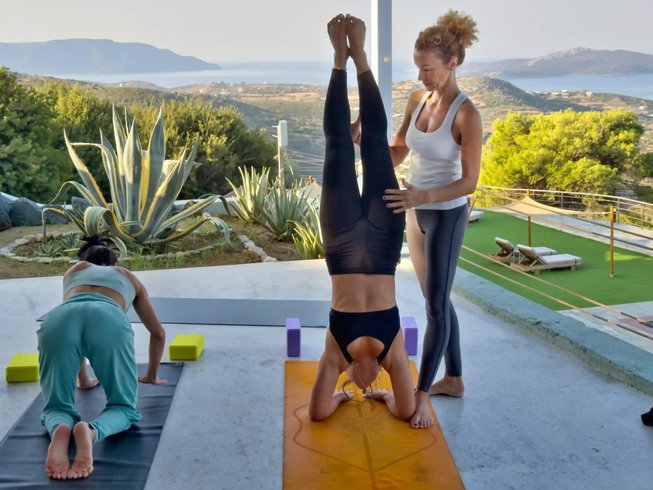
Above all, proper practice and spotting techniques of advanced inversions will be applied in the morning classes when necessary.
Teaching skills and practicum
You will integrate knowledge and principles discussed in alignment classes to adapt your manner, body language, tone, words, and public speaking to fit your audience’s needs and requests. Define and refine your teaching voice. They are not into creating a cookie-cutter monologue about how and what teachers should say in their classes.
You will teach in small groups every day and observe, analyze, and assist in other students’ classes. You will receive constructive feedback from both the other students and your teachers.
Topics include:
- Identifying your dominant learning style: how to teach based on other learning styles.
- Communication skills: include group dynamics, time management, and establishing priorities and boundaries.
- Specific needs of individuals and cultures: how can they be addressed to the greatest degree possible in a group setting?
- Speech patterns: active vs. passive language and the effective use of each; positive and conscious communication; habitual speech and communication patterns (filler words)
- Principles of demonstration: demonstration techniques, observation, assisting, and correcting.
Alignment and hands-on adjustments
Learning how to organize the body to allow safety in the deepest expressions of asanas. The deepest expression is not the ‘most advanced’ shape of a pose but the breath and concentration required to practice it. Therefore, you explore this "deeper" expression through a dual approach of understanding safe and effective alignment for different bodies and basic biomechanics for functional movement, as well as how to adjust postures for healing, as well as for depth.
Much of your time will be spent expanding your knowledge of asanas while paying attention to key alignment and anatomical structures. This will help you deepen your own practice and, secondly, guide others safely into poses verbally, visually, and physically.
Topics include:
- Alignment principles: for postures grouped by the foundation so that you can create yoga sequences that flow easily from one pose to another (standing, seated, all 4's, hands, etc)
- Learning the five categories of asanas: standing poses, forward bends, backbends, twists, and inversions) and the key poses and alignment principles in each category
- Developing alignment maps: For each of the five categories of asanas, find a resemblance in the foundation, learn how to build upon this foundation, and create ideal transitions.
- Physical benefits and cautions for yoga postures
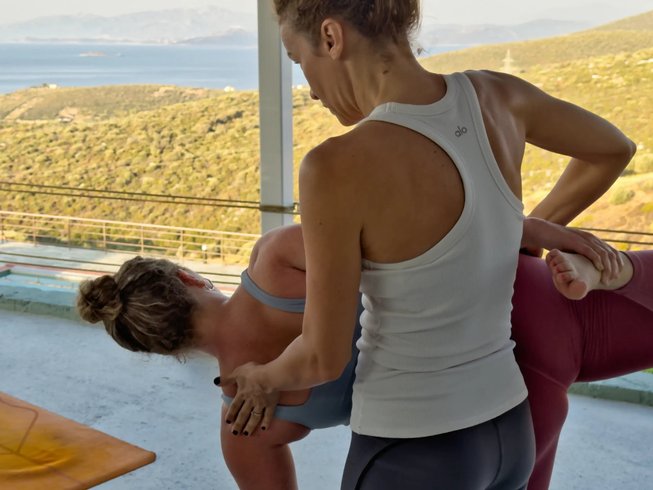
- The art of touch and adjustment: Theory, clarifying when to adjust, how to adjust, and mainly when not to adjust. Advanced assisting – hands-on and verbal.
- Safe spotting techniques: For deeper inversions, so that you can assist your students with confidence.
- Creating sequences: Develop mini-flows based on alignment principles and through correct transitions between asanas. Anatomical sequencing and working towards a peak pose / pathway sequencing.
Sequencing
Anyone can teach yoga and put random asanas next to each other. Actually, many teachers do just that. Great sequencing is an art. It shows your unique understanding of what an amazing class can look like. Although people initially come to your class to discover yoga, they will eventually return because of your sequence, what you say, how you say it, and your understanding of the practice. Great sequencing, along with hands-on adjustments, will have a real impact on your students' practice and make them come back for more.
Workshops
Advanced posture workshops
- On arm balances, forearm stand, headstand, handstand, chaturanga dandasana, and backbends.
- You will learn how to recognize when the body is ready to attempt them, how to progress in practicing, and, if you choose, how to teach them to others.
Yin yoga module
- Understanding Yin yoga: Through experiential and theoretical classes, you will explore the philosophy and principles of Yin yoga, and how and why it contrasts with more dynamic styles. You will also learn how to use it to promote relaxation, deep meditation, nervous system downregulation, and deep stretching across connective tissue.
- Key postures and alignment: Learn foundational yin yoga postures and the key principles of how to practice them in the yin tradition effectively.
- The science of stretching: Discover the anatomical, physiological, and energetic aspects of yin yoga, including how sustained stretches influence connective tissues, joints, and energy flow in the body.
Anatomy
You focus on an experiential and engaging breakdown of the human body as it relates to yoga practice. You won’t just sit there and take notes; you will learn how to directly apply this essential information to your practice and your teaching.
You explore a deeper understanding of anatomy and physiology modalities from Eastern and Western medicine and their applications to traditional yoga philosophy. You strive to understand the body and the practice so that you can understand how to apply the practice to each individual with any style or level of understanding to create personalized, functional, and safe classes to bring students to their deepest mind-body edge.
Topics include:
- Practical applications of anatomy: In specific yoga postures with a major emphasis on muscular and skeletal structures and in-depth study of anatomical and skeletal differences (i.e., compression, tension, proportion, and orientation theory), Comparative anatomy, and understanding different body types.
- Focus on the four systems that allow and restrict movement: The skeletal, muscular, nervous, and connective tissues. Conduct sectional studies of specific joints of the body, such as the hip, knee, foot, spine, and shoulder.
- Scapular stability: The strength in deeper arm balances and inversions.
- Role of fascia in flexibility: Yin yoga theory and basic meridian theory. Basics of Thai massage and relationship to meridian theory.
- Breathing and respiratory system: The role of breath in asana.
- Therapeutic applications of postures: Working with injuries in an asana class.
Philosophy
This Advanced TTC will help you move from understanding to living yogic philosophy by providing practical tools from ancient yoga scriptures.
- Branches of yoga: You will dive deep into the six branches of yoga, understanding the roots, different limbs, and aims of Hatha, Raja, Kriya, Bhakti, Karma, and Jnana Yoga. Emphasis will be placed on Raja Yoga, the king of all yogas, and its treasure-house of mind-management techniques.
- Chakras and Koshas: The Koshas, chakras, and nadis will finally make sense to you, as they will all be linked to the branches and to pranayama and meditation practices.
Yogic lifestyle will no longer be restricted to certain hours of self-practice, the food you eat, and the clothes you wear - it will be integrated into every moment of your life. You will leave the course with a whole new knowledge, spiritual and mental practices, and a lot of inspiration. The teacher will be transmitting all the knowledge she received from the 1500+ hours she spent at the ashram.
Meditation and pranayama
Advanced pranayama, Yoga Nidra, and meditation practices from ancient tantric traditions will be introduced to you in a very systematic and simple way, allowing you to experience moments of complete physical and mental stillness. After the course, you will take what you learned in meditation from the mat, out to the world, and you will be able to develop an unbroken flow of awareness throughout your whole day.
Prerequisites
The most important prerequisite to join this course is an open mind and an eagerness to learn. This makes an advanced student—a humble mindset, not cool poses. To make the most of this intensive course, the applicant must be healthy physically and mentally.
To join, you need to have completed a 200-hour yoga teacher training in any style (exception to this rule may apply on a case-by-case basis). Please read the blog on five reasons why every yoga teacher should take a 300-hour yoga teacher training.
Previous teaching experience is not mandatory; however, if you have taught yoga before, it will enhance your overall experience and allow you to apply the techniques more effectively in practice.
Basic English language understanding is required as this 300-hour yoga teacher training is conducted in English. Classes are in session from Monday to Saturday, with Sundays off for rest.
Daily schedule sample of the 300-hour YTT
- 06:30 - 07:20 Meditation, chanting, and pranayama
- 07:30 - 09:30 Dynamic Vinyasa flow practice
- 09:30 - 10:30 Breakfast
- 10:30 - 12:30 Anatomy / philosophy
- 12:30 - 13:30 Alignment, adjustments, workshops
- 13:30 - 15:30 Free time / snacks
- 15:30 - 17:45 Teaching methodology / sequencing / teaching practicum
- 17:45 - 18:00 Break
- 18:00 - 19:00 Asana practice / Yin yoga / sequencing / adjustments
- 19:00 - 20:00 Dinner
- 20:00 - 21:00 Satsang / free time / kirtan / chanting mantras
Instructors

Rachel Berryman
Coming from a background of 20 years of ballet and contemporary dance training, Rachel has always been interested in working with the body and the amazing capacity our bodies have. Rachel has been practicing yoga for 14 years and has taught over 5000+ hours of yoga classes and teacher training. Originally from the U.S.A., she has been a lead teacher in over 30 yoga teacher training courses worldwide and recent years split her time teaching yoga between India and Albania. Rachel is the co-founder, owner, and main teacher at Tirana Yoga Studio in Tirana.
Sandy Boutros
Sandy’s meditation journey began in 2012 after developing a keen interest in exploring the mind and its potential. After attending several yoga retreats with Swamis from Bihar School of Yoga, she decided to leave her advertising job, pack up her bags and go to their ashram in India for a 4-month course in advanced yogic studies, where she was exposed to all the branches of yoga and its philosophy and was able to develop and maintain a yogic lifestyle. Right after the yogic studies course, Sandy did her teacher training and kept going to the ashram for progressive trainings in Raja Yoga.

Leah Sugerman
With a strong focus on breath and anatomical integrity, Leah teaches vigorous yet accessible classes designed to cater to and meet the needs of each student. Her classes emphasize the beautiful dichotomy inherent in yoga: the contrast between the strength and power and the grace and surrender of the practice. She intends to challenge her students to promote both physical and spiritual growth, yet she encourages them to find their edge.

Sean Pepper Robinson
Originally advised to try yoga in 2014 to manage stress and heal his spine from BMX-related injuries, Sean found a sense of stillness and challenge. Upon completing his first training in India in 2017 he began teaching in Sri Lanka. Each year he would return to India for 2-3 months to assist (and eventually teach) at the same school where he received his certification. For the last 3 years, he has lived and worked in HK, teaching Yoga full-time. With a background in Ashtanga, Vinyasa, and Rocket his classes lean toward the dynamic. Sean emphasizes clarity of communication in his classes
Location
Alpha Yoga School is hosting this teacher training just two hours away from the Athens Airport. The retreat center is a five-minute drive or a six-kilometer walk from Nea Styra village, with mini markets, restaurants, coffee shops, a beach, a pharmacy, and everything you need.
Distances
- Nea Styra - 5-minute drive, 6 kilometers
- Athens Airport - 2 hours
- Other beautiful beaches - 10 to 15 minutes in a taxi

Food
Eco Filion's kitchen caters to all breakfasts, afternoon snacks, and dinners, even on your days off. Their chef provides fresh, natural vegetarian and vegan cuisine using only the finest local ingredients. Specializing in Greek and healthy dishes, their goal is to satisfy an array of palates through balanced nutrition. However, please keep in mind that this is not a health and wellness farm. The vegan, gluten-free, lactose-free, and any other special menu costs 100 EUR per person for the whole course.
The following meals are included:
- Breakfast
- Dinner
- Snacks
- Drinks
The following drinks are included:
- Water
- Coffee
- Tea
The following dietary requirement(s) are served and/or catered for:
- Vegetarian
- Vegan
- Gluten Free
- Lactose Free
- Other dietary requirements on request
What's included
- Eligibility to register with Yoga Alliance upon completion of the course
- Asana manual
- Tuition fees
- Lots of opportunities to teach yoga to your peers
- Experienced teachers, so you can learn from the best
- 23 nights accommodation in clean rooms with a terrace overlooking the sea
- Beautiful yoga studio with a sea view
- Rooms with sea view, terrace, A/C, mosquito net, and good quality mattresses
- Daily deliciously amazing breakfast, afternoon snacks, tea, coffee, and dinners, even on your days off
- Delicious Mediterranean food and desserts
- Certification of completion upon successful completion of the practical and written exam
What's not included
- Flights
- Lunch (If you want to buy food from the supermarket, estimate the cost of food for your stay. It could be worth 50-60 EUR for the whole stay)
- Transfer to and from the airport, but Alpha Yoga School can arrange this
- Travel Insurance
- Personal expenses
- Other activities, such as taxi to go to the beach on your day off. A taxi can cost 15 EUR for all passengers, one way. In general, taxis on the island are not expensive
How to get there
Recommended Airports
Transfer not provided
Athens International Airport (Eleftherios Venizelos Airport)
39 km away from your destination
Arrival by airplane
Book your flight to Athens Airport (ATH) on the first day of the course (land before 2 p.m.) and book your return flight on the last day of the course, taking into account that it takes 2.5 hours to get to the airport.
Arrival by shuttle
Group transportation from Athens Airport to the retreat center can be arranged by the organizer so that you can relax once you set foot at the airport. They usually arrange one or two shared minibusses for the students, depending on what time you arrive. The cost of transportation is not included in the price.
Cancellation Policy
- A reservation requires a deposit of 16.94% of the total price.
- The deposit is non-refundable, if the booking is cancelled.
- The rest of the payment should be paid 30 days before arrival.

Reviews
For this organizer you can guarantee your booking through BookYogaTeacherTraining.com. All major credit cards supported.