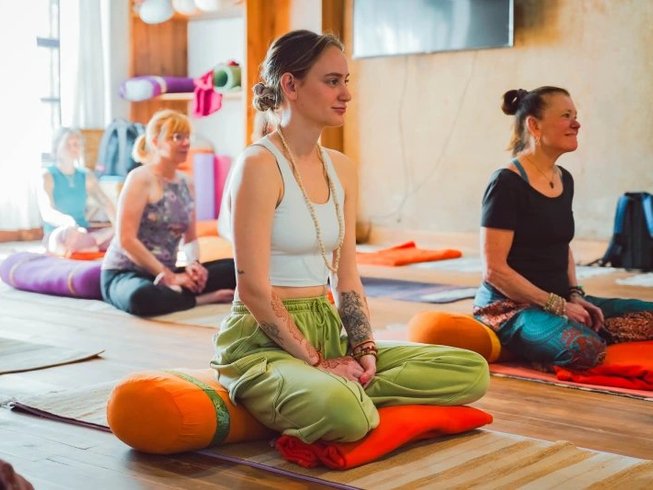
25 Day 300-Hour Kundalini Yoga Teacher Training in Ubud, Bali, Indonesia
300 Hour Kundalini Yoga Teacher Training in Bali
Deepen your yoga practice and elevate your teaching skills with our 300-Hour Kundalini Yoga Teacher Training in Bali. This comprehensive program is designed for both experienced yogis and teachers who wish to expand their knowledge and certification.
Meet the instructors
Highlights
- Comprehensive 300-hour Kundalini yoga curriculum
- Daily meditation and pranayama sessions to enhance mental clarity and inner peace
- Advanced techniques in Kundalini kriyas, chanting, and energy work
- Expert guidance from experienced international yoga instructors
- Immersive cultural experience in the serene and inspiring environment of Bali
- Holistic approach integrating yoga philosophy, anatomy, and teaching methodology
- Small group setting for personalized attention and mentorship
- Opportunities for self-discovery and connection with a global yoga community
- 24 nights accommodation with meals
Skill level
- Beginner
- Intermediate
- Advanced
Types
25 days with instruction in English
 Average daily hours of activity: 7
Accommodation
Facilities
- Swimming pool (outdoor)
- Garden
- Lounge
Accommodation is always an important consideration when traveling to a new location, and staying can be the best way to get the most out of your yoga trip. Many types of accommodation are available at this yoga school, from single rooms to shared rooms. Bali Yoga Retreat is a cozy place to stay that gives you access to comfort and elegance.
Program
Over the course of this immersive training, you will explore advanced Kundalini techniques, meditation practices, and the philosophy behind this transformative Kundalini Yoga tradition.
- Enhance your personal practice
- Develop advanced teaching skills
- Connect with a global yoga community
- Experience the serene and inspiring environment of Bali as well as the physical and energetic benefits
Join this life-changing experience and take your Kundalini Yoga practice to the next level.
Are you a yoga teacher looking to deepen your knowledge and practice of Kundalini yoga?
The 300-Hour Kundalini Yoga Teacher Training in Bali is the perfect opportunity to expand your skills and understanding of this transformative practice. Throughout this comprehensive training, you will learn advanced techniques and teachings of Kundalini Yoga, including kriyas, meditations, and mantras. Led by experienced and certified instructors, you will have the opportunity to delve deeper into the spiritual aspects of Kundalini Yoga, as well as the physical and energetic benefits.
This 300-Hour training is designed for those who have already completed a 200-Hour teacher training program and have a strong foundation in Kundalini Yoga. By the end of the training, you will have a deeper understanding of the science of Kundalini, the chakra system, and the techniques to balance and activate the energy centers.
Join Bali Yoga Retreats in Bali for this life-changing experience and take your Kundalini Yoga practice to the next level.
Why choose 300-Hour Kundalini Yoga Teacher Training with Bali Yoga Retreats?
Internationally recognized certification
After completing the 300-Hour Kundalini Yoga Teacher Training course, you will receive an advanced certification recognized worldwide by Yoga studios, wellness centres, and fitness communities, elevating your teaching credentials to the highest level.
All-inclusive packages
The package includes comfortable accommodation, three meals a day, a course manual, workshops, an adventure outing, and certification fees in one package. There are no hidden costs, only clear and honest pricing, so you can completely focus on your advanced Kundalini training.
Advanced Kundalini training
Go beyond the basics with advanced Kundalini awakening techniques, deeper Chakra sadhana, and intensive energy work. Combined with Hatha, Ashtanga, and Vinyasa styles, this program prepares you to teach Kundalini Yoga with mastery and confidence.
Traditional and modern Yoga styles
At Bali Yoga Retreats, ancient Kundalini Tantra wisdom is blended with contemporary teaching methods. You will deepen your understanding of pranayama, meditation, mantra, and philosophy while learning how to share these powerful practices effectively with modern students.
Teach Yoga confidently at any level
Building on your 200-Hour foundation, this advanced training equips you to guide students through complex sequences, therapeutic applications, and deeper spiritual practices. You will gain the confidence to teach advanced classes anywhere in the world.
Safe and supportive environment
Bali Yoga Retreats ensures a safe and supportive environment so your journey in Bali, Indonesia, is memorable. From the moment you arrive, you will feel welcomed and cared for. Friendly teachers and staff are always nearby to support you, so you can focus on deepening your practice.
Teaching manual
You will receive an advanced course manual, a comprehensive guidebook covering in-depth Kundalini techniques, advanced Yoga poses, breathwork, meditation methods, and teaching guidance. This manual will serve as your lifelong reference for advanced Kundalini Yoga teaching.
Structured and comprehensive learning
The 300-Hour Kundalini Yoga Teacher Training program provides a carefully structured advanced curriculum. Building on your existing knowledge, the program takes you deeper into Kundalini science, energy work, and teaching methodology, ensuring steady growth and mastery.
Eligibility for 300-Hour Kundalini Yoga Teacher Training Course in Bali
Who can join this course?
- If you are new to Yoga (no specific background in Yoga is required; being eager to learn is enough), or if you have been practicing Yoga for a while
- If you have been practicing Yoga for a long time but lack knowledge of anatomy, foundation of asanas, and Yoga philosophy
- If you do not want to be a Yoga teacher but wish to deepen your own Yoga practice and knowledge
Walk on your yogic path with Bali Yoga Retreats
Bali Yoga Retreats offers a holistic understanding of Yoga, combining multi-style Yoga practices with traditional Yoga and modern understanding of the body.
The teachers are ready with all their heart and knowledge to guide you and support you in deepening your Yoga practice and achieving your goals.
Join Bali Yoga Retreats and experience the endless joy of discovering your true self and this life-transformative journey.
Syllabus of 300-Hour Kundalini Yoga Teacher Training in Bali
Mantra and mantra chanting
Mantra is optional. A mantra is a set of words consisting of specific sounds and vibrations received by ancient yogis and seers, offering powerful physical, mental, and spiritual benefits. There are many kinds of mantras available for different purposes.
You will be learning:
- Art and science of mantra
- Mantra and its power
- How mantra is made
- Whether mantra is a religion
- Sound vibration
Mantra chanting
- The proper way of chanting the Om mantra
- Shiva mantra for peace
- Durga mantra for energy awakening
- Kundalini mantra
- Krishna mantra for joy
- Ganesha mantra for stillness and removal of obstacles
- Mantra to be led towards light and immortality (Asatoma)
- Surrender mantra (Tvamevamata)
- Mantra to save life and journey (Trayambakam)
- Mantra for purification of the mind (Gayatri)
- Guru disciple study mantra (Sahana)
- Guru mantra (Guru Brahma)
- Patanjali mantra (Yogenacittasya)
- Suryanamaskar 12 mantra (Om Mitraya)
Kundalini Yoga asana
Alignment, assist, and adjustment
- Surya Namaskar (Sun Salutation)
- Chandra Namaskar (Moon Salutation)
- Bharadvajasana
- Lolasana – swinging pose
- Kukkutasana – rooster pose
- Sarpasana – snake pose
- Shalabhasana – locust pose
- Dhanurasana – bow pose
- Paschimottanasana – seated forward bend
- Janu Sirsasana – head to knee pose
- Parivrtta Janu Sirsasana – revolved head to knee pose
- Sarvangasana – shoulder stand
- Padma Sarvangasana – shoulder stand lotus pose
- Sirsasana – headstand
- Natarajasana – lord Shiva’s pose
- Utthita Hasta Padangusthasana
- Navasana – boat pose
- Vatayanasana – horse face pose
- Mayurasana – peacock pose
- Kurmasana – tortoise pose
- Chakrasana – wheel pose
- Hanumanasana – monkey pose
- Agnistambhasana – fire log pose
- Brahmacharyasana – celibate’s pose
- Astavakrasana – eight-angle pose
- Eka Pada Sirsasana – one foot to head pose
- Chaturanga Dandasana
- Pincha Mayurasana – feathered peacock pose
- Eka Pada Koundinyasana
- Handstand – Adho Mukha Vrksasana
- Ardha Pincha Mayurasana – dolphin pose
- Makara Adho Mukha Svanasana – dolphin plank pose
- Bakasana – crow pose
- Eka Pada Bakasana – one-leg crow
- Utthan Pristhasana – lizard pose
- Pashasana – noose pose
- Parivrtta Surya Yantrasana – sundial pose
- Titibasana – firefly pose
- Parsva Bakasana – side crow
Kundalini joints movements
Warm-up exercises
- Feet and ankle exercises
- Knee movement
- Hip movement and rotation
- Leg cradle
- Side bending
- Arm movements
- Arm swing
- Elbow movement
- Wrist and hand movement
- Neck exercises
- Chin, jaw, mouth, tongue, eye, and head exercises
Kundalini awakening
Rules and preparation
- Postures
- Chakra sadhana
- Practices to awaken Ajna Chakra
- Practices to awaken Muladhara Chakra
- Practices to awaken Swadhisthana Chakra
- Practices to awaken Manipura Chakra
- Practices to awaken Anahata Chakra
- Practices to awaken Vishuddhi Chakra
- Practices for chakra awareness
- Bindu practices
- Moola Shakti Bandha (root energy lock)
- Uddiyana Shakti Bandha (abdominal energy lock)
- Jalandhara Shakti Bandha (throat energy lock)
- Maha Shakti Bandha (great energy lock)
Basic Sanskrit and chakra sound
Bija mantra of chakras:
- Lam
- Vam
- Ram
- Yam
- Ham
- Om
- Sanskrit syllable
- Vowel
- Consonant
- Sound in different chakras
Kundalini Yoga theory and practice
- Serpent power
- Why Kundalini is sleeping
- Risks of awakening Kundalini
- Food for Kundalini awakening
- Tantric understanding of Kundalini
- Muladhara Chakra
- Swadhisthana Chakra
- Manipura Chakra
- Anahata Chakra
- Vishuddhi Chakra
- Ajna Chakra
- Sahasrara Chakra
- Guru and disciple relationship
- Initiation
- Feminine energy
Hatha Yoga
Bali Yoga Retreats teaches traditional ancient Hatha Yoga practiced by Himalayan masters for thousands of years. The practice is adapted to individual strength and flexibility, with the aim of attaining health and mental peace.
You will practice:
- Pawanmuktasana series 1 (15 practices)
- Pawanmuktasana series 2 (10 practices)
- Pawanmuktasana series 3 (10 practices)
- Centering postures series (5 practices)
- Surya Namaskar (12 asana series)
- Chandra Namaskar (12 asana series)
- Standing postures series (10 practices)
- Kneeling postures series (5 practices)
- Sitting postures series (10 practices)
- Forward bending postures series (5 practices)
- Backward bending postures series (5 practices)
- Supine postures series (6 practices)
- Prone postures series (5 practices)
- Fire series (5 practices)
- Inversions series (5 practices)
- Twisting postures series (5 practices)
- Balancing postures series (5 practices)
- Relaxing postures series (5 practices)
- Meditative asana series (5 practices)
Note: In total, you will learn 140 yoga exercises. Theory is as important as practice. Without proper understanding, practice cannot be fully effective. The teachers will guide you through why, how, when, and what you need to do in asana practice. You are encouraged to deepen your self-practice.
You will also learn:
- Philosophy of Hatha Yoga
- Ancient scriptures of Hatha Yoga
- Aim and objectives of Hatha Yoga
- Yoga as therapy
- Yoga as balancing practice
- How Hatha Yoga connects to chakras, nadis, Kundalini, and the subtle body
Pranayama
Pranayama is a central practice in traditional Yoga. It is often misunderstood as only breathing practice, but it is much more. You will learn how Pranayama leads to health, peace, happiness, balance, and Kundalini awakening.
You will learn:
- What is prana
- What is pranayama
- Breath and its connection with prana
- Importance and benefits of pranayama
- Preparation for practice
- Aspects of breathing
- Ancient texts on breathing
- Nostrils and how to activate them
- Secrets of pranayama
- Breath flow in five elements
- Unit of prana
- Function of prana
- Three levels of prana
- Three gunas
- How prana flows
- Quality of breath
- Imbalance of prana
- Breath retention
- Six sitting positions for pranayama
- Breathing patterns
- Prana connection with chakras and Kundalini
Beginner and intermediate practices:
- Clavicular pranayama
- Thoracic pranayama
- Diaphragmatic pranayama
- Yogic pranayama
- Pranava pranayama
- Nadi Shodhana pranayama
- Bhastrika pranayama
- Kapalabhati pranayama
- Bhramari pranayama
- Ujjayi pranayama
- Sitali pranayama
- Sitkari pranayama
- Murcha pranayama
- Surya Bhedana pranayama
- Chandra Bhedana pranayama
Meditation
Once posture is stabilized through asana, energy is cleansed through pranayama, and senses are controlled through pratyahara, the mind can be focused. Meditation begins with concentration practices and develops toward deeper awareness and mastery.
You will learn:
- Introduction to meditation
- History of meditation
- Preparation for meditation
- What meditation is and is not
- Why, how, where, and when to meditate
- Philosophy of meditation
- Meditation traditions and scriptures
- Aim and objectives of meditation
- Sitting positions and correct posture
- Relaxation in meditation
- Diaphragmatic breathing in meditation
- Correct breathing in meditation
Styles of meditation practices:
Himalayan meditation practices
- Breath, mind, mantra awareness
- Trataka meditation
Nada meditation practices
- Music meditation
- Om meditation
- Mantra power meditation
Active meditation practices
- Dynamic moving meditation (Osho)
- Buddha walking meditation
- Karma Yoga meditation
- Gaurishankar meditation
Tantra and Kundalini meditation practices
- Seven Chakra awareness meditation
- Ajna Chakra awakening meditation
- Kundalini active meditation
Vipassana and passive meditation practices
- Breath awareness (Anapana)
- Mindfulness and sensation
- Total awareness practice
Mantra and kirtan meditation practices
- Japa (recitation) practice
- Kirtan practice and creating a spiritual atmosphere
- Silence practice
- One-day silence meditation
Yoga Nidra
Yoga Nidra (sleep awareness or psychic sleep) is a journey from a conscious to a superconscious state of awareness. All animals, birds, insects, and humans sleep in the same way, and the experience of sleep is also similar. This state brings oneness, and there is a great secret behind it. Yogi Vishnu is one of the most famous Yoga Nidra teachers. His proven techniques have been practiced for a long time by sages. He will be the mentor and teacher, showing how it can transform your life in a very short period of time. Yoga Nidra practices take place every Friday.
Basic relaxation practices
- Visualisation Yoga Nidra
- Chakra awareness Yoga Nidra
- Inner flame Yoga Nidra
You will learn the basics of Yoga Nidra:
- Meaning and purpose of Yoga Nidra
- Different schools and traditions of Yoga Nidra
- Tantric origin of Yoga Nidra
- Lifestyle and rules for Yoga Nidra practitioners
- Benefits and risks of Yoga Nidra
- Difference between Yoga Nidra and meditation
- Yoga Nidra experience
- Yoga Nidra and healing
- Four states of consciousness
- Three-body awareness
- Tension and relaxation
Yoga cleansing
In this course, you will learn key cleansing practices for physical, mental, emotional, and spiritual well-being. The body continuously produces toxins, so proper cleansing of the nostrils, ears, eyes, skin, tongue, and other organs is essential. Beginners will practice six Satkarma techniques to unblock energy channels and deepen their yogic experience, along with understanding the theory behind them.
- What is Satkarma
- Benefits and risks
- Who should and should not practice it
- Experiences
- Preparation for Satkarma
- Practices after completion
- Nadi cleansing
Practices you will learn:
- Jihva Dhauti
- Danta Dhauti
- Karna Dhauti
- Rubber neti
- Jala Neti
- Kapalabhati
- Agnisara
Kundalini Tantra philosophy
- Introduction to Kundalini Yoga
- Definition and understanding of Chakras
- Muladhara Chakra
- Swadhisthana Chakra
- Manipura Chakra
- Anahata Chakra
- Vishuddhi Chakra
- Ajna Chakra
- Sahasrara Chakra
- Kundalini awakening process
- Mantra Shaktipata
Kundalini anatomy
- Nadis (energy channels)
- Chakras
- Panchakosha (five sheaths)
- Respiratory system
- Nervous system
- Tridosha
- Dhatus
- Vayu
Yoga therapy
Yoga is a holistic science that nurtures body, mind, and soul. It carries natural healing energy through which one can remain healthy and support the body’s natural healing process. You will learn the basics of Yoga Therapy in classes. Teachers will provide therapeutic guidance during asana, pranayama, meditation, and anatomy sessions. There is no separate class for Yoga Therapy.
- What is Yoga Therapy
- Rules and regulations of Yoga Therapy
- Healing through asana, pranayama, and meditation
- Therapy for common diseases
Ayurveda
Ayurveda is the sister science of Yoga. It teaches that the body is made of five elements that create three doshas: Kapha, Vata, and Pitta. When these are balanced, health is maintained; when imbalanced, illness arises. Ayurveda provides essential health management knowledge for Yoga teachers.
Bali Yoga Retreats offers one Ayurveda workshop with a doctor.
- Introduction to Ayurveda
- Unique features of Ayurvedic treatment
- Fundamentals of Ayurveda
- Panchamahabhuta
- Kapha (structure and lubrication)
- Vata (movement energy)
- Pitta (transformation and heat energy)
- Prakriti – understanding your constitution
Kundalini Tantra mudra
Mudra is a divine gesture practiced with the hands. There are hundreds of mudras, and they can bring powerful changes in body and mind.
- Secrets of mudra
- Position of elements in the hands
- Need for mudra
- Importance and advantages of mudras
- Special guidelines for mudra
- Gyan mudra (gesture of wisdom)
- Purna Gyan mudra (gesture of complete wisdom)
- Vairagya mudra (gesture of dispassion)
- Abhaya mudra (gesture of fearlessness and blessing)
- Dhyana mudra (meditation mudra)
- Vayu mudra (gesture of air)
- Prana mudra (gesture of life force)
Bandha (energy lock)
The universe is made of energy, and the human body is also energy in constant transformation. Mudras help channel energy, while bandhas help control and retain it. This supports energy balance and Kundalini awakening.
- Meaning and importance of energy locks
- Why energy is drained and how bandhas help
- Energy knots and how to open them
- Understanding Muladhara, Manipura, and Vishuddhi chakras
- Experience of energy locks
- Benefits and risks of bandha practices
Practices (beginner and intermediate level):
- Agnisara (preparation for Uddiyana)
- Bahir Kumbhaka (external breath retention)
- Antar Kumbhaka (internal breath retention)
- Ashwini Mudra
- Vajroli Mudra
- Mula Bandha
- Uddiyana Bandha
- Jalandhara Bandha
Teaching methodology
Learning Yoga is not enough to teach it. Teaching Yoga is an art of transforming lives.
- Proper demonstration of Yoga practices
- Proper instruction and guidance
- Alignment principles
- Safe adjustments with or without props
- Development of yogic personality
Alignment
- Sense of alignment
- Role of alignment in daily practice
- Balance of prana and chakras
- Alignment in five koshas
- Importance of alignment
- Injury prevention
- Joint mobility improvement
- Alignment by body regions (upper limbs, lower limbs, torso, spine, neck, head)
- Finding balance between body and mind
Adjustment
- Meaning of Yoga adjustment
- Levels of adjustment
- Need for adjustment in asana practice
- Safe adjustment techniques
- Use of props and tools
- Self-adjustment practices
- Adjusting others in class
- Body weight management in postures
- Safety rules and preparation
Yoga philosophy
- Introduction to Yoga, its philosophy, and evolution
- Introduction to Yoga Sutras of Patanjali
- Definition of Yoga
- Four aspects of mind and its functions
- Daily schedule of a Yoga student
- Five elements and ten senses
- Yama, Niyama, Asana, Pranayama, Pratyahara, Dharana, Dhyana, Samadhi
Evaluation and certification
At the end of the course, participants will be evaluated based on:
- Performance during the course
- Attendance
- Practical asana demonstration test
- Written test (objective and subjective)
- Behaviour
Daily schedule for 300-Hour Kundalini Yoga TTC in Bali
The schedule follows a structured schedule where most of the 6 to 7 training hours per day are dedicated to different aspects of Yoga. The training can feel intensive yet deeply enlightening. Depending on the Yoga school, mornings may begin as early as 05:30 with meditation, followed by Yoga postures, philosophy, or anatomy classes. Chanting and Pranayama are also part of the daily routine. During training, students are provided with two to three nutritious vegetarian meals, fruit refreshments, and green tea. Daily written homework is also included to support in-depth learning. Early sleep is encouraged as part of yogic discipline.
- 05:00 – Wake up
- 05:30–06:30 – Silent meditation
- 06:30–08:00 – Kundalini kriyas
- 08:00–08:15 – Shatkarma / Yoga cleansing
- 08:15–09:15 – Pranayama / Bandha / Mudra
- 09:15 – Breakfast
- 10:30–11:30 – Self-study
- 11:30–12:30 – Yoga philosophy
- 12:30–13:30 – Yoga anatomy
- 13:30–14:30 – Lunch
- 15:30–16:30 – Self-practice / Practice teaching
- 16:30–18:00 – Kundalini mantra and meditation
- 18:00 – Kundalini Yoga asana
- 18:00–18:30 – Shower
- 18:30–19:00 – Dinner
- 19:00–19:30 – Digestive and silent meditative walk
- 19:45–21:00 – Satsang / Evening cultural program / self-study
- 22:00 – Lights out
Please note: The timing of teaching and modules may vary depending on seasons.
Included excursions
As part of your 300-Hour Kundalini Yoga Teacher Training in Bali, you will have the opportunity to explore the island’s rich culture, natural beauty, and spiritual sites. These excursions are designed to complement your Yoga practice and provide a deeper connection to Bali.
- Visit sacred temples such as Uluwatu and Tirta Empul to experience Balinese spirituality and rituals
- Explore lush rice terraces in Ubud and enjoy guided nature walks through serene landscapes
- Participate in traditional Balinese ceremonies and cultural performances for an immersive cultural experience
- Enjoy guided trips to waterfalls and natural hot springs for relaxation and rejuvenation
- Optional excursions to local artisan markets and villages to connect with the community and Balinese craftsmanship
- Sunset trips to iconic beaches for meditation and reflection in stunning surroundings
Instructors
Yogi Vishnu Panigrahi
Guru Vishnu has been devoted to spiritual practice since childhood, guided by traditional teachings and early meditation experiences. He blends ancient yoga wisdom with practical guidance, helping students cultivate mindfulness, inner balance, and self-awareness. Known for his compassionate approach, Vishnu inspires personal growth and a deeper connection to both body and spirit.
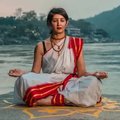
Anita Mander
Anita is a 500-hour RYT Kundalini and Tantra yoga and a 200-hour RYT multi-style yoga Vinyasa and Hatha yoga trained teacher. She is also a Level 1 and 2 cobra breath teacher, initiated through the lineage of Grand Master Sunyata Saraswati, as well as yoga Nidra and 50 hours of Ayurveda training. She passed her Reiki levels 1 and 2 and trained directly under the 10th lineage of Dr. Usui. She teaches Kundalini and Tantra styles at Kundalini Yoga Ashram, World Peace Yoga School, and Samadhi Yoga Ashram. She also teaches Kundalini and Tantra with Profit 28 and Santosha Yoga.
Location
The resort is located 8 kilometers north of the busy center of Ubud surrounded by green rainforest in a tranquil area. The surrounding rainforest and terraced rice paddies, dotted with Hindu temples and shrines, are among Bali’s most famous landscapes. The landscape offers a calmness and will balance your mind and body. It is easy to get around from the resort and visit sights for the day like the famous Goa Gajah, the elephant temple. Ubud is known for being the cultural capital of Bali and it still has the highest concentration of art galleries on the island. Ubud is also home to many talented metalsmiths and jewelers. Along with visiting the Monkey Forest, seeing a traditional Balinese dance performance is almost compulsory.

Food
Bali and India are well known for their beautiful taste in food. Ayurveda teaches about how to balance your body through your diet. Different foods influence your different systems and elements. Students will enjoy the most tasty and healthy meals at Bali Yoga Retreat. The kitchen team is guided by the Ashram and they know how to prepare food with spiritual feelings. They do not use any meat, eggs, or alcohol in their kitchen. They also encourage students to not use them while they are there. They serve mostly vegetarian dishes. But with the requirement of the students, they also provide:
- Vegan
- Gluten free
- Vegetarian
- Lactose-free
- Fruits
- Salad
- Ayurvedic khichdi
The following meals are included:
- Brunch
- Lunch
- Dinner
- Drinks
The following drinks are included:
- Water
The following dietary requirement(s) are served and/or catered for:
- Vegetarian
- Vegan
- Gluten Free
- Lactose Free
- Ayurvedic
Things to do (optional)
- Book private or specialized yoga sessions for deeper practice
- Upgrade accommodation to a premium room or villa
- Purchase wellness treatments such as massages, spa therapies, or energy healing sessions
- Join additional workshops such as meditation, Ayurveda, or sound healing
- Rent scooters or arrange guided tours to explore nearby temples, waterfalls, and rice terraces
- Take cooking classes to learn traditional Balinese cuisine
- Participate in local cultural experiences, such as dance performances or craft workshops
- Arrange personalized excursions, like sunrise hikes to Mount Batur or boat trips to nearby islands
- Hire a personal photographer or videographer to capture your yoga retreat experience
Spa treatments
- Balinese Massage – Traditional full-body massage using long strokes to relax muscles and improve circulation. Available as an add-on; not included in the base package
- Aromatherapy Massage – Customized massage with essential oils to balance mind and body. Optional, extra cost applies
- Hot Stone Therapy – Warm stones placed on key points to relieve tension and promote relaxation. Add-on service; not included in the retreat package
- Reflexology – Foot massage targeting pressure points to improve overall wellness. Available at an additional fee
- Facial Treatments – Customized facials for hydration, detox, and rejuvenation. Optional, extra cost applies
- Herbal Body Scrub – Exfoliating treatment using natural Balinese ingredients. Add-on; not included in package
- Energy Healing / Reiki Sessions – Holistic therapy to balance energy and promote healing. Available as an extra service
What's included
- 300-Hour Kundalini Yoga Teacher Training certification
- Daily yoga and meditation sessions
- Comprehensive workshops on Kundalini kriyas, philosophy, anatomy, and teaching methodology
- Experienced international yoga instructors and personalized mentorship
- Healthy plant-based meals throughout the program
- Comfortable shared or private accommodation
- Access to included excursions and cultural experiences in Bali
- Study materials and training manuals
- Group sharing circles and personal development sessions
- Free time for self-practice, reflection, or exploration of Bali
- Certificate upon completion of the program
- 24 nights accommodation
- Daily nutritious meals
What's not included
- International flights to and from Bali
- Airport transfers (unless specified otherwise)
- Travel insurance and medical coverage
- Personal expenses, souvenirs, and shopping
- Optional excursions or activities not listed in the included excursions
- Meals or beverages outside of the provided meal plan
- Yoga props or personal equipment not supplied by the retreat
- Visa fees or related travel documentation costs
- Tips for staff or instructors
How to get there
Recommended Airports
Transfer available for additional US$ 35 per person
Ngurah Rai International Airport
24 km away from your destination
Arrival by taxi
It will take 1 hour by taxi and it costs around 35 USD. With advanced notice, Bali Yoga Retreats team can arrange transportation for you to Ubud.
Cancellation Policy
- A reservation requires a deposit of 30% of the total price.
- The deposit is non-refundable, if the booking is cancelled.
- The rest of the payment should be paid on arrival.

Reviews
For this organizer you can guarantee your booking through BookYogaTeacherTraining.com. All major credit cards supported.
Similar Yoga Teacher Training you might like
You recently viewed