5 Days Ayurveda Yoga Teacher Training Course In Bali, Indonesia
Balanced Yoga Teacher Training in Indonesia
Ayurveda and yoga are sister sciences that work to maintain the delicate balance between the spirit, mind, and body to promote health. Yoga helps to establish self-balance through asana, pranayama, mudra, mantra, pratyahara, dhyana, and samadhi, dhyana, mantra chanting, mudra, bandhas, pranayama, and asana. On the other hand, Ayurveda teaches how to achieve maximum health and offers an appropriate amount of energy to pursue the yogic path. Both sciences help develop greater consciousness, self-control, discernment, and awareness. You will discover the basics of Ayurveda in this program, as well as useful tips you may use to improve your health and energy. You'll also understand how yoga's basic therapeutic properties link to the huge corpus of Ayurvedic knowledge.
Meet the instructors
Highlights
- Certificate of completion
- Daily yoga classes
- Daily meditation and pranayama sessions
- Silent meditative walks
- Practice teaching classes
- Weekend excursions and Balini culture experience
- 4 nights accommodation
- Daily nutritious meals
Skill level
- Beginner
- Intermediate
- Advanced
Types
19 days with instruction in English
 Average daily hours of activity: 7
Accommodation
Facilities
- Spa
- Swimming pool (outdoor)
- Dining area
- Garden
- Kitchen
- Yoga shala
Simply find a program that fits your needs in terms of accommodation, and get ready for an unforgettable trip to Bali. Bali Yoga Retreats offers their students either shared or private rooms. Private rooms and some of the services listed on their official website will cost you extra.
Program
The Ayurveda yoga TTC in Bali, Indonesia, with Bali Yoga Retreats, provides in-depth contraindications and tools for the safety of students. In this course, you will learn about the Chakra system, Pancha Vayu, Pancha Kosha, Pancha Mahabutha, Triguna, Prana, Tridosha, Pranayama, Mantra chanting, Meditation, Rejuvenating tonics, relaxing teas or drinks, marma points, the relation between yoga and ayurveda, Principles of ayurveda, etc. This course will educate you about Ayurveda and the anatomy and physiology of yoga so that you may achieve a state of balance and health for yourself, and if you're a teacher or therapist, so that you can learn how to assist others.
Course Overview
Mantra
Mantra is a set of words that consist of specific sounds, vibrations received by ancient yogis and seers, which offer a powerful physical, mental, and spiritual benefit. There are many kinds of Mantras available for different purposes. You will be learning:
- Art and science of mantra
- Mantra and its power
- How mantra is made
- Is mantra a religion
- Sound vibration
Mantra Chanting
You will be learning:
- The proper way of chanting the Om mantra
- Shiva mantra for peace
- Durga mantra for energy awakening
- Kundalini mantra
- Krishna mantra for joy
- Ganesha mantra for stillness and removal of obstacles
- Mantra to be led towards light and immortality (Asatoma)
- Surrender mantra (Twamevamata)
- Mantra to save life and journey (Trayamvakam)
- Mantra for purification of the mind (Gayatri)
- Guru disciple study mantra (Sahana)
- Guru mantra (Guru brahma)
- Patanjali mantra (Yogenacittasya)
- Suryanamaskar 12 mantra (omMitraya)
Hatha Yoga
World Peace Yoga School teaches the traditional ancient style of Hatha yoga that has been practiced by the Himalayan masters for thousands of years. At the school, you practice according to your strength and flexibility. The main purpose is to attain perfect health and peace of mind. Here is the list of asana series that will be practiced:
- Pavan Muktasana series 1 (15 practices)
- Pavan Muktasana series – 2 (10 practices)
- Pavan muktasana series - 3(10 practices)
- Centering postures series(5 practices)
- Surya Namaskar (12 asana series)
- Chandra Namaskar (12 Asana Series)
- Standing postures series(10 practices)
- Kneeling postures series(5 practices)
- Sitting postures series(10 practices)
- Forward bending postures series(5 practices)
- Backward bending postures series(5 practices)
- Supine postures series(6 practices)
- Prone postures series (5 practices)
- Fire Series series(5 practices)
- Inversions series(5 practices)
- Twisting postures series(5 practices)
- Balancing postures series(5 practices)
- Relaxing posture series(5 practices)
- Meditative asana series(5 practices)
Note: In total, you will learn 140 yoga exercises
The theory is just as important as practicing. Without proper understanding, you cannot do well. The teachers will teach a base of understanding why, how, when, and what you need to do in an asana class. You must be self-motivated to go deeper into the postures. Here are some of the theories you will be learning:
- Philosophy of Hatha yoga
- Ancient scriptures of Hatha yoga
- Aim and objectives of Hatha yoga
- Yoga as a therapy
- Yoga is balancing
- How Hatha yoga is connected to your Chakras, Nadis, Kundalini, and your subtle body
Ashtanga Yoga
In the 20th century, K. Pattabhi Jois developed a modern-day form of classical Indian Yoga called Ashtanga Vinyasa. His teacher Krishnamacharya taught this form, which is an energetic practice with breath awareness and mindful movements.
The first series is taught in the 200-hour yoga teacher training course. You will learn all the asanas systematically, and all the details are in the Ashtanga Manual that you will receive.
- Introduction to Ashtanga yoga
- History of Ashtanga yoga
- Awakening the fire within
- The breath of life
- Prana
- A Chakra contemplation
- Eight limbs of yoga and the practice of K. Pattabhi Jois
- How to do Bandha in Ashtanga
- Drishti - focusing the attention during movements
- Cleansing and purification
- Creating a sacred place
- The challenging asanas
- Proper use of props and yoga instruments
- Sun salutation A and B
- Standing asana series
- Sitting asana series
- Finishing asana series
- Teaching practices (Traditional and Mysore style)
- Pādāṅguṣṭāsana – Big toes posture
- Pāda hastāsana – Hand under foot posture
- Utthita trikoṇāsana (A+B) Triangle posture
- Utthita pārśvakonāsana (A+B)- Extended side angle pose
- Prasārita pādottānāsana (A,B,C,D)- Intense wide leg stretch
- Pārśvottānāsana – intense side stretch posture
- Utthita hasta pādāṅguṣṭāsana- hand to big toe posture
- Ardha baddha padmottānāsana – half bound lotus forward bend
- Utkatāsana – Fierce pose
- Vīrabhadrāsana – Warrior pose A+B
- Dandasana – Staff pose
- Paścimattānāsana – intense west stretch or sitting forward bend
- Pūrvattanāsana – Intense east stretch
- Ardha Baddha Padma Paścimattānāsana- half bound lotus forward bend
- Tiryaṅgmukha ekapāda paścimattānāsana- Reverse the leg, one leg intense stretch
- Jānuśīrṣāsana – Head to knee pose
- Marīcāsana – Sage Marichi Pose
- Nāvāsana – Boat pose
- Bhujapīḍāsana – Shoulder pressure pose
- Kūrmāsana – Tortoise pose
- Supta kūrmāsana – Sleeping tortoise
- Garbha piṇḍāsana – Embryo posture
- Kukkuṭāsana – Rooster posture
- Baddha konāsana – Bound angle pose
- Upaviṣṭha konāsana – Seated angle posture
- Supta konāsana – Lying down angle posture
- Supta pādāṅguṣṭāsana – Reclining big toe posture
- Ubhaya pādāṅguṣṭāsana – Both big toes posture
- Urdhva mukha paścimattānāsana – Upward facing full forward bend
- Setu bandhāsana – Bridge posture
Finishing Postures:
- Urdhva dhanurāsana – Upward bow posture
- Salaṁba sarvāṅgāsana – Shoulder stand posture
- Halāsana – Plow posture
- Karṇa pīḍāsana – Ear pressure posture
- Urdhva padmāsana – Upward lotus
- Piṇḍāsana – Embryo posture
- Matsyāsana – Fist posture
- Uttāna pādāsana – Extended leg posture
- Cakrāsana – Wheel posture
- Sīrṣāsana – Head stand
- Baddha padmāsana – Seated lotus pose
- Yoga mudra – Sealed yoga posture
- Padmāsana – Lotus posture
- Utpluthiḥ - Uprooting posture
- Savasana – Coprse pose
Pranayama
Pranayama is the central practice in traditional yoga. Many people misunderstand Pranayama as the breathing practice only, but it is something more. In this class, you will learn the secret of pranayama and how it leads us to health, peace, happiness, balance, and the awakening of kundalini.
Every week will lead to a different state of experience:
- Building strength in your system and a step-by-step understanding of Pranayama.
- Move from the beginning to a deeper understanding of Pranayama and practices.
- Move towards advancing the practices by holding the breath and breathing with chakra awareness.
- Practice teaching and move towards mastery of the breath.
Here are the topics you will be learning for the study of Pranayama:
- What is Prana
- What is Pranayama
- What is breath and connection with the Prana
- Importance and benefits of Pranayama
- How to prepare ourselves to practice them
- Aspects of breathing
- Ancient texts of breathing
- General understanding
- Understand all about nostrils and how to activate them
- Secrets of Pranayama
- Breath flow in the 5 elements
- Unit of Prana
- Function of Prana
- Three levels of Prana
- Three Gunas
- How does prana flow
- Quality of breath
- Imbalance of Prana
- Retention of breath
- 6 Sitting positions for Pranayama practices
- Breathing pattern
- Prana connection with chakras and Kundalini
Beginners and Intermediate Practices
- Clavicular Pranayama
- Thoracic Pranayama
- Diaphragmatic Pranayama
- Yogic Pranayama
- Pranava Pranayama
- Nadisodhanam Pranayama
- Bhastrika Pranayama
- Kapalbhati Pranayama
- Bhramari Pranayama
- Ujjayi Pranayama
- Sitli Pranayama
- Sitkari Pranayama
- Murcha Pranayama
- Surya bhedi Pranayama
- Chandra bhedi Pranayama
Meditation
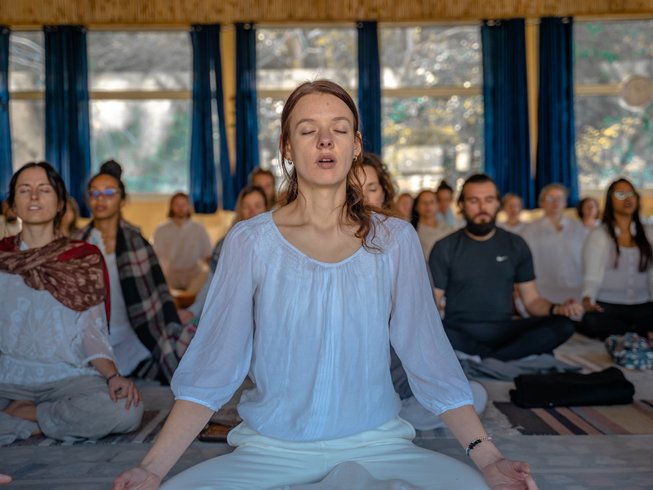
Once you stabilize your posture through Asana, cleanse your energy through Pranayama, and control your senses through Pratyahara, you will be able to focus your mind. Meditation starts with concentration practices, and with the 200-hour YTTC, you will learn great techniques to master the basics by which you can develop a high-level concentration and awareness.
With this 20-day program, you will learn basic to intermediate levels of meditation preparations and techniques. Each day, you will get a little more understanding of how to perform them and experience their benefits.
- Developing Foundation
- Developing one-pointed focus, different types of concentration techniques, and visualization exercises
- Meditation Techniques
- Chakra Awareness and Kundalini Meditation
Here is the list of what you will be learning:
- Introduction to meditation
- History of meditation
- Preparation for meditation
- What is meditation and what it is not
- Why- How- Where- When meditation
- Philosophy of meditation
- Meditation traditions
- Meditation scriptures
- Aim and objectives of meditation
- Sitting positions
- How to sit correctly
- Preliminary practices before practicing meditation
- Role of diaphragmatic breathing in meditation
- Correct breathing in meditation
- How to relax in meditation
- Lifestyle- Diet- Sleep- Sex- Job- Rules in meditation
Styles of Meditation Practices
Himalayan Meditation Practices
- Basic foundation meditation practice
- Breath- mind- mantra awareness
- Tratak meditation
Nada Meditation Practices
- Music meditation
- Om meditation
- Mantra power meditation
Active Meditation Practices
- Dynamic moving meditation (Osho)
- Buddha walking meditation
- Karma yoga meditation
- Gaurishankar meditation
Tantra and Kundalini Meditation Practices
- 7 Chakra Awareness Meditation
- Ajna chakra awakening meditation
- Kundalini active meditation
Vipassana and Passive Meditation Practices
- Breath awareness (Anapana)
- Mindfulness and sensation
- Total awareness practice
- Mantra and kirtan meditation practices
- How to do japa (recitation)
- Kirtan even and creating a spiritual vibe
- Silence practice
- One day of silent meditation
Yoga Nidra
Yoga Nidra (sleep awareness/ psychic sleep) is a journey from a conscious to a superconscious state of awareness. All animals, birds, insects, and humans sleep in the same way, and the experience of sleep is also the same. This state brings oneness, and there is a great secret behind all of it. Yogi Vishnu is one of the most famous Yoga Nidra teachers. His proven techniques have been practiced for a long time by our sages. He will be the mentor and teacher, showing you how it can transform your life in a very short period. Yoga Nidra practices will take place every Friday.
- Basic relaxation practices
- Visualisation yoga Nidra
- Chakra awareness yoga Nidra
- Inner flame yoga Nidra
You will learn the basics of Yoga Nidra.
- Meaning and purpose of yoga Nidra
- Different schools and traditions of yoga Nidra
- Tantric origin of yoga Nidra
- Lifestyle and rules for yoga Nidra practitioners
- Benefits and risks of yoga Nidra
- Difference between yoga Nidra and meditation
- Yoga Nidra experience
- Yoga Nidra and healing
- 4 states of consciousness
- 3 body awareness
- Tension relaxation
Yoga Cleansing
The body produces toxins at all times, and you need to cleanse your body accordingly. Proper ablution, urination, cleaning nostrils, ears, eyes, skin, tongue, and other organs are very important for good health. These are physical, mental, emotional, and spiritual cleansing. In the beginning, yoga practitioners should follow six practices (Sat-Karma) by which they can unblock the channels for higher experiences. With your 200-hour YTTC, you will learn these cleansing practices. You will also learn the basic theory of the following:
- What is Satkarma
- Benefits and risks
- Who should and should not practice it
- Experiences
- Preparation to Satkarma
- Practices after completing it
- Nadi cleansing
Practices that you will learn
- Jiwa dhauti
- Data-Dhauti
- Karna-Dhauti
- Rubber-net
- Jalaneti
- Kapalbhati
- Agnisara
Yoga Philosophy
Yoga philosophy is the philosophy of life. Just by listening and understanding, one can change one's own life. Yogi Vishnu learnt the secrets of Yoga philosophy from his great Master Swami Veda by spending significant time with him. His authentic teachings will be taught by our teachers. Yoga philosophy does not only exist in the Yoga Sutra. There are hundreds of Yogic texts, and you will be introduced to a few important ones, such as the Yoga Sutra, Bhagwat Geeta, and Upanishad.
During these 20 days, yoga philosophy will take you on a great journey of wisdom.
Entering the World of Wisdom
- Introduction to indian culture and spirituality and the Himalayan tradition
- Introduction to the ancient scriptures of yoga and spirituality
- Meaning and purpose of indian philosophy
- Introduction to the 9 major indian philosophies
- Why is yoga philosophy the most important among all?
- History of yoga
- Types of yoga
Patanjali Welcomes You- External limbs
- Patanjali and his work
- Introduction to Yoga Sutra text
- Eight limbs of yoga
- Yamas and niyamas
- Philosophy of asana and pranayama
- Science of karma
Inward Journey of Philosophy- Internal Limbs
- Philosophy of concentration, meditation, and samadhi
- Overview of the first chapter
- Overview of the second chapter
- Overview of the third and fourth chapters of Patanjali
- Mind and its control
- Introduction to the Bhagavat Gita and the Upanishad
Exploring the Wisdom of Yoga
- Chakras
- Nadi
- Kundalini
- Three-fold pain
- Three bodies (Sharira)
- Panchakosha
- Tri-guna
- Mahabhuta (Theory of Elements)
Anatomy and Physiology
Yoga anatomy is one of the most important subjects for yoga teachers. In anatomy classes, you will learn two types of anatomy, physical and spiritual.
Physical Anatomy
- Introduction to the body and its structure
- Body planes
- Anatomical movements
- Bones of the skull
- Cervical vertebrae
- Shoulder girdle/ arm bones/ pelvic region
- Deformities of the spine
- Lower extremity
- Tendons and ligaments
- Muscular system
- Nervous system
- Respiratory system
Spiritual Anatomy
- Nadi (energy channel)
- Chakras (energy centres)
- Kundalini (prime energy and source of all creativity)
- Panchakosha (5 layers)
- Pancha Mahabhuta (5 elements and body structure)
- Tri-guna (three attributes)
Ayurveda
Ayurveda is the sister science of yoga. It believes that the body is made of five elements, which create three Doshas: Kapha, Vata, and Pitta. When you keep them balanced, you are healthy, and when imbalanced, you are ill. Ayurveda talks about proper health management that all yoga teachers need to know to help people. You will be provided with an Ayurveda workshop by a doctor. Here is what you will learn in the Ayurveda classes:
- Introduction to Ayurveda
- Unique features of Ayurvedic treatment
- Fundamentals of Ayurveda
- Panchamahabhuta
- Kapha (the theme of structure and lubrication)
- Vata (the energy of movements)
- Pitta (the energy of bio-transformation and heat generation)
- Prakriti- know your constitution
Mudra
Mudra is a Divine gesture practiced with human hands. There are hundreds of them, and they can bring miraculous changes in the body and mind with their extraordinary powers.
You will learn about these powerful and secret mudras and their understanding.
- The secrets of mudra
- The position of elements in the hands
- The need for mudra
- The importance and advantages of mudras
- Special guidelines about mudra
- Gyan mudra (gesture of wisdom)
- Purn gyan mudra (gesture of complete wisdom)
- Vairagya mudra(gesture of dispassion)
- Abhaya mudra(gesture of blessing, fearlessness)
- Dyan mudra (meditation mudra)
- Vayu mudra(gesture of air)
- Pran mudra (gesture of prana)
Bandha (Energy Lock)
The whole universe is made of energy. At all times, the energy is converted into matter so that you see the whole universe as what it is. The physical body is also made of energy, and it constantly works with it. With mudra channelise the energy, and with bandha you control the energy and prevent it from draining. It helps you manage and maintain your energy. It is also helpful for kundalini awakening.
There are only three Bandhas according to yoga, but you will learn many preparation techniques that will help you perform the bandhas correctly.
Here is what you will learn:
- Meaning and importance of the energy lock
- Why the energy lock and how our energy gets drained
- Energy knots and how to open them
- Understanding the three chakras: muladhara-manipura-visuddhi
- Experience with energy lock
- Benefits and risks of bandha practices
Practices (Beginners and Intermediate Level)
- Agnisar (Preparation to Uddiyana)
- Vahir Kumbhaka (External Retention)
- Antar Kumbhaka (Internal Rentention)
- Ashwini Mudra
- Vajroli Mudra
- Mulabandha
- Uddiyana Bandha
- Jalandhara Bandha
Teaching Methodology
Learning or practicing yoga is not enough to teach. Teaching yoga is an art in which you transform people's lives. A proper teaching methodology will help you with:
- Not to forget the sequence
- Avoid injuries
- Manage happiness during and after the practice
- Work with all sides of yoga and all levels
- Give a meditative experience
- Manage and balance the energy flow
Here is what you will learn:
- Proper demonstration of a yoga practice
- The proper way to instruct and guide a lesson
- Proper alignment of yoga postures
- Proper adjustment with/ without props
- Yogic personality establishment
Alignment
- Sense of alignment
- Role of alignment in daily practice
- How to balance prana and chakras
- How alignment works in the 5 koshas
- Importance of alignment
- Different aspects of alignment
- To decrease the risk of injuries
- Increase the movement of joints
- Alignment based on body regions
- Upper limb alignment
- Lower limb alignment
- Torso – thorax - abdomen – pelvis alignment
- Head and neck - alignment
- Spinal alignment
- Basic alignment postures
- How to bring the body into a comfortable position
- How to find the balance between body and mind
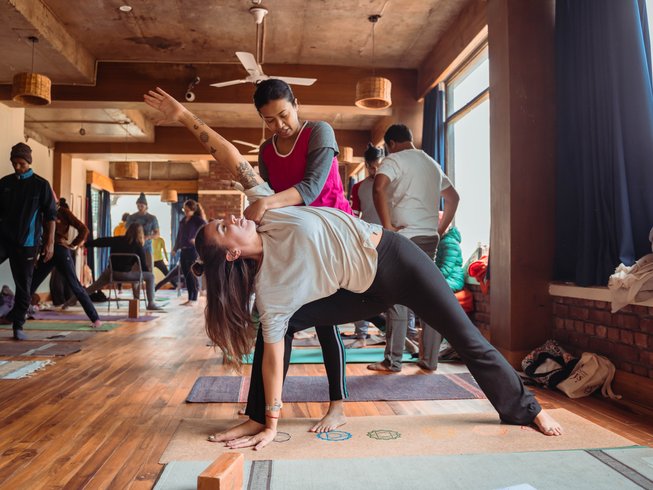
Adjustment
- What is the sense of yoga adjustment
- What is the level of yoga adjustment
- Why adjustment is needed in yoga asana
- Role of adjustments in yoga asana class
- The right technique of perfect adjustment
- How to apply a bandha and when
- Exploring the dynamics of each asana
- How to self-adjust in a posture
- How to adjust others during the class
- Pre-requisite methods of adjustment
- Uses of different tools and props to achieve the peak of the posture
- Body weight management during a posture
- Safety rules and preparations
Evaluation and Certification
At the end of the course, you will be evaluated, and according to that, you will get the certification. Your evaluation will be based on the following:
- Performance during the course
- Attendance
- Practical asana demonstration test
- Written test (Objective and subjective type)
- Behavior
Daily Schedule
The program follows a tight schedule where almost every one of the 6 to 7 training hours in the day is assigned to some aspect of yoga. You could find the training intensive but enlightening. Depending on the yoga school, the mornings can begin as early as 05:30 with meditation, followed by some yoga postures and maybe some classes or lectures in philosophy or anatomy. Chanting and pranayama are also part of the schedule. During training, you are provided with two to three yoga meals, fruit refreshments, and green tea. Daily written homework is also the norm, as that is how you gain in-depth knowledge of the subject. Sleeping early is encouraged as that is part of yogic practice.
- 05:00 - Wake Up
- 05:30 - 06:30 - Silent Meditation
- 06:30 - 08:00 - Hatha Yoga
- 08:00 - 08:15 - Shatkarma (Yoga Cleansing)
- 8:15 - 09:15 - Pranayama / Bandha / Mudra
- 09:15 - Breakfast
- 10:30 - 11:30 - Self-Study
- 11:30 - 12:30 - Yoga Philosophy
- 12:30 - 13:30 - Yoga Anatomy
- 13:30 - 14:30 - Lunch
- 15:30 - 16:30 - Self-Practice / Practice Teaching
- 16:30 - 18:00 - Vinyasa Yoga / Yin
- 18:00 - 18:30 - Hatha / Ashtanga Yoga Asana
- 18:30 - 19:00 - Shower
- 19:00 - 19:30 - Dinner
- 19:30 - 20:00 - Digestive and Silent Meditative Walk
- 20:00 - 21:15 - Satsang / Evening Cultural Program / Self-Study
- 22:00 - Lights out
Please note that the timing of teaching and modules may vary depending on the seasons.
Included excursions
Weekend excursions are included in the package.
Instructors
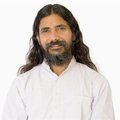
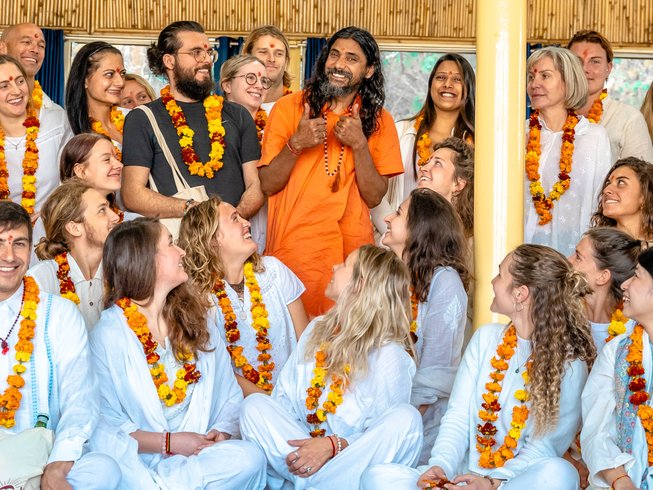
Yogi Vishnu Panigrahi
Guru Vishnu has been devoted to spiritual practice since childhood, guided by traditional teachings and early meditation experiences. He blends ancient yoga wisdom with practical guidance, helping students cultivate mindfulness, inner balance, and self-awareness. Known for his compassionate approach, Vishnu inspires personal growth and a deeper connection to both body and spirit.
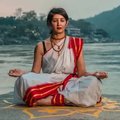
Anita Mander
Anita is a 500-hour RYT Kundalini and Tantra yoga and a 200-hour RYT multi-style yoga Vinyasa and Hatha yoga trained teacher. She is also a Level 1 and 2 cobra breath teacher, initiated through the lineage of Grand Master Sunyata Saraswati, as well as yoga Nidra and 50 hours of Ayurveda training. She passed her Reiki levels 1 and 2 and trained directly under the 10th lineage of Dr. Usui. She teaches Kundalini and Tantra styles at Kundalini Yoga Ashram, World Peace Yoga School, and Samadhi Yoga Ashram. She also teaches Kundalini and Tantra with Profit 28 and Santosha Yoga.
Location
What better environment could you imagine for your yoga teacher training than one with breathtaking landscapes, authentic yoga vibes, a healthy lifestyle, delectable vegetarian alternatives, and world-class gurus to learn from? That is how yoga teacher training in Bali Yoga Retreats is structured, and the good news is that it is less expensive than the majority of courses offered in other yoga schools in Bali. Because of this, it has become one of the top locations for yogis looking to advance their practice or embark on a new profession as a yoga instructor.

Food
The daily meal plan includes three meals, as well as water, tea, and detox juices. Every meal will energize and uplift your body, allowing you to keep going all through the intensive training. All food is prepared fresh, within a brief moment after being prepared, to ensure that you receive the maximum amount of vital energy or life force energy from it.
The following meals are included:
- Brunch
- Lunch
- Dinner
- Drinks
The following drinks are included:
- Water
The following dietary requirement(s) are served and/or catered for:
- Vegetarian
- Yogic
Things to do (optional)
Explore the beaches of Bali, including Kuta, Seminyak, and Nusa Dua
Take a guided hike to Mount Batur for sunrise
Visit the Tirta Empul Temple and experience the holy spring water ritual
Join a Balinese cooking class
Experience a traditional Balinese dance performance
Go snorkeling or diving at Nusa Penida or Menjangan Island
Enjoy a spa day or Ayurvedic massage
Explore Ubud’s Monkey Forest and artisan markets
Take a day trip to the rice terraces in Tegalalang
Participate in a meditation or wellness workshop
Visit local waterfalls such as Tegenungan or Sekumpul
Enjoy a river rafting adventure on the Ayung River
Spa treatments
Ayurvedic Massage – Traditional massage using warm herbal oils to balance doshas. (Optional, extra cost)
Shirodhara – Warm herbal oil poured gently on the forehead to promote deep relaxation and mental clarity. (Optional, extra cost)
Abhyanga Full-Body Massage – Gentle rhythmic massage for overall wellness and detoxification. (Optional, extra cost)
Hot Stone Massage – Uses heated stones to relieve muscle tension and improve circulation. (Optional, extra cost)
Reflexology Foot Massage – Targets pressure points on the feet to stimulate organ systems and improve energy flow. (Optional, extra cost)
Herbal Facial Treatment – Natural Ayurvedic ingredients to rejuvenate and nourish the skin. (Optional, extra cost)
Detoxifying Body Scrub – Removes dead skin cells and promotes a healthy glow. (Optional, extra cost)
Included Wellness Treatments – Some daily wellness sessions, such as guided meditation or light self-massage techniques, may be included in the course package.
What's included
- Certificate of completion
- Outdoor yoga class
- Weekend excursions
- Kirtan session
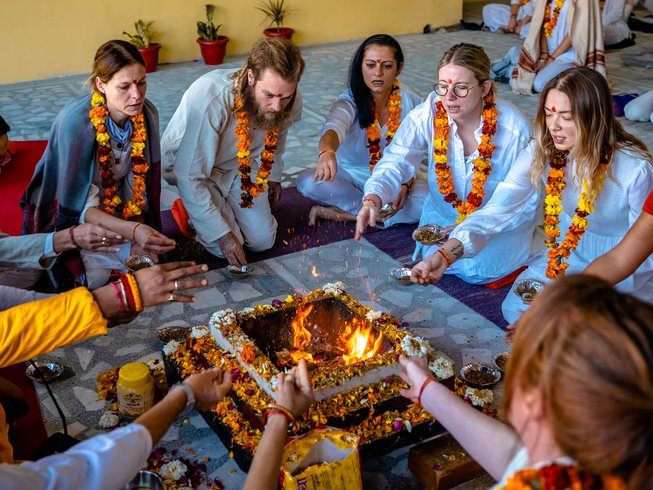
- Sacred Fire Ceremony
- Balini Culture experience
- 24 nights accommodation(air conditioned room)
- Daily nutritious meals
- Yoga material
- Towels and bed sheets
- Online pre-recorded preparatory course videos after booking
What's not included
- Medical expenses
- Insurance
- Ayurveda consultation
- Visa
- Panchkarma
- Toiletries
How to get there
Recommended Airports
Transfer available for additional US$ 35 per person
Ngurah Rai International Airport
35 km away from your destination
Arrival by airplane
Please book your flight to arrive at Ngurah Rai International Airport (DPS). You can find many taxi services from this airport to the school. It takes anywhere between 60 minutes to 70 to 80 minutes depending on traffic.
Cancellation Policy
- A reservation requires a deposit of 30% of the total price.
- The deposit is non-refundable, if the booking is cancelled.
- The rest of the payment should be paid on arrival.

Reviews
For this organizer you can guarantee your booking through BookYogaTeacherTraining.com. All major credit cards supported.