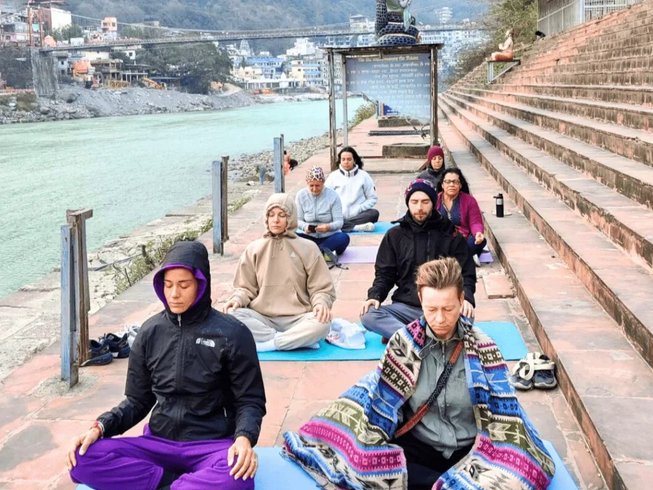


58 Day 500-Hour Yoga Teacher Training in Rishikesh, India
Transformative Yoga Teacher Training in India
The 500-hour yoga teacher training in Rishikesh is completed over 50 days. This course is highly recommended for all yoga practitioners since it is a perfect mix of the foundation course called 200 hours yoga TTC and the next level of practice and information taught in the 300 hours yoga TTC. The 500-hour yoga TTC in Rishikesh is a highly well-rounded course where yoga practitioners can fully submerge themselves in yoga for extended periods. This means a calmer and focused mind and a more flexible body. After completing such a wonderfully intense course, your body and mind will indeed feel to make yoga a part of your daily routine.
Meet the instructors
Highlights
- Gain a better understanding of the ancient Hatha yoga style
- Practice ways to calm your mind through meditation techniques
- Learn how Mudras play an essential role in Hatha yoga
- Learn how to eliminate stress and anxiety with the help of Yoga Nidra
- Purify your body using yogic cleansing techniques like Neti
- Eat delicious and freshly prepared food three times daily
- 57 nights accommodation
Skill level
- Beginner
- Intermediate
- Advanced
Types
57 days with instruction in English
Accommodation
Facilities
- Special menu request
- Yoga shala
- Free Wi-Fi
- Laundry
- Tour assistance
You’ll be staying at the Hatha World Retreat Center, with accommodation options including a private room, a shared double room, or a shared triple room—choose what suits you best for comfort and connection.
Program
The yoga teacher training in Rishikesh, India, makes it easy for you to carry this ancient wisdom and gift everywhere and always. In the 200-hour yoga TTC, students gain a strong foundation in yoga and the practice, including (but not limited to) asanas, pranayama, and meditation. The foundation course opens the doors to a much bigger world of yoga and will surely make you eager to learn and practice more in the 300 hours of YTTC. If you would like to teach yoga and share it with the world, you will, without a doubt, feel confident in your abilities as a yoga instructor, guiding and helping the people around you.
Course highlights of 500-hour yoga teacher training in Rishikesh
- Gain a better understanding of the ancient Hatha Yoga style
- Discover how important it is to incorporate yoga into daily life and see how yoga is still relevant in the modern world when seen as a lifestyle
- Practice ways to calm your mind through meditation techniques
- Gain control over your breathing patterns with pranayama techniques
- Learning about human body anatomy will teach you how to move your intelligent body and the functions of asanas
- In the Art of Alignment sessions, you will understand how to modify asanas according to different body possibilities, limitations, and particular needs
- Learn how to chant Mantras and discover the inner peace and calmness that follows
- Learn how mudras play an essential role in Hatha yoga
- Learn how to eliminate stress and anxiety with the help of Yoga Nidra
- Purify your body using yogic cleansing techniques like Neti
- Learn how to teach a class and gain the tools and skills to do so confidently
- Eat delicious and freshly prepared food three times daily, made with love and of local fresh produce
- Experience India’s colorful and beautiful culture and explore beautiful nature on tours and excursions
The 200-hour yoga teacher training course is mandatory before the 300-hour yoga teacher training course. The 500-hour YTTC combines the 200-hour yoga teacher training course and the 300-hour yoga teacher training course. Hatha Yoga World offers a 500-hour yoga TTC in Rishikesh by the foothills of the Himalayan mountains at the beautiful school Hatha Yoga World.
Who offers the Yoga Alliance registered Master level, called 500 hours yoga teacher training? The 500-hour yoga teacher training course in Rishikesh, India, at Hatha Yoga World lasts two months. Hatha Yoga World is a 5/5 star ranked yoga school in Rishikesh and is one of the most reputed yoga teacher training schools in Rishikesh. With this certificate, you can complete an advanced course, register as a yoga teacher, and teach worldwide. You can jump into this learning experience as a beginner or a practitioner looking to deepen an already existing yoga practice and knowledge. The 500-hour yoga TTC will undoubtedly be a self- and life-transforming experience.
Curriculum
1. Hatha yoga (traditional yoga)
Hatha yoga involves performing foundational yoga postures. It is an essential and finished framework that helps the practitioner self-realize. Hatha yoga is the traditional and first kind that gives you the real taste of the essence of yoga. When you think of yoga, you tend to look towards the West and its various styles of yoga. All these practices have one common approach: Hatha yoga.
This branch of yoga uses postures to preserve and increase the vital force (Prana) in the body and mind. Hatha yoga is a well-known style that helps you to gain purification mentally and physically. The practice is a tool to grow spiritually through transformation.
2. Ashtanga Vinyasa
This style of yoga was made famous by a man called K. Pattabhi Jois in the 20th century. The style is a flow where you coordinate the breath and movements. Asanas are linked by performing a specific flow called a ‘Vinyasa.’ Each asana in Ashtanga yoga is part of a set sequence. The purpose of the asanas is to increase the strength and flexibility of the body. Five rounds of Surya Namaskar (sun salutations) are performed when practicing Ashtanga Vinyasa. After the sun salutations, standing asanas are practiced, followed by a series and a closing sequence.
3. Vinyasa yoga
Vinyasa is a flow, and the movements are practiced in coordination with the breath, which brings a sense of natural balance. ‘Vi’ means specially, and ‘Nyasa’ means to place. The word ‘special’ explains the intention and choice behind a movement, the logic of placement, and how the placement is arranged. Vinyasa is a fast-paced practice in which you experience smoothly from one posture to the next, using breath and gaze for steady alignment.
4. Yin yoga
A Yin yoga practice is characterized by long static holds, allowing for a meditative focus, self-reflection, letting go of stored emotions and thoughts, to surrender and find stillness. It is a powerful self-healing practice. The two opposite energies of Yin and Yang are similar to the principle of the duality of Ida and Pingala Nadis, which are the channels you work with in traditional Hatha yoga. The two energies can be used to benefit different people in different situations.
5. Art of alignment (proper alignment, adjustment, and modification)
In traditional Hatha yoga, alignment is the key to practicing without injuries. Modification is the way to unite all level practitioners in the same session. You will be able to gain the full benefits of a pose when practicing with the right body alignment.
6. Pranayama (breathing techniques)
Prana is the vital force, the essence of the entire creation. ‘Pranayama’ combines the Sanskrit words ‘Prana’ and ‘Ayama.’ ‘Prana’ is the principle of life or aliveness. ‘Ayama’ means expansion or the extension of the range of Prana. Pranayama purifies the energy channels and increases the energy flow within the body. There are many Pranayama practices, and you can adopt them as a part of your daily Sadhana. ‘Bhastrika’ can increase the level of Prana, ‘Nadi Shodhana’ can bring harmony to personality, and ‘Bhramari’ is a tranquilizing Pranayama. By practicing Pranayama, you can learn to control the subtle energies within the body and gain full control over the mind.
7. Anatomy and physiology of yogic practices
Important topics in anatomy include the skeletal, muscular, and cardiovascular systems. The skeletal, muscular system is responsible for movement and posture and comprises muscles, bones, and joints. The cardiovascular system is complex and vital for maintaining health and well-being. Understanding its structure, function, and disorders is important for anyone interested in yoga, health, and medicine.
8. Meditation
Through meditative awareness, one gains intuitive knowledge, which removes the boundaries of the conditioned mind, thus bringing one closer to their source. Meditation is a state of concentrated attention to an object of thought or awareness. It usually involves turning the attention inward to a single point of reference. In yoga, it is seen as a means to spiritual mastery. Mediation trains the mind like asanas train the body.
9. Yoga philosophy and history
No one knows exactly when yoga began, but it predates written history. Stone carvings depicting figures in yoga positions have been found in archaeological sites in the Indus Valley dating back 5,000 years or more. The tradition of yoga has always been passed on individually from teacher to student through oral teaching and practical demonstration. The formal techniques now known as yoga are, therefore, based on the collective experiences of many individuals over many thousands of years. One of the earliest texts describing Yoga was written by a scholar named Patanjali. Patanjali set down yoga theories and practices of his time in a book called ‘Yoga Sutras.’
10. Teaching practice and methodology
Be sure to have a balance of exercises in the class. Give the same time to forward bends, backward bends, side bends, and spinal twists. Integrate hip-openers and balancing poses as inversions. Having a list of precautions available for certain exercises is also good. Ask new people if they have heart problems or back problems.
11. Self practice
Self-practice means gaining your own experience, and this is key. It helps you understand the knowledge you have learned. You realize what you understand or do not, and accordingly, you can move further in your practice. Discuss with your teacher what is next in your practice, or if you gain enough experience and confidence, you will feel what the next level is for you in your practice.
12. Mantra chanting
Mantra chanting is a part of ‘Bhakti yoga’ (devotion). It is a part of any asana class at Hatha Yoga World. A simple chant like “OM Shanti Shanti Shanti” is a powerful way to end a class. The mantra means ‘peace.’ Another example of a chant is “Lokah Samastah Sukhino Bhavantu.” It means ‘let the entire world be happy’ and is a good intention to set any day.
13. Kriyas (cleansing process)
The science of purification to achieve a state of higher consciousness. The first step is the purification of the body. When the body is detoxified, energy blockages are removed. Examples of Kriyas taught at Hatha Yoga World are ‘Neti,’ which is a process of cleansing and purifying the nasal passages, ‘Kapalbhati’ which is a breathing technique that clears the frontal portion of the brain, ‘Trataka,’ which is gazing at one point or at an object to develop the optimum concentration and one-pointed awareness and ‘Nauli’ which is the rotation of the abdominal muscles and it massages and tones the abdominal organs.
14. Ayurveda
Ayurveda is an ancient and one of the oldest medical systems that originated in India over 3,000 years ago. ‘Ayurveda’ means ‘science of life’ and is a natural and holistic approach to preventing and healing disease physically, mentally, and emotionally. An important aspect of Ayurveda is to know which of the three Doshas is most dominant in the body. The three Doshas are called Vata, Pitta, and Kapha and are elements of which the body is made.
15. Karma yoga
‘Karma yoga’ or the ‘discipline of action’ is a form of yoga based on the teachings of the Bhagavad Gita. Karma Yoga is an important step in the process of higher Sadhana. It cleans the impurities of the mind and purifies the soul. Only when the mind and soul are purified can one move toward higher levels of meditation or consciousness. In the course, you will practice Karma yoga by keeping your room clean and helping with keeping the shared facilities clean by washing your dishes and tidying up the dining hall.
Daily Schedule
- 06:00 Wake up
- 06:15 Ayurvedic tea
- 06:30 Neti kriya
- 07:00 - 08:00 Pranayama (breathing class)
- 08:00 - 10:00 Hatha yoga with proper alignment and adjustments
- 10:00 - 11:00 Breakfast
- 11:00 - 12:00 Philosophy
- 12:00 - 13:00 Anatomy and physiology
- 13:00 - 14:00 Lunch
- 14:00 - 15:00 Self-study
- 15:00 - 16:00 Yoga alignment
- 16:00 - 18:00 Hatha Vinyasa flow
- 18:00 - 19:00 Mantra chanting, meditation, and yoga Nidra
- 19:00 - 20:00 Dinner
- 21:00 Lights off
Instructors

Pankaj Seth
Pankaj is born and raised in the holy city of Varanasi. Over many years of sadhana and teaching experience, Pankaj has developed a deep understanding of the body. By observing the body and the potential of practitioners, Pankaj has the ability to guide students to explore their limits. After working with Western people, Pankaj has gained an understanding of the modern mind and body and how imbalances affect people. Pankaj helps students to deal with mental and physical challenges to bring clarity, balance, and freedom into their life.

Julie Seth
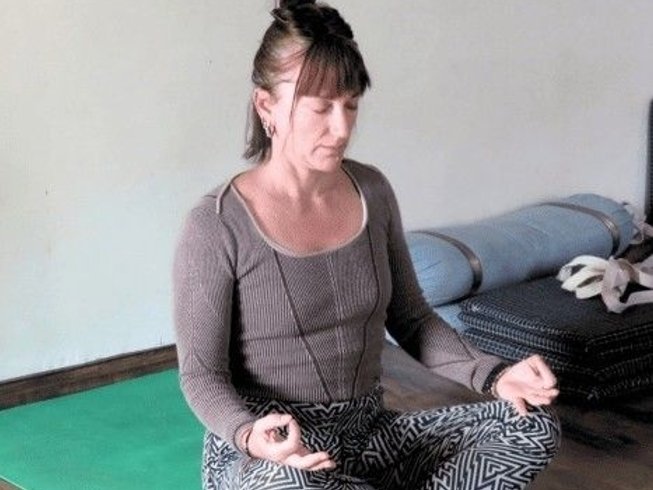
With a spiritual perspective, Julie focuses on chakras, meditation, philosophy, and pranayama and leads the way to this knowledge with a warm-hearted female energy. She teaches Hatha Vinyasa which is a mixture of the best from the two styles and Yin yoga. Always paying respect to the root and true essence of yoga, she has a spiritual approach in her teachings but also covers practical topics like how to create a yoga asana sequence with a theme focus. The theme could be chakras, the five elements, etc. You will receive plenty of tools from Julie to become a confident and compassionate teacher.

Rajnikant Singh
Rajnikant Singh was born and grew up in Delhi. He was drawn to the power and subtlety of the 'breath' in the form of meditation, which opened him to inner and outer calmness. His yoga journey began four years ago when he left his career in the finance sector and fulfilled a lifelong ambition of becoming a yoga teacher. He now teaches yoga anatomy in Rishikesh. Inspired to follow his passion, he practiced the Iyengar style of yoga and continued to study on deeper levels where he sighted acumen and assertion of what he had been finding on his own through practice.
Location
The training will take place in Rishikesh, India.

Food
You will be provided with 3 daily, delicious, freshly prepared meals, made with love and of local fresh produce. All the drinks including lemon ginger honey tea, Green tea and black tea are included.
The following meals are included:
- Breakfast
- Lunch
- Dinner
- Drinks
The following drinks are included:
- Tea
The following dietary requirement(s) are served and/or catered for:
- Vegetarian
What's included
- Certificate of completion
- Evening walks/meditation/mantra chanting/video shows, etc.
- 57 nights accommodation
- Daily vegetarian meals and drinks
- Manual
- Study materials
- Neti pot and cleansing process materials
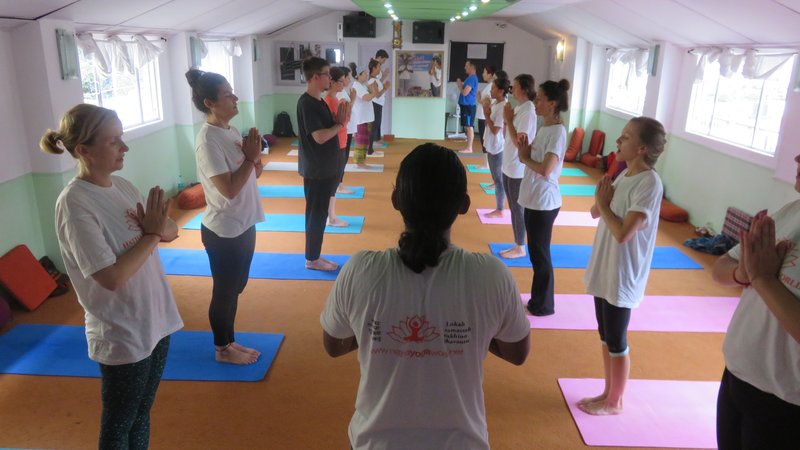
- Hatha Yoga World printed t-shirt
- High-speed Wi-Fi
- All the drinks (lemon ginger honey tea, green tea and black tea)
What's not included
- Airfare
- Airport transfer
- GST
How to get there
Recommended Airports
Transfer available for additional US$ 20 per person
Jolly Grant Airport
15 km away from your destination
Cancellation Policy
- A reservation requires a deposit of 30% of the total price.
- The deposit is non-refundable, if the booking is cancelled.
- The rest of the payment should be paid on arrival.

Reviews
For this organizer you can guarantee your booking through BookYogaTeacherTraining.com. All major credit cards supported.
Similar Yoga Teacher Training you might like
You recently viewed