
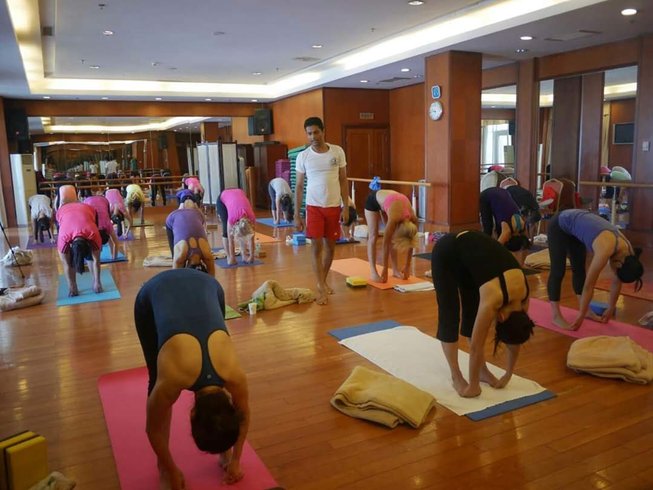
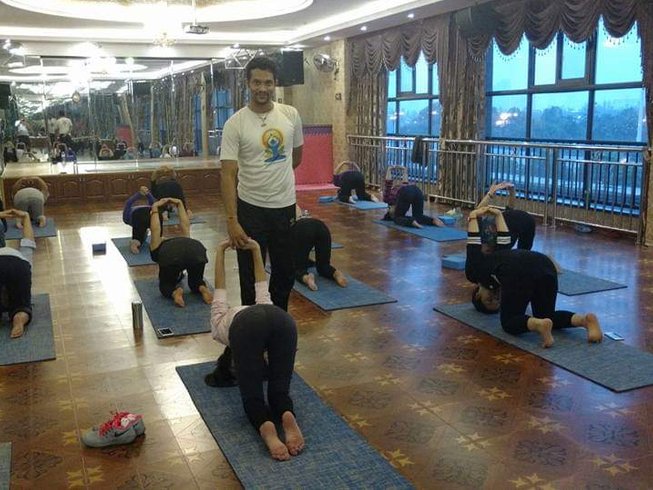
26 Day Hatha Yoga 200-Hours Teacher Training Course in Mysore, India
Credited Yoga Teacher Training in India
This course will empower your physical and mental well-being as you learn to teach a complete classical Hatha yoga system. The course is structured to understand the traditional yogic way of self-practice and the new-age yogic way of teaching. Practice yogic breathing, study anatomy and physiology for yoga, and learn a teaching methodology surrounded by the relaxing vibes of Mysore, India.
Highlights
- Daily yoga classes
- Study ethics and business for yoga
- Study anatomy and physiology for yoga
- Daily active and passive meditation sessions
- Learn philosophy of Pathajali and yoga Sutras
- Buffet lunch served on Saturdays and weekday vegetarian meals
- 25 nights accommodation
Skill level
- Beginner
- Intermediate
Types
25 days with instruction in English
Accommodation
Facilities
- Air-conditioned rooms
- Café
- Kitchen
- Dry cleaning
- Free Wi-Fi
- Ironing / ironing board
- Laundry
The Nirvana Yoga Shala center has accommodation available within the school. You can stay either in a private room with a private bathroom, a private room with private bathroom and air-conditioner, or a private room with a king or queen size bed, air conditioner, living room, a kitchen, and a private balcony. The general facilities for students include security, hot water jacuzzi and shower, free Wi-Fi connection, and a roof top chill-out lounge.
Program
Course description
The course presents strong emphasis on the Classical Hatha Yoga series. Trainees are expected to maintain a daily yoga practice during the training.
The course includes the following areas of study:
- Asana level 1 and 2
- Yogic breathing practice
- Anatomy and physiology for yoga
- Philosophy of Patanjali Yoga Sutras
- Teaching methodology
- Active and passive meditations
- Ethics and business of yoga
Course objectives
- Trainees will be able to practice and teach Level 1 and 2 asana sequence and able to do self practice and teach
- Trainees will be able to use yoga accessories like belt, bricks, and bolsters to reach desired goal of yoga and also how to practice / teach injury free yoga practice
- Trainees should able to teach led classes on Level 1 and 2 series, pranayama, and able to lead meditation sessions
- Trainees will learn philosophy of Patanjali Yoga Sutras, Samadhi Pada, and Sadhana Pada
- Trainees will learn yogic breathing techniques called pranayama
- Trainees will learn active and passive meditation techniques
- Trainees will learn applied anatomy for yoga and understand articulation of body parts based on asanas
- Trainees will learn basic skills in business, marketing, and ethics of yoga
Asana practice Level 1 and 2 and teaching methodology (96 hours)
First and second week Level 1: led class focus on basic stretches, surya namaskar A (sun salutations), standing poses, sitting poses, supine poses, prone poses, and finishing sequence. Total 45 individual asanas will be covered. Second week focus on self practice alignments and adjustments from faculties and trainees.
Afternoon class focus on individual poses, how to practice alignment correctly, using yoga accessories like belt, bricks, bolsters, how to lead led class, hands on adjustment, etc.
Third and fourth week level 2: led class focused on advance stretches, surya namaskar B and advance poses of standing, sitting, supine, prone, and finishing sequences. Total 40 advance individual poses will be covered.
Fourth week trainees lead the led class and will be able to give hands-on adjustments and alignment. Practical exam evaluated by faculties of Mystic School.
Pranayama - yogic breathing practice (24 hours)
First and second week: techniques covered kapalabhati, bastrika, ujjai, nadi shodana, surya bhedana, chendra bedana, anuloma-viloma, shithali, shitkari, and bramari.
Third and fourth week: advance variations of first and second week practice, bandas, mudra will be added.
Fourth week: trainees will lead the class and practical exam evaluated by Mystic School faculties. Pranayama is control of breath”. “Prana” is breath or vital energy in the body. On subtle levels prana represents the pranic energy responsible for life or life force, and “Ayama” means control. So pranayama is “control of breath”. One can control the rhythms of pranic energy with pranayama and achieve healthy “body-mind”.
Anatomy and physiology (20 hours)
Covering some of the basics of muscular skeletal anatomy you will also be looking closely at joint mechanics, where movement comes from, the nature of body tissues and how they are affected through yoga. Sessions will include multimedia presentations, hands on anatomy, case studies of injuries, and why difficulties with certain movements can occur.
Lectures to include:
- Anatomy basics, terminology, movements, and surface anatomy
- How tissues are affected during asana
- The nervous system
- The spine and intervertebral disc
- The knee
- The hip
- The shoulder and elbow
- The ankle and balance postural analysis
Meditation (20 hours)
Techniques covered:
- Intoning the sounds
- Third eye
- Nadabrahma
- Osho Kundalini
- Chakra sounds
- Chakra breathing
- Gourishankara
- Relaxing body and mind
- Conscious sleeping and dreaming
- Vipasana and Zazen
The entire Eight Limbs of the Patanjali system are also sometimes referred to as Dhyana or the meditative path, although strictly speaking, only the last 4 limbs constitute meditation Pratyahara, Dhyana, Dharana, and Samādhi. The preceding steps are only to prepare the body and mind for meditation. Meditation starts by being separate from the mind, by being a witness. That is the only way of separating yourselves from anything.
Many meditative techniques require one to sit still and silent. But for most accumulated stress in the body-mind makes that difficult. Before you can hope to access your inner powerhouse of consciousness, you need to let go of your tensions. Active meditations have been scientifically designed by Osho for the contemporary man. The activity itself creates the situation in which passivity happens.
Yoga Sutras (20 hours)
196 Sutras of Patanjali has been divided into 4 chapters:
- Chapter 1: Samadhi Pada (concentration)
- Chapter 2: Sadhana Pada (practice)
- Chapter 3: Vibhuti Pada (progressing)
- Chapter 4: Kaivalya Pada (liberation)
Yoga Sutras of Patanjali succinctly outlines the art and science of yoga meditation for self-realization. It is a process of systematically encountering, examining, and transcending each of the various gross and subtle levels of false identity in the mind field, until the jewel of the true self comes shining through.
When Patanjali codified, or compiled the Yoga Sutras, it was not that a new system was created, but rather, the ancient practices were summarized in an extremely organized and scientific way.
Chapters 1 and 2 will be covered during this course.
Ayurvedic diet, ethics, and business of yoga
On Saturdays ^guest lecturers will be invited to talk on Ayurvedic yogic diet, ethics, cultural, and traditional inheritance of yogic schools of India and how to set up a studio to teach yoga and business of yoga.
Materials
- The course will provide full manual which cover all the modules of syllabus
- Pre reading of books are mailed and students are expected to read themselves from yoga related professional shop or online
- Dropbox sharing of all course material to keep - a copy in computer
Prerequisites
- The practitioners are expected to have minimum one year of any style of yoga practice before they can be accepted onto this course. The style of yoga can be Shivananda, Hatha, Ashtanga, Power, Bikram, Vinyasa, or any other style of yoga
- Prior notice is a must in case of practitioners having major injuries, chronical health issues, or psychological issues
Evaluation procedure and grading criteria
- Trainees will be accessed on asana performance, teaching led class, and hands on adjustments
- Trainees should able to teach pranayama class including the names of each techniques and contraindications of each techniques
- If the trainees get injured during the course and could not continue the course, certification will not be given and the school will not offer partial or full refunds
Please note: on the last day of the course there will be certification distribution ceremony and dinner get together party will be organized.
Attendance
The trainees should attend 90% of all the classes during the course. In the event of health situation or injuries, students can miss a few classes and should take special classes on Sunday.
Code of conduct and shala policies
The code of conduct outlines proper behavior, such as active inclusion, respect for student-teacher relationships, consent-based touch, and honesty in communications within all the programs, classes, appropriate dress code for the meditation and yoga classes and other offerings.
No alcohol, drugs, or any addictive substance are allowed during the student’s stay at Nirvana yoga Shala.
The code of conduct applies to every Nirvana Yoga Shala member. It applies to both the teacher and the students. It sets out acceptable, recommended, required, and prohibited professional and ethical behaviors by which members agree to conduct themselves and are based upon core values intrinsic to the practice of yoga and meditation.
Attendance policy
Missing training hours
Certification from the program requires the student’s attendance for 100% of training sessions. Acceptable reasons to miss classes are temporary sickness (i.e. fever, cold, and headache) or absolute emergency calls from home or work. No matter the reason, all absences must be informed and approved in advance by the teachers before missing each class.
Leaving class before class ends also falls under missing training hours section of the attendance policy. If the student has an absolute emergency and needs to leave an on-going class, please inform reasons to the teacher immediately.
In the case that a student missed training hours over maximum hours allowed by Nirvana Yoga Shala even though with acceptable reasons and advanced notices, Nirvana Yoga Shala may decide that the student needs to retake the course to complete training hours as required by Yoga Alliance.
Nirvana Yoga Shala does not accept unapproved absences and they may result in dismissal from the program without refund. In this case, graduation will be at the sole discretion of the Nirvana Yoga Shala teacher.
Anti-harassment policy
Harassment is unwelcome verbal or non-verbal conduct where:
(i) the conduct shows hostility or aversion towards the person and has the purpose or effect of unreasonably interfering with their work, study, or other activity
(ii) enduring the offensive conduct becomes a condition of the continued relationship, and/or
(iii) the conduct has the purpose or effect of creating an environment that a reasonable person would consider intimidating, hostile, or abusive
Harassment includes name calling, negative stereotyping, insults, intimidation, ridicule, threatening, intimidating or hostile acts, and display of written or graphic material that shows hostility or aversion toward a student or toward a teacher or an employee in the Nirvana Yoga Shala.
Harassment includes, but is not limited to: offensive verbal comments related to age, gender, gender identity, sexual orientation, race, ethnicity, culture, national origin, religion, body type, personal appearance, physical or mental ability, socioeconomic status, marital status, political activities or affiliation, or any other basis proscribed by local, state, national regulations; deliberate intimidation; stalking; following; harassing photography or recording; sustained and intentional disruption of class or other events; and inappropriate physical contact.
Location
This teacher training will take place at the Nirvana Yoga Shala in Mysore, India. The school is located in the Gokulam suburb, one of the upmarket suburbs in Mysore. It has a convenient location that offers privacy and a friendly environment to hang out with your fellow students.

Food
Vegetarian food will be served. The meals included are breakfast, lunch, and dinner from Mondays to Fridays. On Saturdays, only a buffet lunch is included. On Sunday, meals are not included, but students can try the vegetarian restaurants that are within walking distance from the school.
The following meals are included:
- Breakfast
- Lunch
- Dinner
- Drinks
The following drinks are included:
- Water
- Coffee
- Tea
The following dietary requirement(s) are served and/or catered for:
- Vegetarian
- Ayurvedic
Spa treatments
During this training, you can enjoy Ayurvedic massage services or Reiki sessions for an additional cost at the Mystic School.
What's included
- 25 nights accommodation
- All materials mentioned in the itinerary
- Buffet lunch on Saturdays
- Daily yoga classes
- Full yoga program
- Tuition
- Vegetarian breakfast, lunch, and dinner on weekdays (Mondays - Fridays)
- 18% GST
What's not included
- Additional activities
- Airfare
- Airport transfers
- Breakfast and dinner on Saturdays
- Meals on Sundays
- Spa treatments
- Transportation
How to get there
Recommended Airports
Transfer available for additional US$ 50 per person
Kempegowda International Airport
152 km away from your destination
Arrival by plane
Please book your flight to arrive at Kempegowda International Airport (BLR). Transfer from and to this airport is available upon request for an additional cost. You can ask for a mini cab for around 3,200 (INR), a mini cab with air conditioner for 3,700 (INR), or a SUV cab for approximately 4,700 (INR).
Arrival by bus
From Kempegowda International Airport, you may take a bus to the downtown bus station and then you can take a bus or train to Mysore.
Arrival by train
You can take a train from Delhi to Bengaluru and then change to Mysore.
Cancellation Policy
- A reservation requires a deposit of 30% of the total price.
- The deposit is non-refundable, if the booking is cancelled.
- The rest of the payment should be paid on arrival.

Reviews
For this organizer you can guarantee your booking through BookYogaTeacherTraining.com. All major credit cards supported.
Similar Yoga Teacher Training you might like
You recently viewed