58 Day 500-Hour Multi-Style Yoga TTC & 85-Hour Yin Yang Yoga TTC in Rishikesh, India
All-Level Multi-Style Yin Yoga TTC in India
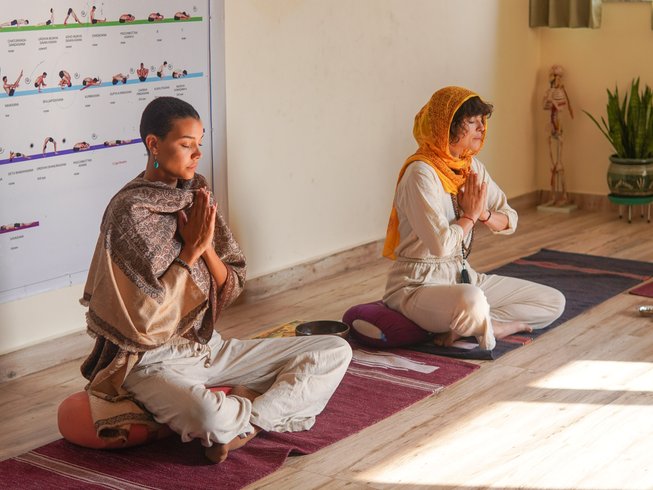
Adi Yoga Ashram welcomes divine souls from all walks of life to join the life-changing and transformative 58-day 500-Hour Beginner to Advanced Multi-style Yoga TTC and Yin Yang Yoga Teacher Training in Rishikesh, India. At the end of the program, Students will receive two certificates, ie, 500 Hour Yoga Alliance (RYT) and 85 Hour Yin Yang Yoga TTC (YACEP).
Meet the instructors
Highlights
- Daily traditional Hatha, Ashtanga-Vinyasa classes
- Daily pranayama – traditional breath work and Shatkarma classes
- Meditation and yoga Nidra classes
- Eligible to register with Yoga Alliance upon completion
- Yoga alignment and adjustment classes with teaching methodology
- Yin yoga classes and yang yoga classes
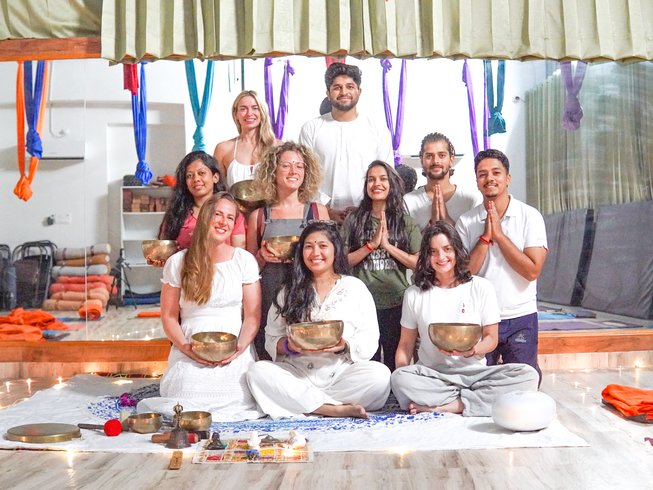
- Sound healing session and cocoon meditation
- 57 nights' accommodation with 3 yogic meals daily
Skill level
- Beginner
- Intermediate
- Advanced
Types
50 days with instruction in English
Accommodation
Facilities
- Air-conditioned rooms
- Dining area
- Lobby
- Luggage room / storage
- Smoke-free property
- Terrace
- Yoga shala
- Currency exchange
- Medical assistance
- Tour assistance
- Wireless internet
Adi Yoga Ashram surroundings and accommodations are some of the best and cleanest spaces in the whole of Rishikesh. Whether you are on a vacation or on a yoga course, amenities make life a little easier when you are away from home. For different types of travel, there are amenities that are more important than others. The school provides three types of accommodations,Dormitory, private and twin shared rooms, and students can choose according to their preferences.
In the room, clean bed sheets, blankets, and pillows will be provided. Every room has an air conditioner and an attached bathroom with cold and hot water for 24 hours. The complete school campus has unlimited high-bandwidth Wi-Fi service. The school is surrounded by serene green mountains which heal the inner soul and the river Ganga flows at walking distance.
Program
Certification
Students who complete the training are eligible to register with Yoga Alliance as Registered Yoga Teachers (RYT®).
The course/hours also count as Continuing Education hours for Registered Yoga Teachers (RYT®) only.
About the training
In this transformative course, you cover in-depth knowledge with the best yoga teachers of Rishikesh of traditional Hatha yoga, Ashtanga-Vinyasa, Yin yoga teaching practice, teaching methodology, asanas alignment, breathing techniques and pranayama, shatkarma, yoga asana's anatomy, Indian yoga philosophy, Yin yoga philosophy, body meridian, Yin yoga sequence, traditional Ayurveda theory, meditation and mantra chanting. The course is suitable for beginners to intermediate levels and advanced students, and it will fully prepare students for their yoga teaching career or self-growth.
The class size is very small, from 15–18 students, so teachers and students can communicate and focus. The 58-day 500-hour intense multi-style yoga and Yin yoga teacher training in Rishikesh, India, is an advanced-level teacher training course. The program will give you in-depth knowledge of the history and origin of yoga asanas and yoga philosophy. The 500-hour yoga program is designed to cultivate your skills and knowledge in yoga at an advanced level and evolve your teaching style. This advanced-level teacher training course is a two-month program that is divided into three levels.
The first level of 24 days focuses on the foundational 200-hour module, and from the 24th to 30th, Yin yoga 7-day 85-hour course, followed by 28 days of intensive 300-hour training next month. The program allows students to dive deep and experience yoga from different dimensions. Delve deep into the philosophy of yoga through the Yoga Sutra of Patanjali, Bhagavad Gita, and other yoga texts with this advanced yoga teacher training program. You can practice multi-style yoga here, such as Hatha, Iyengar, Ashtanga, and Vinyasa flow yoga. Discover the powerful Sanskrit and Vedic mantras and how chanting them invokes inner peace and calm.
The advanced learning of Yoga Nidra helps you beat stress and anxiety. The course gives you a chance to open the doorways to mental peace and inner freedom with satsangs. Learn to modify asanas to suit particular needs through adjustments and alignment sessions in this two-month program. At the centre, they always advocate small batches to promote student-teacher interactions and enhance the learning experience.
Benefits
This 500-hour beginner to advanced multi-style yoga TTC and 85-hour yin-yang yoga TTC in Rishikesh, India, can be for those who are in search of eternal peace and harmony. This advanced yoga program contains all levels of yogic practices and teachings. The course is aimed at offering a thorough understanding of the principles of yoga, asana, pranayama, yoga therapy, meditation, and so on. Students can experience transformation with the practice of different forms of yoga, such as Ashtanga, Raja, Kundalini, Karma, and Bhakti yoga.
In the training, you will learn many new teaching technique options. This is an intensive 58-day course, designed to deepen and advance your existing knowledge of yoga. Adi Yoga Ashram invites you to grow your individual teaching style and connect to yourself on a deeper level. All the students who complete this yoga teacher training course can teach yoga to advanced students and spread the essence of yoga worldwide.
Why choose Adi Yoga Ashram?
Adi Yoga Ashram in Rishikesh offers you everything that a sadhak (a dedicated practitioner) needs to fulfil his quest for knowledge. A sacred ambience, a disciplined life, a routine of activities, dedicated learning time, and specific and intensive teacher training are only a part of what you get from their yoga school in Rishikesh, India. When you opt for this 58-day 500-hour multi-style yoga, traditional Ayurveda (theory and practical) teacher training course in Rishikesh, India, they offer you an environment for skilful learning from the best yoga teachers and gurus in Rishikesh.
This training course is designed to keep in mind the broader view of yoga, including yoga philosophy, meditation, anatomy, kriya, pranayama, Ayurveda, and the art of teaching. Their main focus is to imbibe yoga with Ayurveda in your daily life. The training is not just a preparation for you to become a yoga instructor, but an exploration of the self.
This course allows you to walk an inward journey, realising who you are and what you are meant to be here for. Adi Yoga Ashram curriculum takes you through the essential elements required to deepen and enrich your own yoga practice and to teach students with confidence. Their expert team of teachers will guide you through the fundamental stages of leading a class to teach with ease and confidence.
Prerequisites
- Dedication and discipline
- The consumption of meat, fish, eggs, alcohol, tobacco, and drugs is prohibited on the school premises
- Nudity is strictly prohibited
- Recommended readings before the course (note: after paying the advance deposit school will provide basic study material PDF as a preparation for the course)
A. 200-hour course overview
1. Mantra chanting
A mantra is made up of specific sounds and vibrations that ancient yogis and seers received after years of dedication and disciplined spiritual practice. The effects of mantras are on a physical, mental, and spiritual level. There are a variety of mantras for various specific purposes. In this course, you will be learning the following mantras:
- Om Asato Maa Sadgamaya
- Aum Namah Shivaya
- Aum Sarveshaam Svsatir-Bhavatu
- Aum Sarve Bhavantu Sukhinah
- Gayatri Mantra
- Aum Asato Maa Sadgamaya
- Aum Brahmarpanam
- Tvameva mata ca pita Tvameva
- Om Tryambakam Yajamahe
- Om sahana Vavatu
- Yogena Cittasya
2. Ashtanga-Vinyasa yoga postures
You will gain extensive knowledge of yoga postures and increase your strength, flexibility, and discipline.
- Ashtanga yoga and introduction
- History of Ashtanga yoga
- Awakening of the inner fire
- Bandhas and their application
- Eight limbs of yoga
- Drishti (focused attention)
- Cleansing and purification
- Creating a sacred practice space
- Use of yoga props and instruments
- Sun salutations A and B (week one)
- Standing series (week two)
- Sitting series (week three)
- Finishing series (week three)
- Teaching practices (traditional as well as Mysore style - week)
Following are the postures to be taught
- Padangustasana or big toes posture
- Pada Hastasana or hand-under-foot posture
- Utthita trikonasana or triangle posture (A and B)
- Utthita Parsvakonasana or extended side angle pose (A and B)
- Prasarita padottanasana or intense wide leg stretch (A, B, C, and D)
- Pārśvottānāsana or intense side stretch posture
- Utthita hasta pādāṅguṣṭāsana or hand-to-big-toe posture
- Ardha buddha padmottānāsana or half-bound lotus forward bend
- Utkatāsana or fierce pose
- Vīrabhadrāsana or warrior pose (A and B)
- Dandasana or staff pose
- Paścimattānāsana or intense west stretch or sitting forward bend
- Pūrvattanāsana or intense east stretch
- Ardha Baddha Padma paścimattānāsana or half-bound lotus forward bend
- Tiryaṅgmukha ekapāda paścimattānāsana or reverse the leg, one leg intense stretch
- Jānuśīrṣāsana or head-to-knee pose
- Marīcāsana or sage marichi pose
- Nāvāsana or boat pose
- Bhujapīḍāsana or shoulder pressure pose
- Kūrmāsana or tortoise pose
- Supta kūrmāsana or sleeping tortoise
- Garbha piṇḍāsana or embryo posture
- Kukkuṭāsana or rooster posture
- Baddha konāsana or bound angle pose
- Upaviṣṭha konāsana or seated angle posture
- Supta konāsana or lying down angle posture
- Supta pādāṅguṣṭāsana or reclining big toe posture
- Ubhaya pādāṅguṣṭāsana or both big toes posture
- Ūrdhva Mukha paścimattānāsana or upward-facing full forward bend
- Setu bandhāsana or bridge posture
Finishing postures
- Ūrdhva dhanurāsana or upward bow posture
- Salaṁba sarvāṅgāsana or shoulder stand posture
- Halāsana or plough posture
- Karṇa pīḍāsana or ear pressure posture
- Ūrdhva padmāsana or upward lotus
- Piṇḍāsana or embryo posture
- Matsyāsana or fish posture
- Uttāna pādāsana or extended leg posture
- Cakrāsana or wheel posture
- Sirsasana or headstand
- Baddha padmāsana or sealed lotus pose
- Yoga mudra or sealed yoga posture
- Padmasana or lotus posture
- Utpluthih or uprooting posture
- Savasana or corpse pose
3. Hatha yoga course syllabus
The word Haṭha literally means force and thus alludes to a system of physical techniques. In India, Hatha yoga is associated with popular tradition.
- Pawanmuktasana series 1
- Pawanmuktasana series 2
- Pawanmuktasana series 3
- Surya Namaskar (sun salutation)
- Chandra Namaskar (moon salutation)
- Tadasana (palm tree pose)
- Triyak tadasana (swaying palm tree pose)
- Trikonasana (triangle pose)
- Parivirtatrikon asana - revolving triangle pose
- Uttkatasana - chair pose
- Virbhdrasana 1 - warrior 1
- Virbhdrasana 2 - warrior 2
- Virbhdrasana 3 - warrior 3
- Ardha Chandrasana - half moon pose
- Vriksasana - tree pose
- Parvatasana - mountain pose
- Adho mukha svanasana - downward facing dog
- Kati Chakrasana - waist rotating pose
- Malasana - squatted yoga pose
- Garudasana - eagle pose
- Baddha Konasana - bound angle pose
- Rajkapoot asana - pigeon pose
- Bhujanghasana - cobra pose
- Urdhva Mukha Svanasana - upward-facing dog
- Matsyasana
- Setu Bhandasana
- Utrasana
- Dhanurasana
- Salabhasana
- Supta Virasana - reclining hero pose
- Virasana - hero pose
- Vajrasana - thunderbolt
- Gomukhasana
- Balasana
- Dandasana
- Ardha Matsyendrasana
4. Pranayama (breathing practices)
Pranayama is an ancient yogic breathing technique that is used as preparation for meditation and is a vital aspect of practicing yoga. It improves the respiratory system and purifies the body and mind.
- Breath and its importance
- Prana and its meaning
- What is pranayama?
- Breath and its connection with the prana
- Pranayama: importance and benefits
- Preparation for breathing
- Aspects of breathing
- Activation of nostrils
- The flow of breath in the five elements
- How does the flow of prana take place?
- Breath retention
- Sitting positions for practices
- Breathing techniques
- Diaphragmatic breathing
- Thoracic breathing
- Clavicular breathing
- Yogic breathing
- Surya Bhedi pranayama
- Chandra Bhedi pranayama
- Nadi Shodhana pranayama
- Sheetali pranayama
- Sheetkari pranayama
- Bhastrika pranayama
- Bhramari pranayama
- Murcha pranayama
- Ujjayi pranayama
5. Mudra (yoga gestures)
The practice of mudra hand gestures is an ancient facet of yoga. Performing gestures affects the energy flow of the body and can change a person's spiritual and mental characteristics.
- Jnana mudra
- Chin mudra
- Yoni mudra
- Bhairava mudra
- Shambhavi mudra
- Nasikagra
- Khechari
6. Bandhas (energy lock)
The practice of Bandhas expands the lung capacity and breathing capabilities during yoga. It also strengthens the entire body from the inside out.
- Preparation
- Uddiyana
- Jalandhar
- Mula Bandha
- Maha Bandha
7. Yoga cleansing (Shatkarma)
Yogic cleansing exercises are important to learn how to incorporate your breath and meditate properly during the physical aspects of yoga. It also removes the blockages in the energy channels.
- Jalaneti satkarma (nasal cleansing with salty water)
- Rubber neti (nasal cleansing with a rubber string)
- Agnisar Kriya
8. Meditation (Dhyana)
Meditation is a systematic practice that promotes physical, mental, and emotional tranquillity with the purpose of reaching Samadhi (self-realization).
- Meditation: history and introduction
- Preparation for meditation
- What meditation is and what it is not
- Aim and objectives of meditation
- Sitting position
- Breathing awareness meditation
- AUM Mantra meditation
- Trataka
- Dynamic meditation
- Walking meditation
- Japa meditation
- Mantra chanting meditation
- Ajapa meditation
- Tips for developing concentration
- Yoga Nidra (psychic sleep)
- Basic relaxation
- Full body relaxation
- Sound healing meditation
9. Anatomy and physiology (Sharir Vijnan)
Proper understanding of the physical body will help to prevent injury before, during, and after practice. There are two kinds of yoga anatomy: physical and spiritual. Understanding both types is needed.
- Physical anatomy
- Introduction to the body and body structure
- Different body planes
- Anatomical movements
- Bones of the skull
- Cervical vertebrae
- Shoulder girdle, arm bones, and pelvic region
- Spine deformities
- Lower extremities
- Tendons and ligaments
- Respiratory system
- Muscular system
- Nervous system
10. Yoga philosophy (Yoga Darshana)
Yoga philosophy is the foundation of your yoga practice and is the key to earning yogic strength. Through the path of Vedanta Philosophy, you will establish a solid, well-rounded yoga practice.
Patanjali Yoga Sutras
- Introduction to the Himalayan tradition of yoga
- Introduction to the different Indian philosophies
- History of yoga
- Yoga Sutra of Patanjali
- Types of yoga
- Eight limbs of yoga
- Yamas and Niyamas (ethics of yoga)
- Philosophy of asana
- Concentration and its power
- Four aspects of the mind
- How to control the mind
- Samadhi and the goal of yoga
- Introduction to Bhagavad Gita
- Chakras
- Kundalini
- Science of Karma
- Indian culture and spirituality
11. Traditional Ayurveda
- Introduction to Ayurveda
- Features of Ayurveda treatment
- Ayurveda and its various diversified areas
- Ashtanga Ayurveda
- Ayurveda and its fundamentals
- Pancha Mahabhutas (five elements)
- Kapha
- Vata
- Pitta
- Know your Prakriti (constitution)
- Food and nutrition
12. Alignment
- Understanding alignment
- Role in daily practice
- Important aspects of alignment
- Decreasing the risk of injuries
- Increase movement in joints
- Alignment based on different body regions
- Upper and lower limb alignment
- Alignment of the torso, thorax, abdomen, and pelvis region
- Head and neck alignment
- Alignment of the spine
- Basic alignment postures
- How to make the body feel at ease
- Finding the balance between mind and body
13. Teaching practice (Adhyapanam)
Students will take turns practicing their teaching skills by performing in front of their peers and teachers.
- Demonstration
- Alignment
- Instructions
14. Teaching methodology
A yoga teacher should efficiently perform the practical applications of class planning and preparation. You will learn how to create a positive and peaceful class environment for an enjoyable and transformative experience.
- Positive and conscious communication
- Friendship and trust
- Time management
- Qualities of a teacher
- Principles of demonstrating, observing, assisting, and correcting
- Use of voice in class
- Mental and emotional preparation for teaching
- Class preparation
- Step-by-step class structure planning
15. Assessments are based on
You will take turns practicing your teaching skills by performing in front of your peers and teachers.
- Written-test
- Teaching practice
- Attendance
- Performance
- Behavior during the course
200 Hour daily schedule (1st of the month)
- 05:00 Morning bell
- 05:30 - 07:00 Traditional Hatha yoga practice or Yin yoga (once a week) and teaching practice
- 07:00 - 08:00 Pranayama, Traditional breathwork, and shatkarma practice and teaching practice
- 08:00 - 09:00 Meditation, chanting, Yoga Nidra, and teaching practice
- 09:00 Breakfast
- 10:30 - 11:30 Yoga anatomy
- 11:30 - 12:30 Self-study and practice
- 13:00 Lunch
- 15:00 - 16:00 Indian yoga philosophy
- 16:00 - 17:30 Ashtanga-Vinyasa yoga and teaching practice
- 17:45 - 18:45 Alignment- adjustment, teaching methodology
- 19:00 Dinner
- 21:00 Lights off
B. 300-hour course overview
1. Recitation of sacred sound (mantra chanting)
- Om Asato Maa Sadgamaya (mantra from Upanishad)
- Tvameva mata ca pita Tvameva (Sloka on gods)
- Om Tryambakam Yajamahe (mantra on lord shiva)
- Om sahana vavatu (mantra from Upanishad)
- Guru Brahma Guru Vishnu Gurudevo maheshwara (Guru stotram)
- Yogena Cittasya (Sloka on sage Patanjali)
- Hare Rama, Hare Krishna (Maha mantra)
2. Yoga postures (asana)
- Ashtanga Vinyasa yoga course syllabus
- Surya Namaskar A
- Surya Namaskar b
3. Full primary series
- 1. Padangusthasana
- 2. Padahasthasana
- 3. Utthita Trikonasana
- 4. Parivrtta Trikonasana
- 5. Utthita Parsvakonasana
- 6. Parivrtta Parsvakonasana
- 7. Prasarita Padottanasana A B C and D
- 8. Parsvottanasana
- 9. Eka Pada Padangusthasana A B C and D
- 10. Ardha Baddha Padmottanasana
- 11. Utkatasana
- 12. Virabhadrasana A and B
- 13. Dandasana
- 14. Paschimottanasana A B C and D
- 15. Purvattanasana
- 16. Ardha Baddha Padma Uttanasana
- 17. Triang Mukaikapada Pashimottanasana
- 18. Janu Sirsasana A B and C
- 19. Marichyasana A B C and D
- 20. Navasana
- 21. Bhujapidasana
- 22. Kurmasana
- 23. Supta Kurmasana
- 24. Garbha Pindasana
- 25. Kukkutasana
- 26. Baddha Konasana A and B
- 27. Konasana
- 28. Upavishta Konasana
- 29. Supta Konasana
- 30. Supta Padangusthasana A and B
- 31. Ubhaya Padanghusthasana
- 32. Urdhva Mukha Pashimottanasana
- 33. Setu Bandhasana
- 34. Urdhva Dhanurasana
- 35. Salamba Sarvangasana
- 36. Halasana
- 37. Karnapidasana
- 38. Urdhva Pindasana
- 39. Matsyasana
- 40. Urdhva Padmasana
- 41. Sirsasana
- 42. Urdhva Dandasana
- 43. Baddha Padmasana
- 44. Yogimudra
- 45. Uplutih
- 46. Savasana
4. Hatha yoga course syllabus
- 1. Pawanmuktasana series 1
- 2. Pawanmuktasana serie 2
- 3. Pawanmuktasana series 3
- 4. Surya Namaskar (sun salutation)
- 5. Chandra Namaskar (moon salutation)
- 6. Tadasana (palm tree pose)
- 7. Triyak tadasana (swaying palm tree pose)
- 8. Trikonasana (triangle pose)
- 9. Parivirtatrikon asana - revolving triangle pose
- 10. Uttkatasana - chair pose
- 11. Virbhdrasana 1 -warrior 1
- 12. Virbhdrasana 2 -warrior 2
- 13. Virbhdrasana 3 -warrior 3
- 14. Ardha Chandrasana - Half moon pose
- 15. Vriksasana - tree pose
- 16. Parvatasana - mountain pose
- 17. Adho mukha svanasana - downward facing dog
- 18. Kati chakrasana - waist rotating pose
- 19. Malasana - squatted yoga pose
- 20. Garudasana - eagle pose
- 21. Baddha Konasana - bound angle pose
- 22. Rajkapoot asana - pegion pose
- 23. Bhujanghasana - cobra pose
- 24. Urdhva mukha svanasana - upward-facing dog
- 25. Matsyasana
- 26. Setu Bhandasana
- 27. Utrasana
- 28. Dhanurasana
- 29. Salabhasana
- 30. Supta Virasana - reclining hero pose
- 31. Virasana - hero pose
- 32. Vajrasana - thunderbolt
- 33. Gomukhasana
- 34. Balasana
- 35. Dandasana
- 36. Ardha Matsyendrasana
5. Pranayama (breathing practices)
Pranayama is an ancient yogic breathing technique that is used as preparation for meditation and is a vital aspect of practicing yoga. It improves the respiratory system and purifies the body and mind.
Week 1
- Introduction of pranayama, benefits of pranayama, general guidelines
- Clavicular, thoracic, and diaphragmatic breathing (yogic breathing)
- Ujjayi
- Bhastrika
- Kapalbhati
- Nadi - Sodhana
- Bhramari
- Surya - Bhedi & Chandra - Bhedi
- Sheetali and Sheetkari
6. Mudra (yoga gestures)
The practice of mudra hand gestures is an ancient facet of yoga. Performing gestures affects the energy flow of the body and can change a person's spiritual and mental characteristics.
- Jnana mudra
- Chin mudra
- Yoni mudra
- Bhairava mudra
- Shambhavi mudra
- Nasikagra
- Khechari
7. Bandhas (energy lock)
The practice of bandhas expands lung capacity and breathing capabilities during yoga. It also strengthens the entire body from the inside out.
- Preparation
- Uddiyana
- Jalandhar
- Mula and Maha bandha teaching
- Teaching
- Doubts
8. Meditation (dhyana)
Meditation is a systematic practice that promotes physical, mental, and emotional tranquility with the purpose of reaching Samadhi (self-realization).
- Introduction to meditation
- Breathing awareness meditation
- Om or Mantra meditation
- Trataka
- Dynamic meditation
- Tips for developing concentration
- Silence practice
- Ajapa Japa
- Antar Mouna
9. Yoga Nidra (psychic sleep)
When a yoga practitioner moves through the various internal states of yoga Nidra, a profound experience of relaxation occurs. This is called "Turiya," a sensation of pure bliss.
- Basic relaxation
- Tension relaxation
- Full body relaxation
10. Yoga cleansing (shatkarma)
Yogic cleansing exercises are important to learn how to incorporate your breath and meditate properly during the physical aspects of yoga. It also removes the blockages in the energy channels.
- Jalaneti Satkarma (nasal cleansing with salty water)
- Rubber neti (nasal cleansing with a rubber string)
- Bhasti
- Agnisar Kriya
11. Anatomy and physiology (sharir vijnan)
Proper understanding of the physical body will help to prevent injury before, during, and after practice. There are two kinds of yoga anatomy: physical and spiritual. Understanding both types is needed.
- Digestive system
- Respiratory system
- Circulatory system
- Nervous system
- Endocrine system
- Organs
- Bodily systems
- Nadis
- Chakras
- Muscular system
- Skeletal system
- Muscle function according to joint movement
- Anatomy of breathing, inversions, and savasana
12. Yoga philosophy (yoga darshana)
Yoga philosophy is the foundation of the yoga practice and is the key to earning yogic strength. Through the path of Vedanta Philosophy, you will establish a solid, well-rounded yoga practice.
13. Patanjali Yoga Sutras
a. Week 1
- Introduction to the Himalayan tradition of yoga
- Introduction to the different Indian philosophies
- History of yoga
- Yoga Sutra of Patanjali
- Types of yoga
b. Week 2
- Eight limbs of yoga
- Yamas and Niyamas (ethics of yoga)
- Philosophy of asana
- Concentration and its power
c. Week 3
- Four aspects of the mind
- How to control the mind
- Samadhi and the goal of yoga
- Introduction to Bhagwat Geeta
d. Week 4
- Chakras
- Kundalini
- Science of karma
- Indian culture and spirituality
14. Teaching practice (adhyapanam)
Students will take turns practicing their teaching skills by performing in front of their peers and teachers.
- Demonstration
- Alignment
- Instructions
15. Teaching methodology
A yoga teacher should efficiently perform the practical applications of class planning and preparation. Students will learn how to create a positive and peaceful class environment for an enjoyable and transformative experience.
- Positive and conscious communication
- Friendship and trust
- Time management
- Qualities of a teacher
- Principles of demonstrating, observation, assisting, and correcting
- Use of voice in class
- Mental and emotional preparation for teaching
- Class preparation
- Step-by-step class structure planning
16. Assessments are based on:
Students will take turns practising their teaching skills by performing in front of their peers and teachers.
- Written test
- Oral test
- Attendance
- Performance
- Behavior
300 Hour TTC daily schedule (2nd of the month)
- 05:00 Morning bell
- 05:30 - 07:00 Traditional Hatha yoga practice or Yin yoga (once a week) and teaching practice
- 07:00 - 08:00 Pranayama, Traditional breathwork, and shatkarma practice and teaching practice
- 08:00 - 09:00 Meditation, chanting, Yoga Nidra, and teaching practice
- 09:00 Breakfast
- 10:30 - 11:30 Yoga anatomy
- 11:30 - 12:30 Self-study and practice
- 13:00 Lunch
- 15:00 - 16:00 Indian yoga philosophy
- 16:00 - 17:30 Ashtanga-Vinyasa yoga and teaching practice
- 17:45 - 18:45 Alignment- adjustment, teaching methodology
- 19:00 Dinner
- 21:00 Lights off
C Yin-Yang Yoga course syllabus
Yin philosophy
- Meaning and importance of Yin yoga
- History and origin of Yin yoga
- Understanding the concept of yin and yang
- Yin and Yang organ
- Yin yoga in daily life
- What is Yang yoga
- Yin tattva
- Tao and yin
- Chakra
- Nadis
- Understanding yoga and Yin
Body meridians
Meridians are energy channels that transport energy and life through your body. They affect how you think, feel, and your overall health. When the meridian pathways are open and clear, pranas freely flow through your body to maintain harmony and balance. Practitioners are taught asanas that target these body meridians.
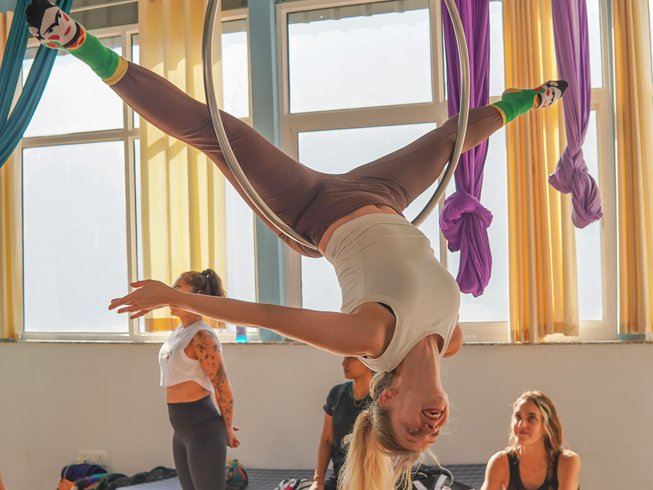
Aerial Yoga
Mudras
Practitioners learn the technique of using seals or gestures to facilitate the flow of energy in the body.
- Jnana mudra
- Chin mudra
- Yoni mudra
- Bhairava mudra
- Hridaya mudra
- Shambhavi mudra
- Nasikagra mudra
Bandhas
Practitioners learn the technique of consciously blocking and unblocking energy flow to different parts of their body.
- Mulabandha
- Uddiyana
- Jalandhar
- Maha Bandha
Yin pranayama
- What is prana and pranayama
- How to take Yin breath
- Types of breathing
- Healing pranayama
- Yang breath
- Cooling breath
- Breathing and Yin movements
- Different from normal pranayama
Yin yoga asana
- Camel pose
- Cat pulling its tail pose
- Caterpillar pose
- Child’s pose
- Dangling pose
- Deer pose
- Dragon pose
- Melting heart pose
- Ankle stretch pose
- Banana pose
- Half butterfly pose
- Butterfly pose
- Frog pose
- Happy baby pose
- Reclining spinal twist pose
- Saddle pose
- Shoelace pose
- Snail pose
- Sphinx pose
- Seal pose
- Square pose
- Squat pose
- Straddle pose
Yang practice
In contrast to Yin, Yang is a more active practice that works on the muscles, blood flow, building strength, stamina, and flexibility. Practitioners learn Yang styles of yoga, which involve rhythm and repetition quite like the Ashtanga-Vinyasa flow.
Anatomy
Learn more about the anatomy of the body to better understand safe and stable physical alignment in yoga poses. Pick up in-depth knowledge to take to the mat to fine-tune and deepen your practice.
- Tissues
- Joints and movement
- Systems
- Compression and tension in the body according to Yin postures
Alignment and adjustment
- Purpose of props and support material
- Right placement of the props
- Contraindications and challenges
- Overcoming teaching challenges
Meditation and yoga Nidra
- Meaning and purpose of meditation
- Meditation and yoga Nidra
- Practices
- Technique 1: Basic relaxation practices
- Technique 2: Visualization yoga Nidra
- Technique 3: Chakra awareness yoga Nidra
- Technique 4: Inner flame yoga Nidra
Teaching methodology
The assistants will help students with modifications, props, alignment, and physical assistance. This is a great way to gain experience. Once this has been mastered, teaching friends in small groups, semi-private, or private sessions is a good way to develop inner confidence.
- Explaining the art of teaching Yin postures
- Building teaching skills
- Building communication skills
- Preparing for a class
- Managing a class
- Overcoming teaching challenges
Students will take turns practising their teaching skills by performing in front of their peers and teachers. Assessments are based on:
- Attendance
- Performance
- Behavior
Yin-Yang daily schedule Yin yoga from the 24th to the 30th of the month
- 05:00 Wake up
- 05:30 - 07:00 Yin Yoga asana practice and teaching
- 07:00 - 08:00 Pranayama / mudra and shatkarma
- 08:00 - 09:00 Meditation and Yoga Nidra
- 09:00 Breakfast
- 10:00 - 11:15 Body meridian system and marma points
- 11:30 - 13:00 Yin yoga sequence and teaching practice
- 13:00 Lunch
- 15:00 - 16:00 Yin philosophy
- 16:00 - 17:00 Yang yoga (Hatha, Ashtanga-Vinyasa or Aerial yoga)
- 17:00 - 18:30 Adjustment-alignment and teaching methodology
- 19:00 Dinner
Included excursions
- Excursion to Kunja Puri Temple, the temple of Shakti (the feminine energy)
- Excursion to Vasistha Cave, an ancient cave on the banks of the Ganges where Sage Vasistha meditated for many years
- Excursion to the Ghats on the banks of the Ganges for a world-class Ganga Aarti ceremony
- Trek to the waterfall (Neer or Patna waterfall)
Instructors
Monika Pundir Ji
Monika Ji began practicing yoga in 2015. Discovering her natural aptitude, she quickly progressed to becoming a yoga pranayama and meditation teacher. She has training in traditional Hatha yoga and pranayama. She has M.A. in yogic science from Uttarakhand Sanskrit University in Haridwar. She also holds an E-RYT 500-hour, YACEP, and RPYT registered yoga teacher certificate from Yoga Alliance USA. Although her pranayama skills have earned her recognition, Monika's teaching includes mindfulness and the intention to form a complete practice.
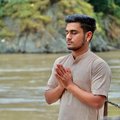
Ajay ji
Ajay Pandey, hailing from Rishikesh, is a highly experienced yoga teacher who has dedicated himself to sharing the transformative benefits of yoga with others. With a solid background in yoga training and education, Ajay has been practicing and teaching Ashtanga yoga for the past five years. In June 2018, Ajay completed a yoga teacher training program, earning certification for 200 hours of comprehensive training. This foundational training provided him with a deep understanding of yoga principles, asanas, pranayama, meditation techniques, and the underlying philosophy of yoga.
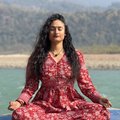
Soma Ji
From a young age, Soma was drawn towards a spiritual way of living and mind-body connection. She loved yoga right from the start, exploring many different styles. It wasn’t until a couple of years later that Soma started practicing asana pranayam & meditation yoga and meditative qualities captured her heart. Soma had no intentions of teaching yoga. She wanted to immerse herself in a training to deepen her practice. Little did she know the universe had other plans. Soma has practiced with many renowned teachers and is always learning and expanding her experience and knowledge of this lifelong.
Location
The training will take place in Rishikesh, Uttarakhand, India. Learn yoga in the world’s yoga capital, Rishikesh, from traditional Himalayan yoga teachers from the very basics to advanced, in a traditional way, at Adi Yoga Ashram which is situated in Tapovan, Laxman Jhula, in Rishikesh, which is in India's northern state of Uttarakhand, in the Himalayan foothills, beside the Ganges River. The river is considered holy, and the city is renowned as the world’s yoga capital. The surroundings of Adi Yoga Ashram are very serene and peaceful, and at the same time very energetic by the flowing energy of the river Ganga.
Also, Rishikesh is a magical and holy place that has been somehow attracting people from all over the world for many years already. The school is within walking distance from the river Ganga. It is surrounded by serene green mountains which heal the inner soul and the Ganga River flows. The school is far from the craziness but near enough to reach everything you need. All over Rishikesh, you can find local markets, unique shops, and breathtaking views of the Holy River and nature.

Food
You will be served daily yogic vegetarian meals and detox tea included in the price. Adi Yoga Ashram regards food as medicine. Using only fresh seasonal herbs and vegetables from the local market, they provide a daily menu of wonderfully nourishing vegetarian food. Food that not only supports the healing of the body but also enhances the purification process during your stay. In addition to serving healthy, soulful, delicious vegetarian meals, they provide unlimited, filtered mineral water from their private well; naturally chilled and served from traditional earthen water basins.
Adi Yoga Ashram also provides an unlimited supply of detoxifying herbal teas made from homegrown herbs like tulsi basil, lemongrass, and ginger. This wonderfully refreshing tea is available throughout the day and is a great detox drink for the body. It keeps you well hydrated and is designed to support the digestive process.
The following meals are included:
- Breakfast
- Lunch
- Dinner
- Drinks
The following drinks are included:
- Water
- Tea
The following dietary requirement(s) are served and/or catered for:
- Vegetarian
- Vegan
- Gluten Free
- Yogic
- Ayurvedic
Things to do (optional)
There are some amazing things to do in Rishikesh. These activities are not included in the package, but they can be arranged upon request.
- Attend Ganga Arti
- Ayurvedic massage and therapies
- Bungee jumping
- Camping and bonfire
- Cliff jumping
- Experience the traditional Indian culture
- Flying fox
- Kayaking
- Mountain biking
- Parasailing and paragliding
- Rappelling and rock climbing
- River rafting - the most popular thing to do in Rishikesh
- Trekking
Spa treatments
Traditional Ayurveda and massages are available with extra charges.
What's included
- Daily mantra chanting, meditation, asana, yoga anatomy
- Relaxation and meditation techniques
- Yoga philosophy and yogic lifestyle
- Yin yoga philosophy and body meridian
- Detailed content for structured learning
- Alignment-adjustment with teaching methodology
- Sound healing session
- 1 aerial yoga session
- Ayurveda classes
- 200-hour yoga TTC (RYT)
- 7 days 85-hour yin yoga course (YACEP)
- Certificate of completion
- Ganga Arti and Ganga Puja ceremony
- Weekend excursions
- 1 Himalayas sightseeing trip
- 57 nights accommodation
- 3 yogic vegetarian meals and detox tea per day
- Pick up from Dehradun Airport (DED) to Adi Yoga Ashram
- Study material (PDF) after booking the slot
- GST included
What's not included
- Airfare
- Visa
- Drop off to Dehradun airport
- Pick-up service from Indira Gandhi International Airport (DEL)
- Air-conditioner or room heater
- Extra activities
How to get there
Recommended Airports
Transfer included
Jolly Grant Airport
14 km away from your destination
Transfer available for additional US$ 75 per person
Indira Gandhi International Airport
209 km away from your destination
Arrival by airplane
Please book your flight to arrive at Dehradun Jolly Grant Airport (DED) in India. Traveling by plane from Delhi airport to Dehradun airport is the safest and most convenient way of transportation, and it is a one-hour journey. Most of the students choose this option, and the charge is between 50-60 USD. At Dehradun airport, the school driver will be waiting with a name board to pick you up and transfer you to the school.
Arrival by train
Traveling by train (from Delhi train station to Haridwar Station) is also suitable, and the fare is between 20-25 USD, and it is a 4-5 hour journey. At Haridwar railway station, the school driver will be waiting with a name board to receive you.
Arrival by taxi
Delhi airport to Rishikesh by car is a 6-7 hour journey. Delhi airport to Rishikesh taxi can also be arranged for 75 USD by the school. At Delhi airport, the school driver will be waiting with your name board and transfer you to the school.
Cancellation Policy
- A reservation requires a deposit of 18% of the total price.
- The deposit is non-refundable, if the booking is cancelled.
- The rest of the payment should be paid on arrival.

Reviews
For this organizer you can guarantee your booking through BookYogaTeacherTraining.com. All major credit cards supported.
Similar Yoga Teacher Training you might like
You recently viewed