21 Day 200-Hour Yoga Teacher Training in Kathmandu, Nepal
Yoga Teacher Training in Nepal
Nepal Ayurveda Home has been offering various programs of yoga, meditation, Ayurveda, and therapy. In order to discover the teachers within, it organizes the “200 Hours Yoga Teachers Training in Nepal” in Kathmandu. The course is open for all the people of the world without any restriction of flexibility, age, religion, belief system, etc. Either you want to learn yoga for yourself or want to be a professional yoga teacher; this course is suitable for all. If you are a beginner, then the course acts a medium to get entry into the yogic world for learning yoga and becoming a yoga teacher.
Meet the instructors
Highlights
- Daily yoga and meditation lessons
- Anatomy and physiology / yoga philosophy and chanting
- The sequence of posture / yogic relaxation and mantra chanting
- 20 nights accommodation
- Daily full-board meals during your training period
- Yoga book
- Local certificate of completion
Skill level
- Beginner
- Intermediate
- Advanced
Types
20 days with instruction in English
Accommodation
Facilities
- Air-conditioned rooms
- Garden
- Restaurant
- Yoga studio
- Free Wi-Fi
- Internet access
- Wireless internet
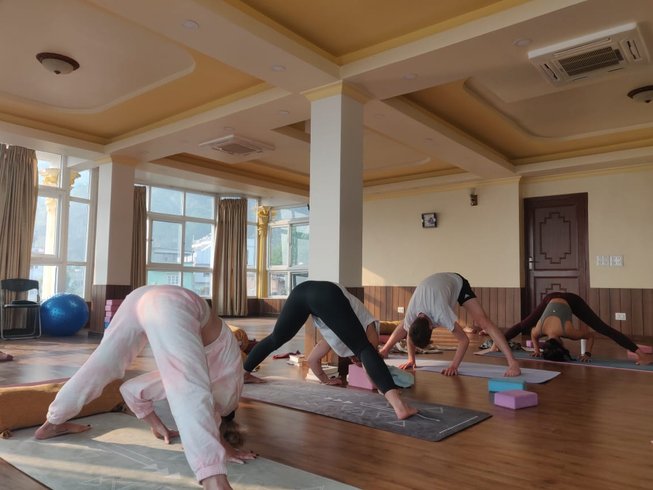
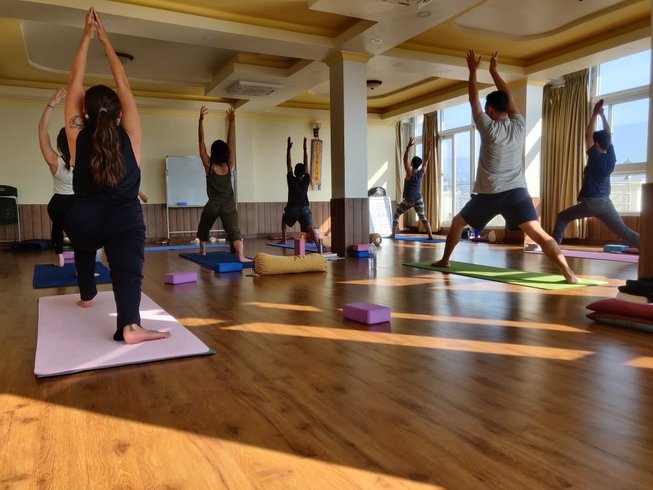
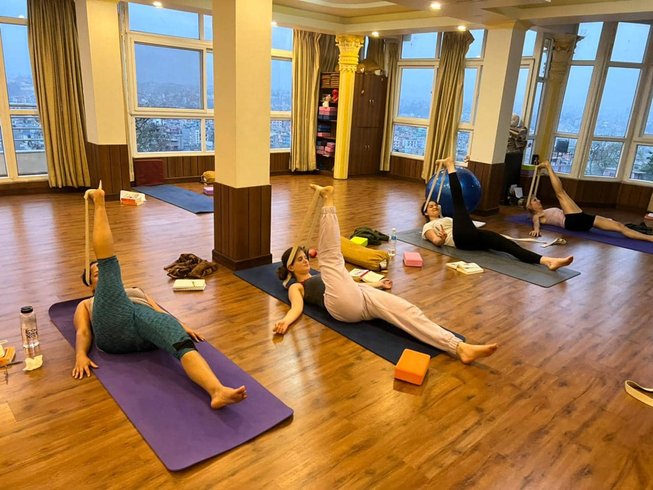
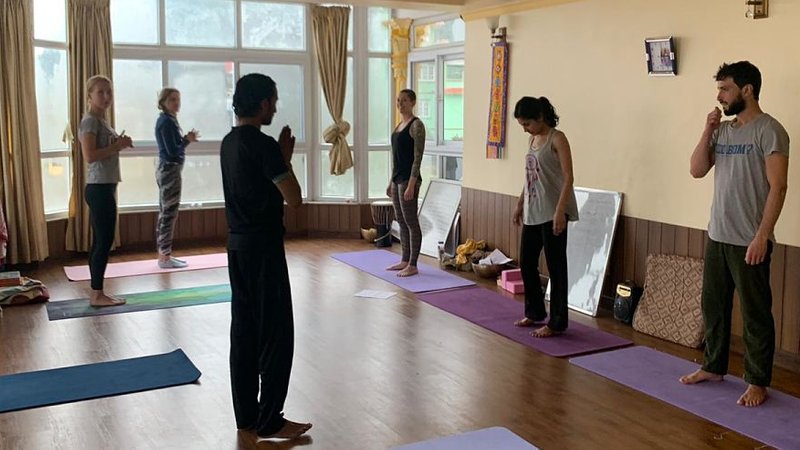
The venue has nice big two yoga halls with air-conditioning where yoga and meditation classes will be conducted. Everyone will enjoy the rooftop which has great 360 views of Kathmandu city and some part of the snowcapped Himalayas. Hot water and Wi-Fi are available in every room. You will stay in a room with an air conditioner, hot water, an attached bathroom, wooden parqueting, and free Wi-Fi.
Program
What you’ll learn in this yoga teacher training course?
- Yoga philosophy, its origin, and principles
- The concepts of manifold yoga systems - Jnana yoga (yoga of knowledge), Bhakti yoga (yoga of devotion), Karma yoga (yoga of action), Mantra Yoga, etc.
- Various systems of yoga - Ashtanga Vinyasa yoga, Power yoga, Yin yoga, Sivananda yoga, Iyengar yoga, etc.
- A theoretical and practical approach to yoga
- Anatomy and physiology
- Brief Ayurveda
- Mind and yoga relation
- Seven bodies and seven chakras
- Patanjali Yoga Sutra
- Around 200 yoga asana (postures)
- Pranayama (breathing control)
- Mudra (hand gesture)
- Bandha (locking of energy from being wasted and transform it for a higher goal)
- Relaxation and yoga Nidra (Yogic sleep)
- Meditation and awareness
- Application of yoga for curing different diseases
- Art of healthy life and health tips
- Natural lifestyle - living with your own nature i.e. living becoming yourself, not becoming others
- Natural lifestyle - art of being harmonious with nature and becoming in sync with existence
This course proves to be one of the awesome moments of your life. You will feel your body stronger and more flexible as well as a great change in your psychology. You will feel lightness in your body and free from the bondage. The course gives you all-round development and helps you in every step of life. It is helpful to achieve success in the physical world endowing better health and working efficiency. It is also a great path to get spiritual development and achieve self-actualization and self-realization.
Curriculum
The course is provided through a scientifically designed curriculum by the expert group of yoga teachers. The subject matters of study are internationally matched, which is sufficient for you to be a qualified yoga teacher and teach throughout the world. The curriculum of yoga teachers training in Nepal is as follows:
1. Yoga Philosophy
The philosophy of yoga helps you to learn insightfully. There are some morals and ethics; by observing them your life becomes happier and healthier. Yoga philosophy makes the path of yoga clear from the beginning to the ultimate. This topic gives you the overall theoretical concept of yoga. Under this topic, the following things are taught:
- Definition and explanation of yoga
- A philosophy based on different scripture: Veda, Yoga Sutra, Bhagavad-Gita, Upanishads, Veda, Purana, etc.
- Origin and history of yoga
- Principles and foundations of yoga
- Aim and purpose of yoga
- Eight branches of yoga: Yama, Niyama, Asana, Pranayama, Pratyahara, Dharana (concentration), Dhyan (meditation), Samadhi (ultimate liberation)
- Importance and application of yoga
- Ancient life, contemporary life, and yoga
- Different traditions of yoga
- Interesting information of Pratyahara (control of sense organ)
2. Asana
You will learn and practice over 100 asanas (yoga poses) in correct alignment. You will learn Ashtanga Vinyasa deeply. Sivananda yoga, Power yoga, Yin yoga etc. are also practiced. You will learn to be mindful during the holding of asana. This helps you to strengthen mindfulness all the time. You will learn the basic concepts of all the modern form of yoga practices. Along with the yoga asana, you will also learn Sanskrit name, English name, benefits, contraindication, proper breathing, awareness of different chakra, therapeutic benefits etc. After the completion of the course, you will also learn how to apply the asana in disease.
3. Pranayama
Pranayama is an art of breathing where you learn to control, master, and monitor your breath. It also teaches consciousness on the breath. You will learn about 10 types of pranayama.
4. Mantra and chanting
Mantra has its own special vibration. It has powerful effects to control the unstable mind. Chanting the mantra has mental and spiritual benefits. You will learn here different types of Mantra from the original Vedic text. You will learn the following mantra:
- Gayatri Mantra (mantra for Wisdom)
- Sarve Bhawantu Sukhina (mantra for peace and happiness)
- Om Asato Maa Sadgamaya
- Om Tryambakam Yajamahe (mantra for healing and removing the fear of death)
- Om Sahana vavatu (mantra for togetherness)
- Bhajan Mantra - Hare rama, Hare Krishna
- Bhakti Yoga Mantra- Guru mantra
- Bij mantra
- Mulmantra
- Sun salutation mantra
- Moon Salutation mantra etc.
5. Mudra
Mudra is translated as “gesture” or “attitude”. You can understand mudra with words like emotional, psychic, aesthetic gesture, devotional, etc. Mudra has a direct link with Annamaya Kosha, Manomaya Kosha, and Pranamaya Kosha. There are five groups of Mudra:
- Hasta Mudra (hand mudras)
- Mana (head mudras)
- Kaya (postural mudra)
- Bandha (lock Mudra)
- Adhara (perineal mudra)
6. Yoga detox
For physical and mental purification Nepal Ayurveda Home offers an introduction and some practice of six yoga detox process. They are - Neti, Dhauti, Nauli, Basti, Trataka, and Kapalbhati. All these techniques are very helpful to create a healthy and strong body.
7. Bandha
There is a slight difference between Mudra and Bandha. The Bandha is widely harmonized in Mudra, pranayama, and in some of the asanas. The meaning of Bandha is to hold, lock, tense, or tighten. The Bandha locks the prana and redirects it to the awakening of internal power (Kundalini) and Sushumna Nadi. You will learn Bandh from the level of preparation, its benefits etc. Learn the important types of Bandha - Mula Bandha, Jalandhara Bandha, Uddiyana Bandha, and Tri-bandha.
8. Relaxation
After yoga asana or physical works the body gets tired and needs scientific relaxation. There are some yogic techniques to get immediate relaxation through savasana and yoga Nidra.
9. Meditation
Meditation is the most important aspect of spiritual upliftment. With the increased concentration, it helps to develop awareness, consciousness, and mindfulness. There are different techniques of meditation. You will learn them in the 200-hour yoga teacher training at Nepal Ayurveda Home. Some of them are as follows:
- Breathing meditation
- Vipassana meditation
- Buddha style meditation
- Swa-ham meditation
- Chakra meditation
- Mantra meditation
- Mindful meditation
- Guided meditation, etc.
10. Lifestyle
Life becomes meaningful when you live life being harmonious with your innate nature and possibilities. The 200-hour yoga teacher training teaches correct lifestyle and helps you to live with your true originality. It also teaches you a harmonious relationship with nature.
11. Yoga anatomy
Understanding human anatomy and physiology helps to know about your body and effects of yoga on different parts of the body. It makes easier to identify the physical problems and other diseases and lay down correct methods to treat. Physical anatomy and spiritual yoga anatomy will be included in this course.
- Spiritual anatomy: subtle anatomy, seven chakras, seven bodies, nadis, energy bodies and Kundalini etc.
- Physical anatomy: the human skeleton, bones, muscle tissues, segments / joints its movement, circulation, respiration, digestion, excretion its function
- 12. Teaching practice and methodology
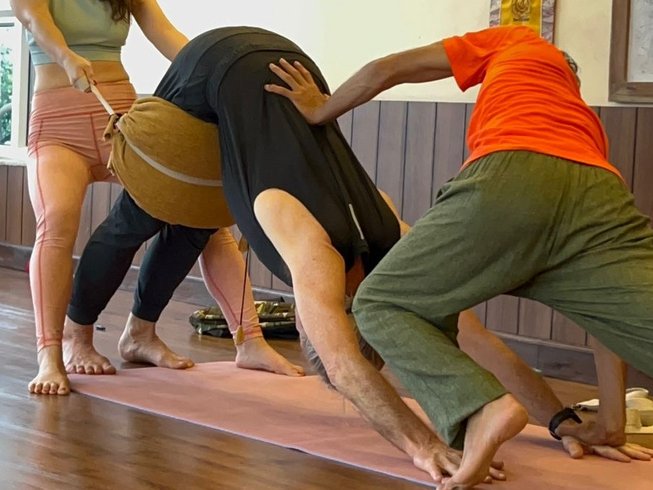
You are given an opportunity to teach in the class so that you will develop teaching skills. You will be trained about the methods of teaching in the class, preparation of lesson plan, sequencing of yoga practices, demonstration, principles of demonstration, observation, assisting and correcting, a way of effective teaching, etc. Each student will perform teaching practice under the guidance of the teacher.
Daily schedule
- 07:00 Yoga asanas (yoga posture)
- 08:30 Breakfast
- 09:30 Meditation / breathing
- 10:30 Free time, sight-seeing, and other activities
- 13:00 Anatomy and physiology / yoga philosophy and chanting
- The sequence of posture / yogic relaxation and mantra chanting
- 14:00 Lunch
- 15:00 Self-practice
- 16:00 Textbook of yoga / alignment, benefits, etc.
- 17:00 Tea break
- 17:30 Sequence of posture and relaxation
- 18:30 Dinner
- 20:30 Rest and sleep and study
This is a sample schedule it may change according to topic, subjects, teacher, climate, and situations.
Instructors

Ram Hari Thapa
Ram Hari did masters degree in yoga. He has many years of experience in Hatha / Ashtanga and Iyengar yoga. He also learned the traditional styles of yoga in Nepal and India so his authentic traditional flavor of class is the next plus point in his teaching.
Prakash Acharya
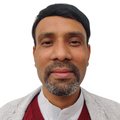
Mr. Prakash Acharya is PhD. in meditation and completed his masters degree in yogic science. He has 15 years of experience in yoga meditation and traditional healing.
Rajendra Neupane
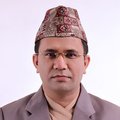
He is handling the meditation and breathing classes. He did masters degree in buddhism and completed the certified yoga teacher training course from Register yoga school to yoga alliance. Currently, he is doing PhD in Meditation.
Location
The property is located on the side of tourism Kathmandu in a peaceful area. It is just 10 kilometers from the airport and on 15 minutes drive distance, you will get many marketplaces and restaurants. The Nepal Ayurveda Home is run by a spiritual family putting a lot of love and care into students and guests. Kathmandu is nice to visit many historical palaces, heritage sites, temples, monasteries, etc. You can visit some heritage sites and monasteries within walking distance.
Nepal Ayurveda Home locates perfectly to explore the whole Kathmandu city. It has a nice rooftop garden where you can see the beautiful Himalayas. Being in the city it's free from hustle and bustle and no sound pollution. When you enter Nepal Ayurveda Home you will get a very spiritual and peaceful environment.
Distances
- Tourism Hub Thamel - 15 minutes drive
- Former king palace in - 15 minutes drive
- Hanuman Durbar square - 20 minutes drive
- Trivuwan international Airport 30 minutes drive
- Monkey Temple - 20 minutes drive
- Patan Durbar square - 40 minutes drive
- Bhaktapur Durbar Square - 45 minutes' drive

Food
Nepal Ayurveda Home tries to provide nutritious and natural Ayurvedic food for better health. Vegetarian and vegan food are its main food. It also serves Ayurvedic drinks, national food, cultural food, Nepali food, etc. If you have any other requirements, inform to the office.
The following meals are included:
- Breakfast
- Lunch
- Dinner
The following dietary requirement(s) are served and/or catered for:
- Vegetarian
- Vegan
- Ayurvedic
What's included
- 20 nights accommodation
- Yoga book
- Daily yoga and meditation lessons
- Daily full-board meals during your training period
- Tax and service charge
- Local certificate of completion
What's not included
- Pick up and drop off service from the airport (10 USD)
- Hiking / trekking/ rafting / mountain flight
- Ayurveda course / spa / massage
- Laundry
- Personal expenses
- Sightseeing or sunrise trip
- Additional food if required
How to get there
Recommended Airports
Transfer available for additional US$ 10 per person
Tribhuvan International Airport
9 km away from your destination
Cancellation Policy
- A reservation requires a deposit of 20% of the total price.
- The deposit is non-refundable, if the booking is cancelled.
- The rest of the payment should be paid on arrival.

Reviews
For this organizer you can guarantee your booking through BookYogaTeacherTraining.com. All major credit cards supported.
Similar Yoga Teacher Training you might like
You recently viewed