
15 Day 100-Hour Meditation Teacher Training Course in Dharamsala, Himalayas, India
Meditation Teacher Training
If you are looking for a comprehensive meditation training course and want to deepen your practice, or aspire to pursue the path of a professional meditation teacher, this course is for you. It is also a great opportunity for certified yoga teachers to take part in a continuing education program, particularly in the field of meditation, to expand the knowledge and bring more value to life. Join the course to be inspired, and inspire others with intensive meditation practice!
Meet the instructors
Highlights
- Learn various meditation techniques
- Supporting gentle yoga and pranayama
- Classes on asana, mantra, anatomy, and physiology
- Dedicated and individualized supervision in every session
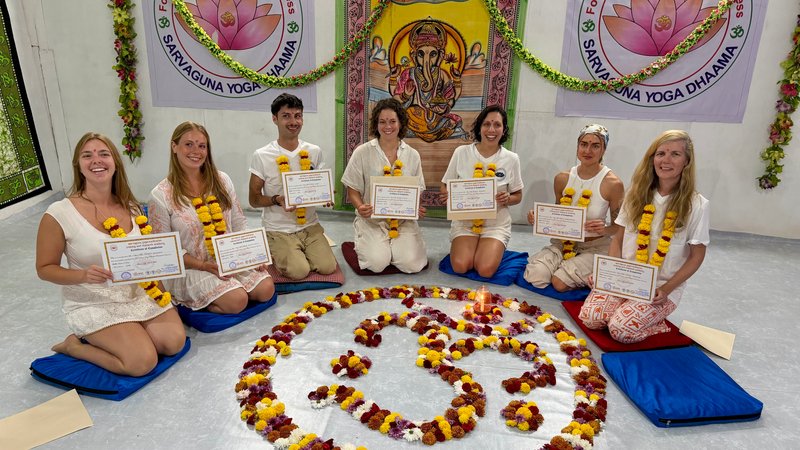
- Certificate of completion
- Daily full-board vegetarian meals throughout the course (except on Sunday and Saturday dinner)
- All tuition fee, yoga kit, and study material
- 14 nights accommodation
Skill level
- Beginner
- Intermediate
Types
14 days with instruction in English
 Average daily hours of activity: 10
Accommodation
Facilities
- Shopping
- Café
- Dining area
- Yoga shala
- Yoga studio
- Beauty salon
- Free Wi-Fi
- Internet access
- Laundry
- Wireless internet
During the training course, you will stay at Sunil House in Upper Bhagsu, about two and a half kilometers away from McLeod Ganj town. Its geographical location makes it comfortably away from main markets and distractions, which results in a calm, quiet, and contemplative environment for yoga and meditation practices. As the area around the center cannot be easily reached by motor vehicles, one can enjoy a true serenity and the peaceful atmosphere of the Himalayas.
While the geographical location of this yoga center provides a calm and quiet atmosphere, the topography of the area naturally brings a meditative disposition, creating an experience of peacefully merging with nature. One can feel that he or she is relaxing in the lap of nature. Located on a flank full of green palm trees and boasting a vibe of a beautiful valley and chirps and tweets of birds, the center truly provides a conducive and spiritual environment for yoga and meditation practices.
The Sunil House has 12 nice rooms for yoga -Meditation students only. Each room has a western-style toilet with a 24-hour hot shower, a wardrobe, a big double bed, a blanket, a table and chairs, and free Wi-Fi. These rooms have enough space for two people.
Program
The 100-hour meditation teacher training program provides the training, support, and supervision to individuals wishing to deepen their own personal practice, teach friends and family members, incorporate meditation training into their existing professions, or develop a private meditation teaching practice. This program incorporates yogic, non-religious, and scientific meditation practices. Many topics focus on the effects of acute and chronic stress on the body and mind.
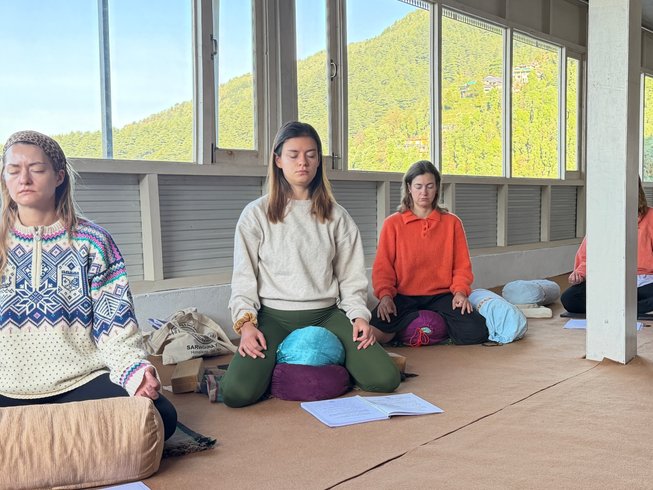
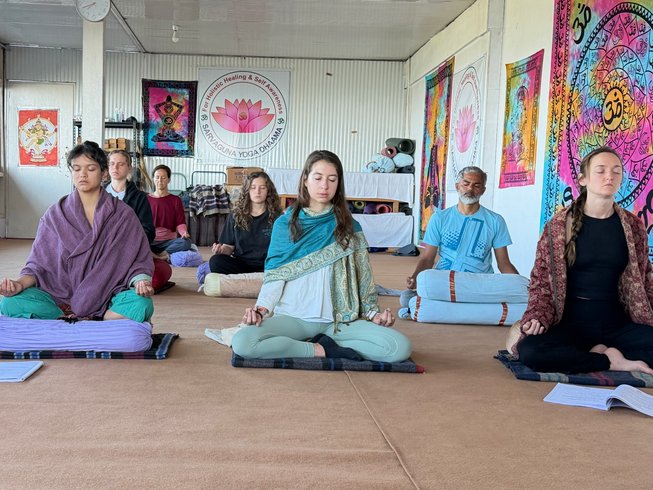
Classes involve Restorative yoga and pranayama practice, facilitated discussions, exercises, and deep connection with your peers. The course requires no experience and all body types are welcome.
In this course, you will be immersed in meditation practices, supported by gentle yoga and pranayama. You will learn a foolproof way to teach anyone how to meditate, and practice teaching what you have learned in this course as well as your personal experience accumulated during the sessions. You will be thoroughly coached by dedicated teachers to enhance your presentation and teaching skills and practice how to share what you have learned with a variety of audiences.
Course standards
This program meets the standards and curriculum of Yoga Alliance as a continuing education program for yoga teachers.
- Techniques training and practice: Includes preparatory asana, pranayama, kriya, chanting, mantra, meditation, philosophy of meditation, teachings from the Bhagavad Gita, yogic lifestyle, modern and scientific meditation techniques, energy anatomy and physiology, chakras, naadis, and so on. This includes both the study of the subject and applications of the principles to yoga practice, such as the benefits, contraindications, healthy movement patterns and more. You will also receive analytical training on how to teach and practice the techniques, and guided practice of the techniques themselves.
- Practicum: Includes practice teaching, receiving feedback, observing others teaching, and hearing / giving feedback. Also includes assisting students while someone else is teaching.
Overview of the course content
Preparatory practices
As preparation for meditation, gentle Restorative yoga will be taught twice a day. This helps to improve muscular relaxation.
Pranayama
Pranayama is breathing techniques. Pranayama has two aspects: breath regulation and breath observation. Pranayama is a very important aspect of meditation practice. Pranayama purifies the mind and prepares the mind for meditation. It facilitates oneself to deeply concentrate while meditating. It detoxes the mind and the body, as well as helping you to reach the inner realm of awareness.
Mudra practices
Mudras are the flow of energy in the body. The position of the hands while practicing a meditation technique is very important. Mudras are a combination of subtle physical movements which alter the mood, attitude, and perception and which deepens awareness and concentration. Mudras enable the meditation practitioner to develop an awareness of the flow of prana, the vital energy in the body. Ultimately, they establish pranic balance within the body and redirect the subtle energy to the upper chakras, inducing higher states of consciousness.
Kriyas
This is the daily practice of therapeutic yoga which includes neti - yogic nostril cleansing, trataka - gazing at the flame to improve concentration, and shambhavi mudra - preparatory practice for Third Eye Meditation.
Meditation friendly diet
The diet plays an important role in meditation practice. As the well-known proverb goes “the man is what he eats” - the food we consume influences our mind and body. This course focuses on yogic or sattvic diet, which makes meditation more effective.
Energy anatomy
Energy anatomy involves the theoretical framework of the energy body (pranic body), nadis (energy channels), chakras (energy centers) and the application of its principles in meditation practice, benefits of opening the nadis and chakras through meditation. the movement of healthy energies within the body, characteristics of a person whose chakras are opened, the kundalini system and kundalini awakening meditation techniques.
Discussed theories of meditation
- Various definitions of meditation, its roots, its theories, its aims and goals, and the myths and misconceptions about meditations
- Preparatory practices for meditation, including both internal and external preparations
- Meditative psychology
- Difficulties faced during meditation and how to overcome them
- Different types of meditation practices and their applications
- The scientifically proven physiological and psychological benefits of a regular meditation practice
- How meditation trains your attention
- The mind and the body connection and creative well-being
- Stress and its effects on the mind and body
- How to shift the stress response from “fight or flight” to “rest and digest” and the need for cognitive change
- Transcendental experiences in meditation and the role of spiritual intelligence
- The spiritual side of meditation, mystic and wisdom traditions, awakened states of awareness, and self-discoveries
- Creating a personal practice and nourishing daily routine
Different types of meditation
- Relaxation meditation
- Concentration meditation
- Chakra balancing meditation
- Kundalini meditation
- Yoga Nidra Meditation
- Pranic awareness meditation
- Mantra meditation
- Mindfulness meditation
- Loving Kindness meditation
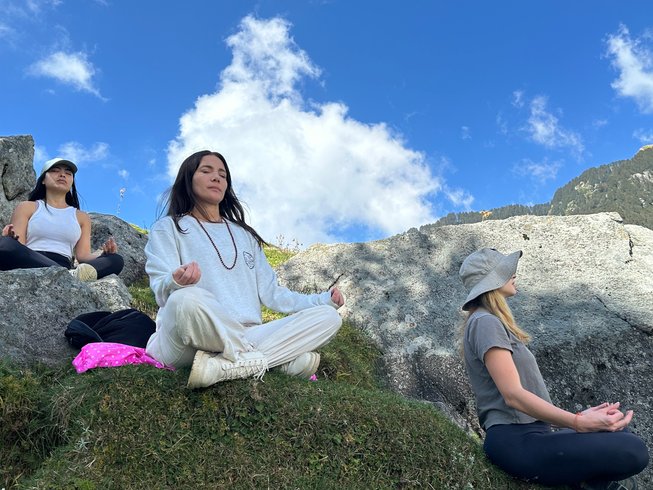
- Group meditation and Nature meditation
- Third Eye/Shambhavi mudra meditation
Certification
After completing the course successfully, you will be certified to teach meditation. You will be able to design your own meditation training program to suit the people you come across. It can be any of the techniques you have learned or a mixture of different meditation techniques. You do not have to have any particular method. Every method, if practiced diligently, will give results.
You will be able to offer and share with your students a comprehensive meditation method that can propel their spiritual practice or help to discover inner peace, harmony within oneself and in relationships, inspiration, creativity, wellbeing and a sense of fulfillment, better physical and psychological health, and self-awareness.
As a certified meditation teacher, you will likely be asked to present meditation classes and lead programs in a variety of settings. On this course, you will learn how to do that, whether you are invited to present at a lunch-and-learn at a corporate headquarter, or to a classroom full of kids who want an experience of mindfulness. You will have everything you need to do it!
Typical daily schedule
- 06:00 - 08:00 Mantra chanting, pranayama, and guided meditation
- 08:30 - 10:00 Asana practice and kriya practice
- 10:00 - 11:00 Breakfast
- 11:00 - 13:00 Theory class and workshops
- 13:00 - 15:00 Lunch break
- 15:00 - 16:00 Theory class, workshops, and Q & A sessions
- 16:00 - 17:00 Techniques training, special workshops, and chakra workshops
- 17:00 - 19:00 Silent sitting, self-guided meditations, and trataka practice on Monday, Wednesday, and Friday
- 20:00 - 21:00 Satsang, Q & A session on meditation philosophy, and spirituality related topics on Tuesday and Thursday
Included excursions
A day trek to Triund, a popular hill dubbed the jewel crown of Dharamsala, is included in the package.
Instructors
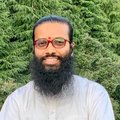
Dr. Keshava Murthy, PhD, E-RYT 500+, M.Sc (Yoga), YACEP
Dr. Keshava has been teaching yoga philosophy, meditation and pranayama, therapeutic yoga, principle teachings of original tantra, Sanskrit language and poetry, and Vedic mantra chanting in various academic settings and yoga teacher training centers. He taught more than 100 yoga teacher training courses. Keshava lives a monastic life practicing and teaching yoga, meditation, and spirituality. He is committed to bringing a deep change in the personality of a seeker in order to have a meaningful and blissful life with peace, harmony and universal awareness.
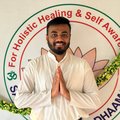
Shubham Dhumal (Shubhu), E-RYT 500+, YACEP
Subham was born and brought up in central India. A yoga enthusiast from the age of 4, he started learning Yoga from his mother Ms. Anjali and always dreamt about being a Yoga Sadhaka and teacher. Shubham received various certificates and titles from Kaivalyadhama, a well-known Yoga Institute in central India on successful completion of different yoga programs. He has been teaching different styles of Yoga, physiology and Anatomy in various Registered Yoga Schools (RYS) and Yoga Teacher Training programs and various platform since 2013.
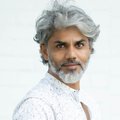
Amaresh K, E- RYT-500+, M.Sc. (Yoga), YACEP
Amaresha – M.Sc.(Yoga), E- RYT-500 +, YACEP – Experienced Hatha Yoga & Vinyasas Yoga Teacher. He is an accomplished yoga educator, contemporary dancer, and theatre artist with over 20 years of interdisciplinary experience. His has completed MSc in Yogic Science from Bangalore University and done Yoga TTCS -RYT-200 & RYT-300 and Yoga Vedanta course from Divine Life Society, Rishikesh. He has been teaching Ashtanga Yoga, Hatha Yoga for many years and specializes in teaching Yoga Asana with Props. His teaching blends physical practice with yogic philosophy.to support holistic growth.
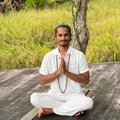
Yogeesh, Bovi, E- RYT-500 +, YACEP
His journey in yoga began at the age of 8, initially training for yoga championship competitions. This early foundation nurtured a deep passion for the practice, which later evolved into a lifelong commitment to the study and teaching of yoga. he pursued formal yoga teacher training and advanced courses to deepen his knowledge and understanding. For more than 10 years, he has been teaching Yoga Teacher Training Courses (TTC), guiding students through various styles and disciplines of yoga. His approach integrates traditional wisdom with practical application and wholistic.
Location
This course will be held in Dharamsala, close to the Himalayas. The Himalayas, meaning the abode of snow in Sanskrit, are a range of mountains with mighty snow peaks, forming the northern border of the Indian subcontinent. Himalayas have been a great inspiration for spiritual practitioners, yogis, saints, as well as healers. Experienced by many practitioners and yogis as a very powerful energy center on the Earth, these sacred mountains have been inspiring many people.
Dharmashala is located in the North Indian state of Himachal Pradesh. Nestled below the mighty snow clad peaks of the beautiful Himalayan Dhauladhar mountain range, it is a wonderful location with an abundance of natural beauty and spiritual diversity.
Dharmashala is the spiritual headquarters of Buddhists all over the world. It is the home of Dalai Lama and the center of theTibetan exile. Dalai Lama has been living here along with his followers since 1959. His presence and the Tibetan population has made Dharamshala a popular destination for Indian and foreign tourists, including students studying the Tibetan culture.
Dharamsala and McLeod Ganj are twin towns located by the Himalayan mountain range. Dharamsala is mainly populated by locals. McLeod Ganj is the abode of Dalai Lama. Many Tibetans have found their permanent settlements in this town and are leading a peaceful life.
Bhagsunag and Dharmakot are twin beautiful hamlets located two kilometers away from McLeod Ganj. These two villages are relatively calm and quiet and give a conducive atmosphere for yoga and meditation practices. Hence, many yoga and meditation learners chose to come here for their training.

Features
Activities
- Massage
- Reiki
- Shopping
- Swimming
General
- Beach
- Café
- Dining area
- Yoga shala
Services
- Beauty salon
- Free bottled water
- Free Wi-Fi
- Laundry
- Local market
- Mosquito net
Food
In this training course, all three meals would be provided except for Saturday dinners and meals on Sunday. The meals would be vegetarian. Vegan and gluten-free food are also served to those who opt. The food during the training period is included in the total course fee.
Sarvaguna Yoga runs its own restaurant exclusively for yoga students. Indian yogic meals are prepared there for the course students.
Additionally, two herbal teas will be provided daily along with unlimited filtered drinking water. For meals on Sundays, you can visit the many local restaurants that are just a 3-minute walk from the yoga center offering Indian, International, and Tibetan cuisine at very reasonable prices.
The following meals are included:
- Breakfast
- Lunch
- Dinner
- Drinks
The following drinks are included:
- Water
- Coffee
- Tea
The following dietary requirement(s) are served and/or catered for:
- Vegetarian
- Vegan
- Gluten Free
- Organic
- Yogic
Exclusive Gifts
Sarvaguna Yoga has prepared a few special surprises for you, including unique experiences and thoughtful extras to make your journey even more memorable.

Free extra one night stay

Reiki healing session for holistic wellbeing
Ayurvedic Massage and Spa Treatment
Things to do (optional)
Explore nearby destinations
There are some interesting places to explore nearby the yoga center, like waterfalls and a glacier. Trekking trips can be arranged to visit these places.
- Ayurvedic consultations and Ayurvedic Massage therapies.
- Indian cooking classes
- Visit the Local Tibetan monasteries.
- Popular destinations from Dharamshala include Rishikesh, Manali, and Amritsar.
Spa treatments
Please note that Ayurvedic Massage facilities are available nearby with additional price.
What's included
- 2 hours yoga asana practices daily
- 5 guided meditation classes daily
- 2 herbal teas daily
- 3 daily vegan, vegetarian, and organic meals (except on Sunday)
- 14 nights accommodation
- A day trip to Triund Hill
- Airport pick-up and drop-off
- Course material
- Certificate upon completion
- Daily mantra chanting, pranayama sessions
- Teaching methodology and training techniques
- Unlimited drinking water
- Yoga kit
Included Exclusive Gifts
Free extra one night stay
You can stay one additional night in a single private room accommodation with attached shower and Wi-Fi either before or after the course.
Reiki healing session for holistic wellbeing
One hour Reiki healing session for removing the Pranic Energy blockages and Balancing the chakras.
Ayurvedic Massage and Spa Treatment
Get an Ayurvedic massage therapy with an experienced massage therapist for free.
What's not included
- Airfare
- Meals on Sunday
- Saturday dinner
- Optional activities
- Personal expenses
- Travel insurance
How to get there
Recommended Airports
Transfer available for additional US$ 75 per person
Sri Guru Ram Dass Jee International Airport
156 km away from your destination
Transfer included
Gaggal Airport
11 km away from your destination
Arrival by airplane
Please book your flight to arrive at Gaggal Airport (DHM). Sarvaguna Yoga will pick you up from the airport. The pick-up is included in the price. The best way for travelers to reach Dharamsala by air is to travel from New Delhi Airport. New Delhi Airport is connected to all most all major destinations and all major cities in India. Daily flights are operated from New Delhi to Gaggal Airport, which is about 25 kilometers away from the yoga center. Alternatively, you can take a flight to Chandigarh (250 kilometers from the yoga center) or Amritsar (200 kilometers away from the center), and we can arrange taxi pick up. It takes five hours to reach there. A taxi ride will cost about 6000 INR. If you choose to arrive at Amritsar International Airport, you can reach Dharamsala by taxi, which is a better option.
Arrival by bus
There are daily bus services from Delhi to Dharamsala every evening. It is a 10 to 12-hour journey with a fare of 1000 to 2000 INR depending upon the type of bus you choose to travel. Public buses are available from New Delhi and from other major cities. This option is the most economical. Bus services are also available from Manali and Shimla. Sarvaguna Yoga can provide you more information on how to travel to Dharamsala if you need.
Arrival by train
There are no direct train to reach Dharamsala. Pathankot is the nearest railway station to a reach Dharamsala. Pathankot Railway Station is well connected by rail with all other major cities in India. The distance from Pathankot to the center is about 100 kilometers and it costs around 2000 INR to reach the center by taxi. We can arrange the taxi pick-up from Pathankot Railway station.
Cancellation Policy
- A reservation requires a deposit of 30% of the total price.
- The deposit is non-refundable, if the booking is cancelled.
- The rest of the payment should be paid on arrival.

Reviews
For this organizer you can guarantee your booking through BookYogaTeacherTraining.com. All major credit cards supported.