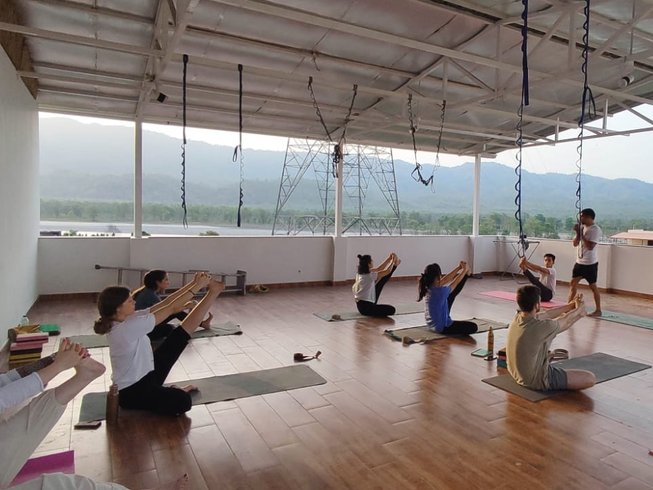

28 Day Multistyle 300 Hour Training (Daily Sessions-Aerial, Yin, Hatha & Ashtanga) Rishikesh, India
Yoga Teacher Training in India
Arohan Yoga School’s 300-Hour Yoga Teacher Training Program aims to provide a well-rounded curriculum that covers Hatha, Ashtanga Vinyasa, and Yin yoga styles. Unlike most 300-hour trainings that tend to focus more on the yang aspects and neglect the equally important Yin aspect, the program provides a balance of both Yin and Yang. In fact, you will follow the Hatha philosophy, where HA represents yang and THA represents yin. The ultimate goal is to help the students achieve a comprehensive understanding of yoga and become well-rounded and knowledgeable yoga teachers.
Meet the instructors
Highlights
- Learn classical Hatha and Ashtanga Vinyasa, Aerial, and more
- Study the philosophy and history of yoga anatomy
- Daily sessions to learn alignment and common postures adjustment
- Provided materials for easy and comprehensive learning
- Eligible to register with Yoga Alliance upon completion
- Complimentary pickup and drop to and from the DED airport
- Healthy meals with unlimited Ayurvedic tea will be served
- 27 nights accommodation
Skill level
- Beginner
- Intermediate
- Advanced
Types
28 days with instruction in English
Accommodation
Arohan Yoga
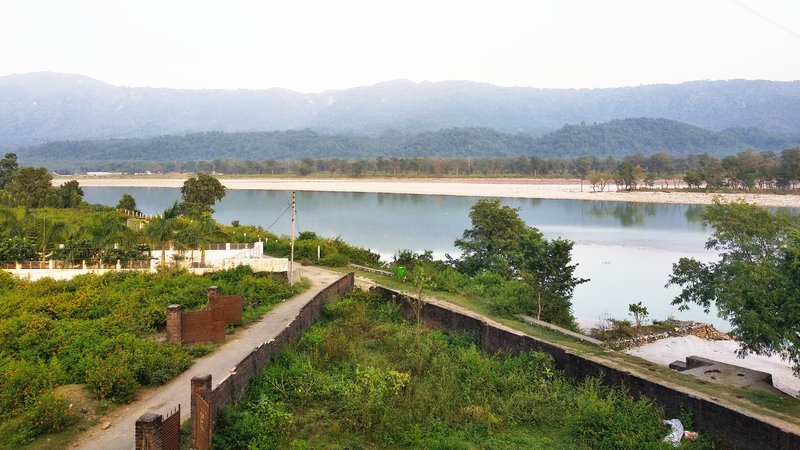
Arohan Yoga School is a beautiful villa near the bank of the Ganges River. Bedrooms with beds, wardrobes, and washrooms with hot showers are available. There is also a free Wi-Fi connection.
Program
Certification
Students who complete the training are eligible to register with Yoga Alliance as Registered Yoga Teachers (RYT®).
Program description
A 300-hour yoga teacher training goes beyond the basics and equips instructors with the knowledge and skills to teach a wider range of students and offer more specialized and nuanced classes. It’s an opportunity to deepen one’s understanding of yoga and become a more confident and proficient yoga teacher.
This program typically builds upon the foundational knowledge and skills acquired in a 200-hour yoga teacher training. Here is some key information for 300-hour yoga teacher training:
- Depth of Knowledge: A 300-hour YTT delves much deeper into these subjects and explores advanced aspects of yoga philosophy, anatomy, and teaching techniques.
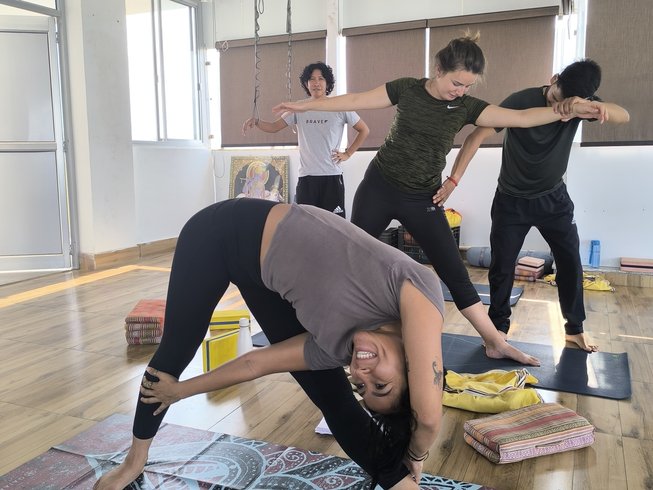
- Advanced Asanas: A 300-hour yoga teacher training often introduces more advanced asanas, including inversions, arm balances, and backbends. Students learn how to safely guide others in mastering these challenging postures.
- Yoga Philosophy: A 300-hour training dives deeper into the philosophical aspects of yoga, including the study of classical texts like the Yoga Sutras, Bhagavad Gita, and other philosophical concepts.
- Pranayama and Meditation: In a 300-hour YTT, students often explore pranayama (breath control) and meditation in greater detail, learning advanced techniques and practices. These skills help students guide others in the subtler aspects of yoga.
- Sequencing and Specialization: In a 300-hour program, students may specialize in certain styles (e.g., Vinyasa, Hatha, Yin, or Kundalini) and learn how to design more intricate and specialized sequences for different needs and levels.
- Assisting and Adjusting: Advanced training typically includes in-depth instruction on assisting and adjusting yoga students, helping them refine their postures and alignment safely.
- Anatomy and Physiology: A 300-hour program may offer a more comprehensive understanding of anatomy and how it relates to yoga practice, including common injuries and modifications.
Curriculum
Shata Karma (Detox Techniques)
- Jala Neti (nasal cleaning)
- Sutra / Rubber Neti
- Kunjal Kriya (cleansing of upper GIT)
- Laghu Shankhaprakshalana (cleansing of lower GIT)
- Agnisara Kriya (for digestive fire)
- Simhagarjanasana
- Kapalabhati (considered both a detox and pranayama as well)
- Technique-1 Trataka
- Technique-2 Trataka
- Technique-3 Trataka
Pranayama (Breathing Techniques)
- Abdominal breathing
- Thoracic breathing
- Clavicular breathing
- Yogic breathing
- Kapalabhati pranayama Technique 1
- Kapalabhati pranayama Technique 2
- Surya Bheda pranayama Technique 1
- Surya Bheda pranayama Technique 2
- Bhastrika pranayama Technique 1
- Bhastrika pranayama Technique 2
- Nadi Shodan pranayama Technique 2
- Nadi Shodan pranayama Technique 3
- Sheetali pranayama Technique 1
- Sheetali pranayama Technique 2
- Sheetkari pranayama
- Bhramari pranayama Technique 1
- Bhramari pranayama Technique 2
- Ujjayi pranayama Technique 1
- Ujjayi pranayama Technique 2
Ashtanga Vinyasa (Primary and Secondary Series)
Primary Series – Yoga Chikitsa
- Surya Namaskara A
- Surya Namaskara B
- Padangusthasana (big toe pose)
- Pada Hastasana (hands under feet)
- Trikonasana (triangle)
- Parivritta Trikonasana (revolved triangle)
- Utthita Parsvakonasana (extended side angle)
- Parivritta Parsvakonasana (revolved side angle)
- Prasarita Padottanasana (wide leg forward fold) A, B, C, D
- Parsvottonasana (intense side stretch)
- Utthita Hasta Padangusthasana (extended hand to big toe)
- Ardha Baddha Padma Uttanasana (half-bound lotus intense stretch)
- Utkatasana (fierce pose)
- Virabhadrasana I (warrior)
- Virabhadrasana II (warrior)
- Dandasana (staff pose)
- Paschimottanasana (west intense stretch) A, B, C
- Purvottanasana (intense east stretch)
- Ardha Baddha Padma Paschimottanasana (half-bound lotus)
- Trianga Mukaikapada Paschimottanasana (1 leg folded back, forward fold)
- Janu Sirsasana (head to knee pose) A, B, and C
- Marichyasana A, B, C, and D
- Navasana (boat) X5
- Bhujapidasana (arm pressure pose)
- Kurmasana (tortoise)
- Supta Kurmasana (reclining tortoise)
- Garbha Pindasana (embryo in the womb)
- Kukkutasana (rooster)
- Baddha Konasana (bound angle, upright, and fold) A, B
- Upavista Konasana (wide angle seated forward fold)
- Supta Konasana (reclining angle pose, open plow)
- Supta Padangustasana (reclining big toe pose A and B)
- Ubhaya Padangustasana (both big toes pose)
- Urdvha Mukha Paschimottanasana (upward-facing paschimottanasana)
- Setu Bandhasana (bridge building pose)
- Urdvha Dhanurasana (upward bow)
- Paschimottanasana (intense stretch)
- Salamba Sarvangasana (Shoulderstand)
- Halasana (plow)
- Karnapidasana (ear pressure)
- Urdvha Padmasana (upward lotus)
- Pindasana in Sarvangasana (embryo)
- Matsyasana (fish)
- Uttana Padasana (intense stretched feet or legs)
- Sirsasana (headstand)
- Balasana (child's pose)
- Baddha Padmasana (bound lotus)
- Yoga Mudrasana (bound lotus with a forward bend)
- Padmasana (lotus)
- Tolasana / Uplutihih (the uplifting)
- Shavasana (corpse)
Secondary Series – Nadi Shodhana
- Surya Namaskara A
- Surya Namaskara B
Standing Postures
- Padangushtasana
- Pada Hastasana
- Utthita Trikonasana
- Parivritta Trikonasana
- Utthita Parshvakonasana
- Parivritta Parshvakonasana
- Prasarita Padottanasana (A, B, C, and D)
- Parshvottanasana
Intermediate Postures
- Pashasana
- Krounchasana
- Shalabhasana A, B
- Bhekasana
- Dhanurasana
- Parsvadhanurasana
- Ustrasana
- Laghu Vajrasana
- Kapotasana
- Supta Vajrasana
- Bakasana
- Bharadvajasana
- Ardha Matsyendraasana
- Ekapada Sirsasana A, B, C
- Dwipada Sirsasana B
- Yoga Nidrasana
- Tittibhasana A, B, C
- Pincha Mayurasana
- Karandavasana
- Mayurasana
- Nakrasana
- Vatayanasana
- Parighasana
- Gomukhasana A, B, C
- Supta Urdhvapada Vajrasana A, B
- Mukta Hasta Sirsasana A, B, C
- Baddha Hasta Sirsasana A, B, C, D
- Urdhva Dhanurasana
- Paschimottanasana
Finishing Postures
- Salamba Sarvangasana
- Halasana
- Karnapidasana
- Urdvha Padmasana
- Pindasana
- Matsyasana
- Uttana Padasana
- Shirshasana
- Baddha Padmasana
- Yoga Mudra
- Padmasana
- Uth Pluthi (Tolasana)
- Shavasana
Hatha Yoga
- Hatha Yoga
- Surya Namaskara with associated mantras
- Chandra Namaskara
- Hatha Flow Yoga
- Acro Yoga
- Standing Postures
- Vajrasana Group of Postures
- Backward Bending Group of Postures
- Forward Bending Group of Postures
- Balancing & Inverted Group of Postures
- Meditative Group of Postures
Yin Yoga
- Advance Yin Flow One
- Advance Yin Flow Two
- Advance Yin Flow Three
- Advance Flow for the Spine
- Advance Flow for the Hips
- Advance Flow for the Legs
- Advance Flow for the Shoulders, Arms, and Wrists
- Advance Flow for the Kidney
- Advance Flow for the Liver
- Advance Flow for the Stomach
- Advance Flow for the Whole Body
- Advance Wall Yin
- Advance Yin / Yang Fusion Flow
- Moon Salutations
- Restorative Yoga Flow A
- Restorative Yoga Flow B
- Miscellaneous Postures
- Anatomical Perspective on Yin Yoga
- The three main principles of Yin
- How to achieve more flexibility through Yin
- Individual postures for each flow
- Variation of individual postures
- Joints and meridians affected
Teaching Methodology
- Difference between structured and non-structured yoga styles
- Difference between the yin and the yang approach
- Different components of a typical yoga class
- Golden rules of sequencing
- The arc-structured yoga class
- Class Planning and Management
- Show (Principles of Demonstration)
- Tell (Principles of Description)
- Touch (Principles of Observation and Adjustment)
- Principles of Injury Prevention
- The ambience of the Yoga Hall
- Yoga Hall Coverage
- Voice and Tone modulation
- Body language
- Time management
- Legal Aspects
Yoga Anatomy
- Yin and Yang Tissues
- Types of Stretches
- Anatomical Reference Position
- Anatomy Basics
- Connective Tissues
- Muscular System
- Skeletal System
- Respiratory System
- Planes and Axis
- Joints
- Spine and Ribcage
- Reciprocal Inhibition
- Pancha Kosha
- Pancha Prana
- Chakras and Kundalini
Ayurveda
- Introduction
- How Ayurveda differs from modern medicine
- The Pancha Mahabhutas (Five Elements)
- The Tri-doshas and their attributes
- Identify your Dosha
- Yoga for different Dosha body types
- The three pillars of Health
- The seven building blocks or Dhatus
- Diagnosis
- Mala
- Ama or Toxins
- Panchakarma and its preliminary practices
Yoga Philosophy
- What is Yoga
- History and Development of Yoga
- The six schools of thought
- Four types of Yogas- Karma, Bhakti, Jnana (Gyana), Raja
- Four Purusharths
- Triguna Concept
- Eight Limbs with Yama and Niyama (Patanjali’s Ashtanga Yoga)
Meditation Techniques
- Anuloma Viloma with Prana Shuddhi
- Chidaksha Dharana
- Chakra Shuddhi
- Nada Brahma Meditation
- Chakra with beeja mantra
- Visualization
- Yoga Nidra
Mantra Chanting
- Aum Namah Shivaya
- Ganapati Mantram
- Gurum Mantram #1 and #2
- Gayatri Mantra
- Shanti Mantram #1 and #2
- Maha Mrityunjaya Mantram
- Aum Asato Ma Sadgamaya
- Aum Purnamadah Purnamidam
- Patanjali Shlokam
- Ashtanga Opening Mantra
- Ashtanga closing Mantra
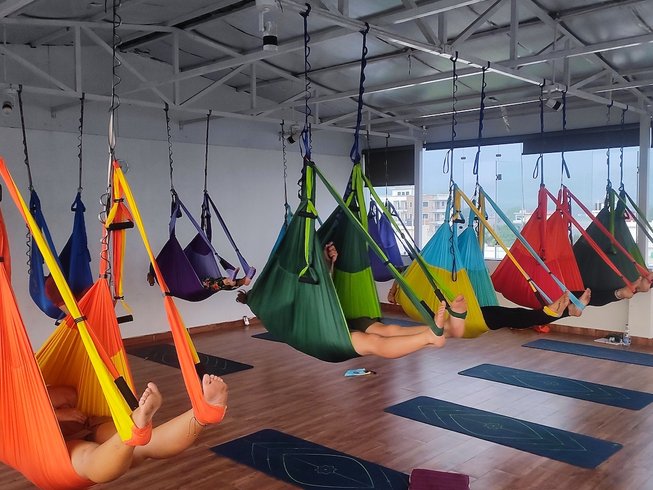
Aerial Yoga
The student will learn about 70 different postures in these subcategories.
- Warm Ups
- Pull-based movements
- Poses for the core region
- Spinal extension
- Shoulders and backbends
- Balancing postures
- Other postures
- Finishing postures
Teaching Practise
- Demonstration and description
- Benefits and contraindications
- Alignment and engagement
- Adjustment and modifications
- Instructions
Evaluation Method
Evaluation of students based upon
- Written / practical / oral exam
- Attendance
- General conduct
- Adherence to the rules of the school
Sample of Daily Schedule
Mondays to Saturdays
- 06:00 – 07:30 Ashtanga Vinyasa Yoga
- 07:30 – 08:30 Mantra and pranayama/detox/Ayurveda
- 08:30 – 10:00 Hatha Yoga
- 10:00 – 10:45 Breakfast
- 12:00 – 13:00 Yoga Philosophy and meditations
- 13:00 – 14:00 Alignment and Adjustments
- 14:00 – 14:45 Lunch
- 16:00 – 17:30 Yoga Anatomy/Aerial Yoga
- 17:30 – 19:00 Yin Yoga
- 19:00 – 19:45 Dinner
- 21:00 Lights off
- Sundays (self-study and practice)
- Schedule is subject to change
Instructors
Neeraj
Neeraj is an experienced, registered yoga teacher E-RYT from Yoga Alliance. He completed his course in Rishikesh. He is also certified as a yoga instructor from the Ayush Ministry, Government of India. Neeraj has completed a course in Vedantic philosophy. He is also an MBA and has nine years of experience in the corporate world. Apart from teacher training and retreats, Neeraj conducts workshops for golfers, corporates, and runners. He believes in imparting holistic yoga knowledge with equal emphasis on asanas, pranayama, mudra, bandha, cleansing, and meditational techniques.
Ravi Prakash
Ravi Prakash, a dedicated yoga instructor with over 15 years of experience, currently resides in Rishikesh, India. He is deeply committed to yoga and its philosophy and is currently pursuing a Ph.D. in Yoga Philosophy at Himalaya Garhwal University. His background extends beyond yoga, as he is also a Physical Education teacher and Neurotherapist. Having grown up in the picturesque foothills of the Himalayas, near the lake town of Nainital, he now dedicates himself to teaching yoga and running a Neurotherapy wellness center in Rishikesh, sharing his passion for well-being with his community.
Sumit
Sumit was raised in Rishikesh and completed his education in yoga in Rishikesh itself. He has a master's degree (post graduate) in yoga. He has been teaching yoga for the last four years. He takes Hatha yoga, Yin yoga, Aerial yoga, and mantra chanting sessions.
Location
Rishikesh, India
Arohan Yoga School is located on the bank of the holy river Ganges in Rishikesh. Here, you can enjoy the best nature has to offer, such as rare migratory birds, stunning views of the Ganges, the Shivalik range of the majestic Himalayas, and beautiful forests. The touristy part of Rishikesh is not far away, 9 kilometers from the location. The city center is 5 kilometers. All day-to-day provisions are available within 500 meters.

Food
Provided meals
- Breakfast typically has two fruits and upma / poha / porridge / parathas / gram flour pancake
- Lunch and dinner typically have one portion of dal, seasonal vegetable curry, chapatis, rice, and yogurt/salad.
In case students want to purchase any additional items like fruits, dry fruits, vegetables, honey, or peanut butter, they can do so at their own cost from nearby sellers.
The following meals are included:
- Breakfast
- Lunch
- Dinner
- Drinks
The following drinks are included:
- Water
- Tea
The following dietary requirement(s) are served and/or catered for:
- Gluten Free
- Yogic
- Ayurvedic
Spa treatments
One 60 minutes session of complimentary Ayurvedic massage is included in the price.
What's included
- Classical Hatha and Ashtanga Vinyasa, Aerial and Yin yoga with detox/cleansing techniques
- Philosophy and history of yoga, alongside yoga anatomy, biomechanics, and ayurveda basics
- Special emphasis on teaching methodology
- Daily sessions to learn alignment and adjust the most common postures
- Experienced specialist teachers
- Learn pranayama, mediations, and mantra chanting
- Get all study material—structured, comprehensive content for easy learning
- 27 nights accommodation
- Three daily meals (except Sundays), unlimited ayurvedic tea, and RO-filtered water
- Complimentary pickup and drop to and from the DED airport
- Get two free excursions
- Laundry twice weekly 5 items, toilet paper
- One 60 minutes session of complimentary ayurvedic massage
- GST if any
What's not included
- Airfare
- Transfers outside the given schedule
How to get there
Recommended Airports
Transfer included
Jolly Grant Airport
17 km away from your destination
Transfer not provided
Indira Gandhi International Airport
200 km away from your destination
Arrival by plane
Book your flight to Jolly Grant Airport (DED), it’s a 50-minute flight from Delhi Airport. Complimentary pick-up and drop to and from the airport available only on the first and last day of the course
Arrival by car
Take a car (Uber) from Delhi Airport directly to their location in Rishikesh. It is usually about 70 USD.
Arrival by bus
You can book online for a bus ride from Delhi to Rishikesh. Charges range from 5 to 20 USD.
Arrival by train
Book a train from Delhi to Rishikesh Railway Station (YNRK) (about 12 kilometers from the school) or Haridwar (HW) (about 25 kilometers from the school). Charges start at 10 USD.
- Please note that due to changing demand and availability, Arohan Yoga cannot guarantee the accuracy of this information and therefore cannot be held liable.
Cancellation Policy
- A reservation requires a deposit of 30% of the total price.
- The deposit is non-refundable, if the booking is cancelled.
- The rest of the payment should be paid on arrival.

Reviews
For this organizer you can guarantee your booking through BookYogaTeacherTraining.com. All major credit cards supported.
Similar Yoga Teacher Training you might like
You recently viewed