21 Day 200-hour Yoga Training with Singing Bowl Healing and Massage in Kathmandu, Nepal
Yoga Teacher Training in Nepal
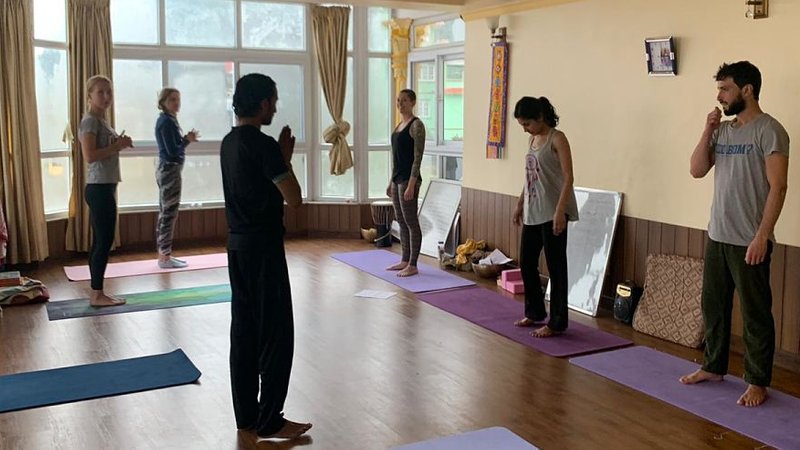
Welcome to this life‑transforming journey of 21 days of yoga training with singing bowl and massage training at Nepal Yoga Home. Step onto sun‑warmed mats and begin a journey unlike any other. Over 21 days, you will dive into yoga, Ayurvedic massage, and singing bowl therapy. Wake before dawn to greet the rising sun with breathwork and asana.
Meet the instructors
Highlights
- Certificate of completion
- Address every layer of your being - physical, energetic, and emotional
- Enhance flexibility, strength, and inner awareness through yoga
- Learn hands‑on massage techniques that soothe the body and clear the mind
- Close each evening with the deep resonance of Himalayan singing bowls
- Gain tools to guide others in movement, touch, and sound
- Earn your 200‑hour certification in a serene Himalayan setting
- 20 nights accommodation with daily full-board meals during your training period
Skill level
- Beginner
- Intermediate
- Advanced
Types
20 days with instruction in English
Accommodation
Facilities
- Air-conditioned rooms
- Garden
- Restaurant
- Yoga studio
- Free Wi-Fi
- Internet access
- Wireless internet
Nepal Ayurveda Home has different types of accommodation, depending on price and interest. They offer deluxe rooms, private rooms, and shared rooms, which you can choose according to your interests. All rooms have an attached bathroom and air-conditioning. Hot water and Wi-Fi are available in every room as well.
They also have two nice and big yoga halls with air-conditioning, where yoga and meditation classes take place. They are friendly for the medically impaired because they have lift (elevator) services to go to a different floor. Everyone will enjoy the rooftop restaurant and rooftop garden to have delicious meals and great 360-degree views of Kathmandu City and some parts of the snowcapped Himalayas.
Program
For whoever is seeking yoga, meditation, healing, and massage, this is the best option at Nepal Yoga Home. No matter if you are a beginner or a regular practitioner, this certified yoga training will provide you with an amazing experience, combined with massage and sound healing.
Yoga posture strengthens your body, meditation calms your mind, singing bowls heal your emotions, and massage rejuvenates and relaxes your body. The fusion of yoga, healing, and massage creates a powerful pathway to holistic well-being, blending movement, mindfulness, and touch.
Why combine yoga, massage, and sound healing?
Most of the trainings focus on just one modality. This training blends three ancient arts into a single, powerful experience:
- Yoga: Yoga builds strength, flexibility, and balance. It calms the mind and energizes the body.
- Ayurvedic massage: Massage helps your body release toxins. It also boosts circulation and melts away stress.
- Singing bowl therapy: Sound vibrations from singing bowls soothe anxiety. They open your heart and clear mental fog.
When you practice all three together, you address every layer of your being - physical, energetic, and emotional. You learn not just to teach yoga, but also to guide others toward true healing during this yoga training with singing bowl and massage.
The purpose of Nepal Ayurveda Home's certified yoga teacher training
This 200‑hour yoga training with singing bowl and massage is more than a certificate. It is a path to self‑discovery and inner growth. In this program, you will deepen your personal practice by refining asanas, breathwork, and meditation. You will explore yoga as an art of living, not just as a profession.
By the end of the twenty‑one days, you will stand taller, breathe more fully, and move with grace.
At the same time, you will gain the skills to teach with confidence. You will learn to read a room, offer clear cues, and make safe adjustments. You will also explore marketing, branding, and how to build a class or workshop that people love. You will study ancient wisdom in texts like the Yoga Sutras and the Bhagavad Gita.
You will learn the ethics of teaching, from inclusivity to professional boundaries. You will even discover how to run a yoga business with integrity. Above all, you will learn to live yoga - every day, on and off the mat.
What you will learn in this 200‑hour training
Yoga enhances flexibility, strength, and inner awareness, while meditation helps clear emotional blockages and restore mental clarity. Healing practices balance the chakra and energy channel. When integrated with Ayurveda massage - targeting muscle tension, stress relief, and lymphatic flow - the body and mind experience deep relaxation and rejuvenation.
This combination not only supports physical health, but also encourages emotional release, energetic balance, and a profound sense of inner peace, making it an ideal approach for total body healing.
Here are what you will learn during the 200 hours of yoga training with singing bowl and massage:
1. Asana practice
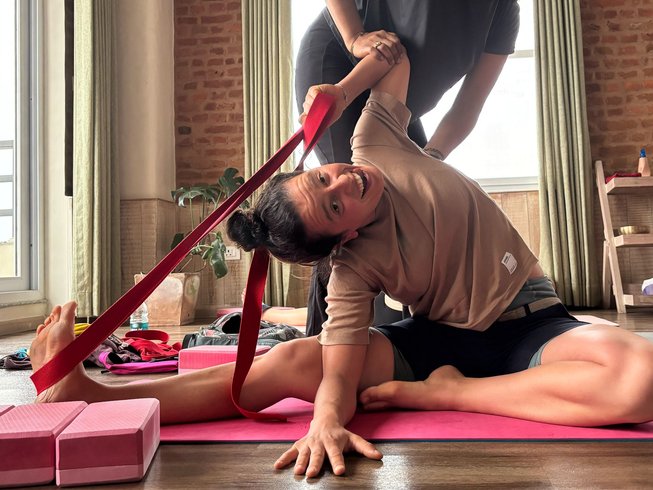
Each morning, you will explore foundational and advanced postures. Instructors will guide you to find the subtle shifts that protect your joints and deepen your stretch. You will learn how to use props - blocks, straps, and bolsters - to support every body type. By practicing safe alignment, you will prevent injuries and build a strong, resilient body.
You will learn the following postures during this 200-hour yoga training with singing bowl in Nepal:
- Tadasana
- Vrikshasana
- Utkatasana
- Trikonasana
- Parivrtta trikonasana
- Virabhadrasana I
- Virabhadrasana II
- Virabhadrasana III
- Ardha chandrasana
- Parsvakonasana
- Parivrtta parsvakonasana
- Prasarita padottanasana
- Garudasana
- Natarajasana
- Utthita hasta padangusthasana
- Malasana
- Padangusthasana
- Padahastasana
- Uttanasana
- Ardha uttanasana
- Anjaneyasana
- Hanumanasana
- Baddha konasana
- Upavistha konasana
- Dandasana
- Paschimottanasana
- Purvottanasana
- Janu sirsasana
- Marichyasana
- Ardha matsyendrasana
- Gomukhasana
- Sukhasana
- Padmasana
- Siddhasana
- Vajrasana
- Simhasana
- Balasana
- Ustrasana
- Bhujangasana
- Salabhasana
- Dhanurasana
- Setu bandhasana
- Chakrasana
- Urdhva dhanurasana
- Matsyasana
- Supta baddha konasana
- Supta padangusthasana
- Pavanamuktasana
- Jathara parivartanasana
- Viparita karani
- Halasana
- Karnapidasana
- Sarvangasana
- Urdhva padmasana
- Hamsasana
- Mayurasana
- Kakasana
- Bakasana
- Titibasana
- Astavakrasana
- Eka pada koundinyasana I
- Eka pada koundinyasana II
- Pincha mayurasana
- Adho mukha vrksasana
- Sirsasana
- Baddha hasta sirsasana
- Yoga mudrasana
- Tolasana
- Lolasana
- Kukkutasana
- Mandukasana
- Ardha kurmasana
- Parighasana
- Parsva bakasana
- Bharmanasana
- Marjariasana
- Vyaghrasana
- Chaturanga dandasana
- Adho mukha svanasana
- Urdhva mukha svanasana
- Shashankasana
- Samakonasana
- Siddha yoni asana
- Shavasana
2. Meditation and mindfulness
Stillness can be as powerful as movement. You will learn techniques like Vipassana and chakra visualization to quiet the mind. Through guided sessions, you will cultivate focus, reduce mental chatter, and tap into inner peace. These tools will serve you both on and off the cushion. You will learn the following meditation techniques during this 200-hour YTTC in Nepal:
- Breathing meditation
- Mindfulness meditation
- Vipassana meditation
- Transcendental meditation (TM)
- Loving-kindness meditation (metta)
- Mantra meditation
- Chakra meditation
- Kundalini meditation
- Guided meditation
- Yoga Nidra
- Silence meditation
- Sound meditation (Nada yoga)
- So-ham meditation
- Trataka (candle gazing meditation)
- Body scan meditation
- Walking meditation
3. Yoga philosophy and ethics
Yoga has a rich history and deep philosophy. You will study key concepts of dharma, karma, and the eight limbs of yoga. You will reflect on how these teachings apply to your life. You will also discuss teaching ethics: how to hold space with compassion, honesty, and respect. You will learn to create an inclusive environment wherein every student feels safe and valued.
Yoga philosophy encompasses the deep spiritual, ethical, and practical foundations of yoga. The main purpose of yoga philosophy is to give a clear idea about the process of yoga in order to achieve liberation from freedom. It helps to unite the body, mind, and soul.
This training includes key concepts such as the eight limbs of yoga (Ashtanga yoga) from Patanjali’s Yoga Sutras: yama (ethical restraints), niyama (personal observances), asana (posture), pranayama (breath control), pratyahara (withdrawal of senses), dharana (concentration), dhyana (meditation), and samadhi (spiritual absorption).
Yoga philosophy lessons will include a clear concept of the meaning and definition of yoga. You will have the opportunity to study the mind, intellect, ego, and consciousness. It also explores ideas like karma, dharma, reincarnation, the nature of the self (atman), and liberation (moksha).
Rooted in ancient Himalaya wisdom, yoga philosophy encourages self-realization, inner balance, and living in harmony with the body, mind, and soul.
4. Pranayama (breath control)
Breath is the bridge between body and mind. You will master techniques like kapalabhati, nadi shodhana, and bhramari. These practices clear energy channels, calm the nervous system, and sharpen mental clarity. You will discover how simple shifts in breathing can transform your mood and energy. Pranayama techniques included in this training are:
- Nadi shodhana pranayama - Alternate nostril breathing
- Anulom vilom pranayama - Subtle alternate nostril breathing
- Bhastrika pranayama - Bellows breath
- Kapalabhati pranayama - Skull shining breath
- Bhramari pranayama - Humming bee breath
- Ujjayi pranayama - Victorious breath / oceanic breath
- Sheetali pranayama - Cooling breath
- Sheetkari pranayama - Hissing cooling breath
- Surya bhedana pranayama - Right nostril breathing (sun-piercing breath)
- Chandra bhedana pranayama - Left nostril breathing (moon-piercing breath)
- Moorchha pranayama - Fainting or swooning breath
- Plavini pranayama - Floating breath
- Sama vritti pranayama - Equal ratio breathing
- Visama vritti pranayama - Unequal ratio breathing
- Dirgha pranayama - Three-part breath / long deep breathing
- Agnisara pranayama - Fire-activating breath
- Udar pranayama - Abdominal breathing
- Vakshya pranayam thoracic (rib cage) breathing
- Skinda pranayama: Clavicular breathing
5. Anatomy and physiology
A clear understanding of the body will make your teaching both safe and effective. You will study muscles, joints, and the skeletal system. You will also explore energetic anatomy: nadis (energy channels), chakras (energy centers), and prana (life force). This dual approach will help you explain how a pose affects both the physical body and subtle energy.
So in this yoga training with a singing bowl and massage, Nepal Ayurveda Home includes the anatomy and physiology part of yoga.
6. Yoga detox (shatkarma)
Purification is an essential step on the yogic path. You will learn six cleansing techniques, from nasal neti to abdominal cleansing (dauti). These practices will remove toxins and prepare your body for deeper breathing and meditation. Under careful guidance, you will learn six processes of cleansing: neti, dauti, nauli, basti, kapalbhati, and trataka. You will experience how a clean body supports a clear mind.
7. Mantra chanting
Another vital part of Nepal Ayurveda Home's 200-hour yoga training is mantra chanting. Sound has the power to shift consciousness. You will learn traditional Sanskrit mantras, including the sacred “om.” You will explore how vibration affects the mind and body. Chanting will become a tool for focus, healing, and raising your vibration.
You will learn major yogic mantras like om mantra, gayatri mantra, mahamrityunjaya mantra, asato ma sadgamaya, om namah shivaya, om mani padme hum, shanti mantra, guru mantra, lokah samastah sukhino bhavantu, om namo bhagavate vasudevaya, saraswati vandana, dhyana sloka, etc.
8. Yoga Nidra and relaxation
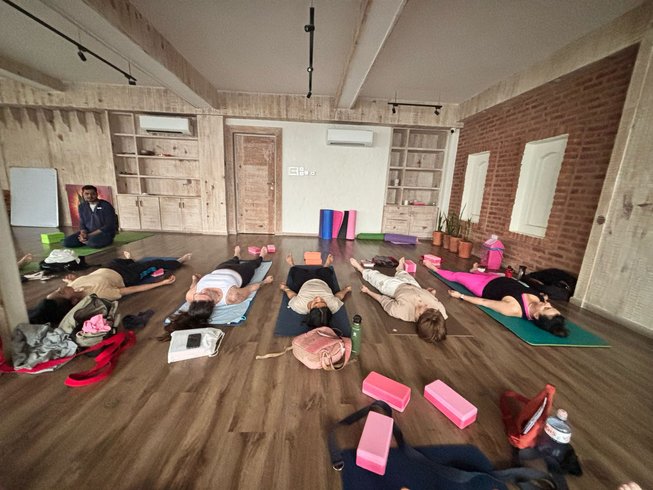
Yoga Nidra, or yogic sleep, guides you into deep rest and subconscious healing. Through systematic relaxation, you will release tension and restore balance. This practice is a powerful complement to asana and pranayama.
9. Teaching methodology and sequencing
Effective teaching requires clear communication. You will learn how to structure a class, from warm‑up to savasana. You will also practice voice modulation, cueing, and demonstration, as well as lead mock classes and receive feedback to refine your style and presence.
10. Adjustments, props, and modifications
No two bodies are alike. You will learn hands‑on adjustments and the safe use of props. You will also practice adapting poses for different levels - beginners, seniors, and those with injuries. These skills ensure that every student can practice safely and confidently.
11. Ethics of yoga teaching
Teaching yoga carries a deep responsibility. You will explore the moral and professional standards that guide this practice. Topics include consent, inclusivity, cultural sensitivity, and maintaining healthy boundaries. You will leave with a strong ethical foundation for your teaching career.
Singing bowl training
Introduction
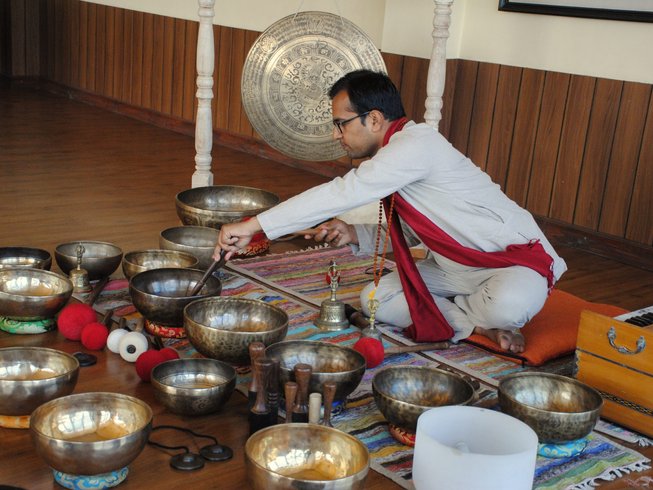
Another interesting part of this training is learning about the singing bowl. Singing bowls are ancient instruments first used by Himalayan monks more than 2,500 years ago. They are typically made of metal or crystal and produce rich, resonant tones when struck or circled with a mallet.
In the training, you’ll learn how these bowls were originally used for meditation and ritual, and how they have evolved into powerful tools for modern sound healing.
How singing bowls work
When you strike a bowl’s rim or circle it with a mallet, you set the material into vibration. Those vibrations become sound waves that travel through the air and your body. The shape and metal alloy of each bowl determine its pitch and harmonic overtones. As the bowl’s frequencies interact with your own energy field, they can gently guide your brainwaves into deeper states of relaxation and clarity.
Benefits and advantages of singing bowls
Practicing with singing bowls offers many advantages:
- Stress reduction: The steady tones soothe the nervous system and lower cortisol.
- Deep relaxation: Harmonic overtones help you enter alpha and theta brainwave states.
- Emotional release: Vibrations can open channels for stored emotions to surface and heal.
- Enhanced meditation: The sound anchors your attention and deepens your inward focus.
Safety and precautions
Sound therapy is gentle, but there are a few precautions:
- Avoid high volumes or prolonged sessions if you have epilepsy or sound sensitivity.
- Keep bowls at low volume around pregnant women and clients with pacemakers.
- Always check in with participants for any discomfort during a session.
Why singing bowls stand out
Unlike many healing tools, singing bowls are simple to use yet deeply effective. Their vibrations stimulate the parasympathetic nervous system, which slows the heart rate and lowers blood pressure. They also encourage the release of endorphins and serotonin, promoting mood elevation and pain relief.
Mental and emotional healing
Regular sound sessions can help ease anxiety, depression, and post-traumatic stress disorder (PTSD). As the bowls’ tones shift your brainwaves into calmer frequencies, you will find space to let go of mental chatter. Many people report feeling lighter, more creative, and more emotionally balanced after just one session.
Kundalini and sound
In Kundalini yoga, life force energy lies coiled at the base of the spine until awakened. Singing bowls can gently stir this energy, guiding it upward through the chakras. As energy rises, practitioners often experience vivid insights, emotional release, and a sense of spiritual awakening.
Spiritual growth with Nada yoga
Nada yoga is the “yoga of sound.” It teaches that all reality is vibration and that by listening deeply, you can connect to your true nature. Singing bowls embody “anahata Nada” (the unstruck sound), guiding you into meditative states where intuition and inner wisdom emerge.
Key learning areas
In this 21-day 200-hour certified yoga training with singing bowl and massage, you will master:
- Science of sound: Waveforms, resonance, and harmonic overtones
- Elements of music: Pitch, tone, rhythm, and overtones in bowl playing
- Bowl varieties: Crystal vs. metal, Himalayan vs. modern designs, ahat and anahat Nada: Struck vs. unstruck sound and their effects on consciousness.
- The power of “om": Universal vibration and its role in mantra and healing
- Chakra theory: What chakras are, their frequencies, and corresponding bowl tones
- Chakra healing techniques: How to balance, purify, and activate each of the seven main chakras
- Playing techniques: Striking, circling, mallet selection, and layered sound baths
- Brainwave entrainment: How sound guides the brain into alpha, theta, and delta states
- Brief history: From ancient Himalayan rituals to modern wellness studios
- Therapeutic uses: Emotional release, pain relief, sleep support, and more
- Contraindications: When to avoid or modify sound sessions
- Applications beyond healing: Yoga classes, massage add‑on, meditation intensives
- 20+ therapy styles: Chakra balancing, aura cleansing, water‑infused bowls, and more
You will complete the singing bowl training Levels 1 and 2 during your yoga training in Nepal. Nepal Ayurveda Home can take your free time or can replace it with any class during this training, but you will complete both levels during your stay.
Ayurvedic massage training
Introduction to abhyanga
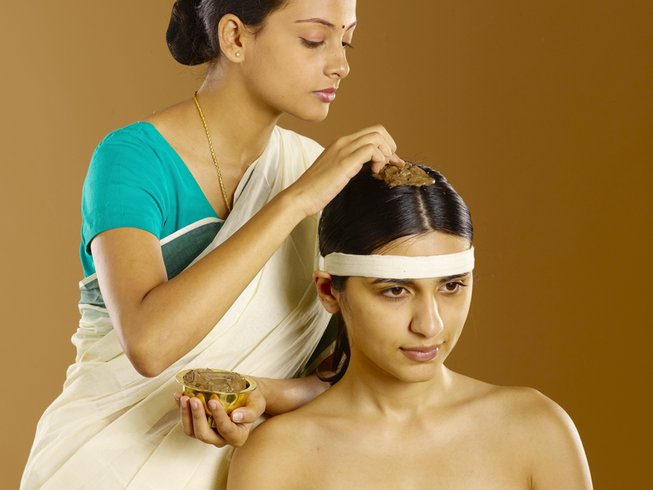
Abhyanga is the classical Ayurvedic full‑body massage using warm, herb‑infused oils chosen for your dosha (vata, pitta, or kapha).
Unlike spa massages focused solely on muscle knots, abhyanga harmonizes body, mind, and spirit. Through rhythmic strokes and gentle pressure on marma points (energy intersections), it will mobilize toxins, nourish tissues, and invite deep relaxation.
Massage strokes and movements
You will learn each foundational stroke and its purpose:
- Effleurage (gliding strokes): Spreads oil evenly and warms the tissues
- Petrissage (kneading): Releases deep muscle tension and improves circulation
- Tapotement (rhythmic tapping): Stimulates nerve endings and awakens energy
- Friction: Applies targeted pressure to break down adhesions and promote detox
Energy work and meridian therapy
Abhyanga goes beyond muscles. You will locate and stimulate marmas (similar to acupressure points) and follow nadis (energy channels). Reflexology on hands and feet enhances organ function. This subtle body work supports the flow of prana (life force) for lasting vitality.
Aromatherapy and essential oils
Each massage begins with a dosha‑specific oil blend - sesame for vata, coconut for pitta, and mustard for kapha - infused with essential oils like lavender, sandalwood, or peppermint. These botanicals enter through the skin and olfactory pathways, calming the mind, reducing inflammation, and supporting immunity.
Ethics and professionalism
You will practice clear communication and informed consent before every session. Nepal Ayurveda Home will cover confidentiality, draping techniques, and maintaining professional boundaries. Cultural respect for Ayurveda’s roots will be emphasized alongside modern client‑centered care.
Creating a healing environment
During this yoga training, a true healing session engages all the senses. You will learn to set up a tranquil space with soft lighting, gentle music, warm linens, and pleasant aromas. Attention to these details fosters trust and comfort for your clients.
Contraindications and safety
Not all conditions suit a full‑body massage. You will learn when to modify or avoid massage for:
- Fever, infection, or acute inflammation
- Recent surgery, fractures, or open wounds
- Early pregnancy or heavy menstrual flow
- Severe cardiovascular issues or blood disorders
- Self‑care and therapist well‑being
To serve others, you must protect your own health. Nepal Ayurveda Home will teach proper body mechanics, ergonomic table height, regular stretching, hydration, and rest. These practices prevent injury and burnout.
Integrating movement and stretch
Abhyanga often includes gentle assisted stretches and joint mobilizations. You will guide clients through safe movements to improve flexibility and joint health, enhancing the massage’s therapeutic effect.
Theory and practice balance
Mornings will be devoted to Ayurvedic theory - dosha assessment, marma maps, and oil preparation. Afternoons will focus on supervised hands‑on practice. Case studies and peer feedback will sharpen your skills and confidence.
What will be your overall experience?
Over 21 days and 200 hours of yoga training with singing bowl and massage, you will grow in body, mind, and spirit. You will leave Nepal Yoga Home with:
- A 200‑hour certification
- Hands‑on expertise in Ayurvedic massage and singing bowl therapy
- A deeper, more confident personal yoga practice
- Tools to guide others in movement, touch, and sound
- A supportive community and lifelong friendships
This journey will ground you in ancient wisdom, inspire your teaching style, and ignite your passion for holistic healing.
Sample daily schedule
- 07:00 - 08:00 - Hatha yoga asana
- 08:00 - 09:00 - Alignment
- 09:00 - 09:30 Breakfast
- 09:45 - 10:45 - Ayurvedic massage training
- 11:00 - Yoga anatomy (starts after the first week)
- 12:00 - 13:00 - Ashtanga Vinyasa
- 14:00 - 15:00 - Lunch
- 15:30 - 16:30 - Meditation
- 17:00 - 18:00 - Textbook of Hatha yoga
- 18:00 - 19:00 - Yoga philosophy
- 19:00 - 20:00 - Dinner
This is just rough schedule, but it will be just how you will spend days at Nepal Yoga Home.
Nepal Yoga Home’s 21-day, 200‑hour yoga training with singing bowl and massage offers a rare blend of yoga, sound healing, and Ayurvedic massage. You’ll develop the skills to transform lives - starting with your own. This program will equip you to teach with clarity, heal with touch, and uplift with sound.
Join them in the Himalayan foothills for an experience that will shape your path as a healer, teacher, and lifelong student of yoga. Om shanti! Shanti! Shanti! May peace be in all.
Instructors

Manoj Pandey
Mr. Manoj Panday has completed four months of the yogic study course from India (Bihar School of yoga) and 200 hours of Tantra yoga teacher training course from his home country, Nepal. Mr. Manoj had been working as a yoga teacher for the past six years in different yoga retreat centers of Nepal. Currently working in Nepal Ayurveda home as a yoga instructor.

Ram Hari Thapa
Ram Hari did masters degree in yoga. He has many years of experience in Hatha / Ashtanga and Iyengar yoga. He also learned the traditional styles of yoga in Nepal and India so his authentic traditional flavor of class is the next plus point in his teaching.
Prakash Acharya
Mr. Prakash Acharya is PhD. in meditation and completed his masters degree in yogic science. He has 15 years of experience in yoga meditation and traditional healing.
Location
Nepal Ayurveda Home is in Goldhunga, Kathmandu, Nepal.

Food
Daily full-board meals will be provided during your training period.
The following meals are included:
- Breakfast
- Lunch
- Dinner
The following dietary requirement(s) are served and/or catered for:
- Regular (typically includes meat and fish)
What's included
- Certificate of completion
- Daily yoga and meditation lessons
- Yoga book
- 20 nights accommodation
- Daily full-board meals during your training period
- Tax and service charge
What's not included
- Airfare
- Pick up and drop off service from the airport (10 USD)
- Hiking / trekking / rafting / mountain flight
- Laundry
- Personal expenses
- Sightseeing or sunrise trip
- Additional food if required
How to get there
Recommended Airports
Transfer available for additional US$ 10 per person
Tribhuvan International Airport
9 km away from your destination
Cancellation Policy
- A reservation requires a deposit of 14% of the total price.
- The deposit is non-refundable, if the booking is cancelled.
- The rest of the payment should be paid on arrival.

Reviews
For this organizer you can guarantee your booking through BookYogaTeacherTraining.com. All major credit cards supported.
Similar Yoga Teacher Training you might like
You recently viewed